

Quick answer: which outdoor roller shade to buy
For a covered patio or porch, buy an exterior solar roller shade with 90% blockage fabric (about 10% openness): it cuts glare and heat and you can still see out. Pick 95% (about 5% openness) for harsh west sun or daytime privacy, and 80% when the view and airflow matter most. A cordless crank or wand shade with a free-hanging bottom bar is the budget route; if the spot gets regular wind, pay for side channels or a zipper track, which is often sold as a motorized system.
Covered patio, afternoon sun: 90% exterior solar roller shade. Harsh west sun or privacy: 95%. View first: 80% in a dark color. Windy spot or shade left down: zipper-track shade. Single hot window: solar screen fabric or an exterior shade outside the glass.
What to buy
Outdoor roller shades to compare
Product types matched to the answer above. Decide the openness and whether you need wind tracks before comparing brands such as Coolaroo.
Disclosure: As an Amazon Associate, we may earn from qualifying purchases.
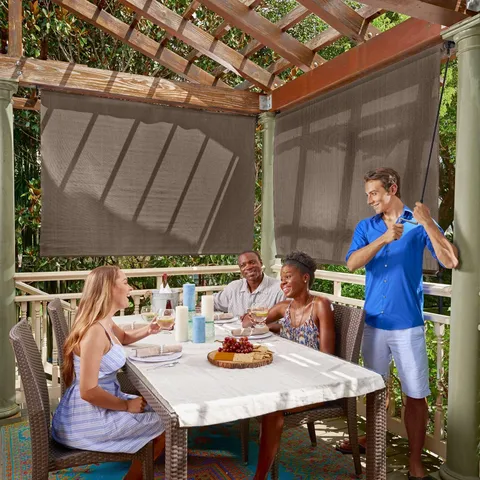
Budget patio shade
Coolaroo Outdoor Roller Shade, 6 x 6 ft, Mocha
Off-the-shelf 6 ft shade for a porch opening or window in low sun
- 72 x 72 in; knitted HDPE that won't fray
- 90% UV block, breathable light-filtering fabric
- Cordless; wall or ceiling brackets; 7 lb
Check:The operating method differs between listings, and it can't mount on a sloped roof.
$81.98as of 2026-11-04 17:57 CET
See sizes on Amazon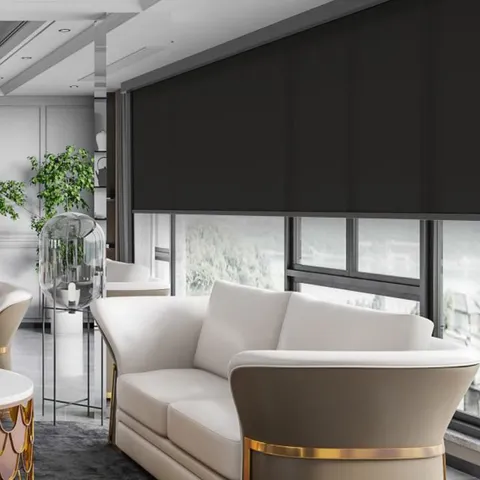
For wind
Motorized Outdoor Zip Screen Shade, 5% Openness
Side tracks stop the fabric billowing, in a ready-made size instead of custom
- Zip screen: fabric edges run in side tracks
- Motorized, 5% openness fabric
- Large off-the-shelf size instead of custom
Check:Brand, exact size, motor and remote details are not confirmed on the listing.
Check price on Amazon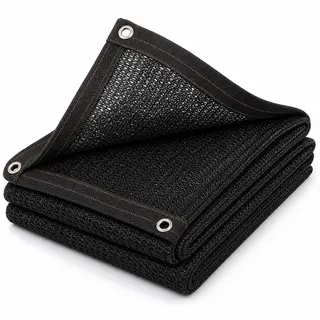
For windows
Solar screen fabric roll (SunTex 80 or 90)
Exterior solar screen mesh for window screen frames
- Stops heat outside the glass on a single hot window
- Fits standard screen frames with spline
- 80 keeps more view, 90 blocks more sun
Check:Frame size and spline diameter, and whether your HOA allows exterior solar screens.
Shop solar screen fabric on AmazonPrices and availability are accurate as of the date/time indicated and are subject to change. Any price and availability information displayed on Amazon at the time of purchase will apply to the purchase of this product.
Buying Direction
What to buy or use
| Situation | Buy / use this | Why |
|---|---|---|
| Covered patio or porch, low afternoon sun under the roof edge | 90% exterior solar roller shade, outside mount on the beam or header | Drops vertically into the low sun a roof cannot stop, and about 10% openness keeps a view out. |
| You mostly want to keep the view (yard, lake, street) | 80% solar screen fabric in a dark color | About 20% openness gives the clearest view and most airflow; darker colors improve the view out. |
| Neighbors see in during the day, or the west sun is harsh | 95% solar screen fabric | About 5% openness gives the most daytime privacy and sun control. At night with lights on inside, people can see in. |
| Windy site, or you want the shade down while you are away | Zipper-track or side-channel shade, often motorized | The fabric edges lock into side channels. Free-hanging shades have to be rolled up before strong wind. |
| One window overheats in the afternoon | Exterior shade or solar screen fabric mounted outside the glass | Exterior solar fabrics stop much of the heat before it reaches the window. |
| Opening wider than about 10 ft | Two off-the-shelf shades side by side, or a made-to-measure motorized screen | Off-the-shelf exterior roller shades such as Coolaroo's are sold in widths of about 6 to 10 ft (120 in); made-to-measure zip-track systems go much wider. |
Openness factor: 80, 90 or 95% solar screen fabric
Openness is how loose the weave is, given as a percentage. A shade with 10% openness lets about 10% of the light through the holes; sellers usually market the same fabric as 90% blockage. Phifer's SunTex line, a common exterior solar screen fabric, shows the pattern: SunTex 80 has roughly 20% openness, SunTex 90 roughly 10%, and SunTex 95 roughly 5%, blocking about 80%, 90% and up to 95% of the sun's rays.
Lower openness means more heat and glare control and less view. Covers and All describes 1% fabric as maximum privacy and heat rejection with a heavily restricted view, 3% as the most popular balance, and 10% as the loosest standard weave with the most light and airflow. Color matters too: darker fabric is easier to see through and cuts visible glare, while lighter fabric reflects more heat.
Daytime privacy reverses at night. When the patio or room is lit and it is dark outside, people can see in through any solar screen, so pair it with curtains or an indoor shade if night privacy matters.
Fabric
Solar screen openness and what you get
| Fabric | Openness | Blocks | View out | Pick it when |
|---|---|---|---|---|
| SunTex 80 type | About 20% | About 80% of the sun's rays | Clearest | View and airflow come first |
| SunTex 90 type | About 10% | About 90% | Good | Most covered patios and porches |
| SunTex 95 type | About 5% | Up to 95% | Reduced | Harsh west sun, daytime privacy |
| 1 to 3% fabrics | 1 to 3% | Most heat and glare | Blurred to restricted | Maximum privacy and heat rejection |
Cordless, crank or motorized outdoor shades
Small and medium patio shades run fine by hand. Coolaroo's exterior roller shade, for example, uses a cordless roller clutch with a removable hand crank wand, so there is no loop of cord hanging down. For indoor window coverings, the CPSC's rule requires stock products to be cordless, have short cords (8 in or less) or have inaccessible cords; a cordless or crank shade avoids the same loop hazard outdoors where kids play.
Motorized shades make sense for wide openings, high headers and zipper-track systems, which are heavy to crank. SunSetter's EasyScreen zipper-track line, for example, runs on a Somfy motor with a remote and requires electricity. If there is no outdoor outlet near the header, budget for one: Angi lists $150 to $260 to install an outdoor outlet.
Operation
How outdoor roller shades open and close
| Operation | How it works | Good for | Watch |
|---|---|---|---|
| Crank wand or clutch | Turn a wand or loop to roll the tube | Single patio bays up to about 10 ft | Takes a minute per shade |
| Motorized, plug-in or hardwired | Tubular motor, remote or wall switch | Wide or high openings, several shades | Needs power at the header |
| Motorized zipper track | Motor plus side channels that hold the fabric edges | Windy sites, shades left down | Most expensive; often made to measure |
How to measure for outdoor roller shades: inside or outside mount
On a patio, the shade almost always goes outside mount: on the face of the beam or header, covering the full opening between posts. Measure the beam width you want to cover and the drop from the mounting surface to the floor or to the top of the railing. On a window you can mount inside the frame if it is deep enough, or outside on the wall around it.
Check the hardware before you drill. Coolaroo's instructions say the included screws are for wood only and to ask the retailer about other materials, so plan masonry or metal fasteners for stucco, brick or aluminum posts.
- Inside mount width: measure top, middle and bottom; order the smallest. The factory deducts about 1/8 in.
- Inside mount height: measure left, middle and right; use the largest.
- Inside mount depth: at least 1 1/4 in flat surface, or 1 3/4 in with a cassette valance.
- Outside mount width: measure the area and add 1 to 1 1/2 in per side to cut light gaps at the edges.
- Outside mount height: add 3 to 4 in if the brackets sit above the window frame.
- Roller fabric ships about 1/2 to 1 in narrower than the ordered width to make room for the brackets.
Outdoor roller shades in wind: free-hanging vs zipper track
A free-hanging roller shade is a sail with a bar at the bottom. Coolaroo includes bungee tie-downs for mild to moderate wind and tells owners to roll the shade up when not in use or before strong winds. Hold-down hooks or brackets at the floor or rail help in breezes, but they do not turn a free-hanging shade into a storm screen.
Zipper-track and side-channel shades lock the fabric edges into tracks on both sides, so the fabric cannot billow out. SunSetter, for example, rates its optional heavy-duty zipper track for wind up to 60 mph and adds a weighted bottom hem bar. Ratings like that come from the manufacturer for its own system; read your model's manual before leaving any shade down in a storm.
On motorized shades, a wind sensor can roll the shade up on its own when gusts start, which matters most when nobody is home.
Patio shades vs window shades
Exterior shades work better against heat than indoor ones because they stop the sun before it hits the glass. Phifer says its exterior sun control fabrics absorb and dissipate 65 to 97% of the sun's heat and glare before it reaches window or door glass, depending on the fabric.
On a covered patio, a roller shade fills the gap a roof cannot: low morning or afternoon sun coming in from the side. On a window, you have two options. A roller shade mounted outside the frame can go up and down with the seasons. A fixed solar screen (SunTex fabric in a screen frame) is cheaper and stays put, but it also cuts winter sun you may want. If you want the window shaded from above while keeping low winter sun, an awning is the better fit.
Watch-outs
Before you buy or install
- Roll free-hanging shades up before strong wind; tie-downs are for light breezes only.
- Use fasteners rated for your surface; included screws are often wood-only.
- Check HOA rules before adding exterior shades or solar screens to the facade.
Read Next
Related guides if your situation is different
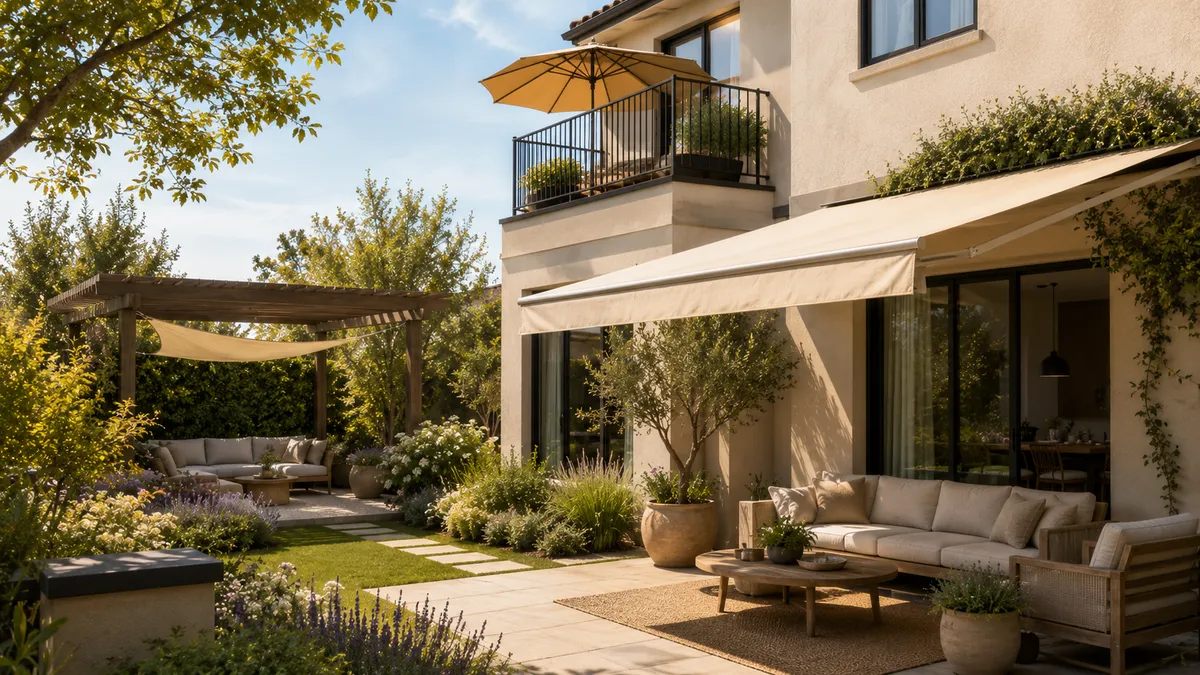
Outdoor Shade Ideas
Outdoor shade ideas sorted by problem: awnings, shade sails, umbrellas, side screens, shade cloth and vehicle awnings, with what to buy for each.
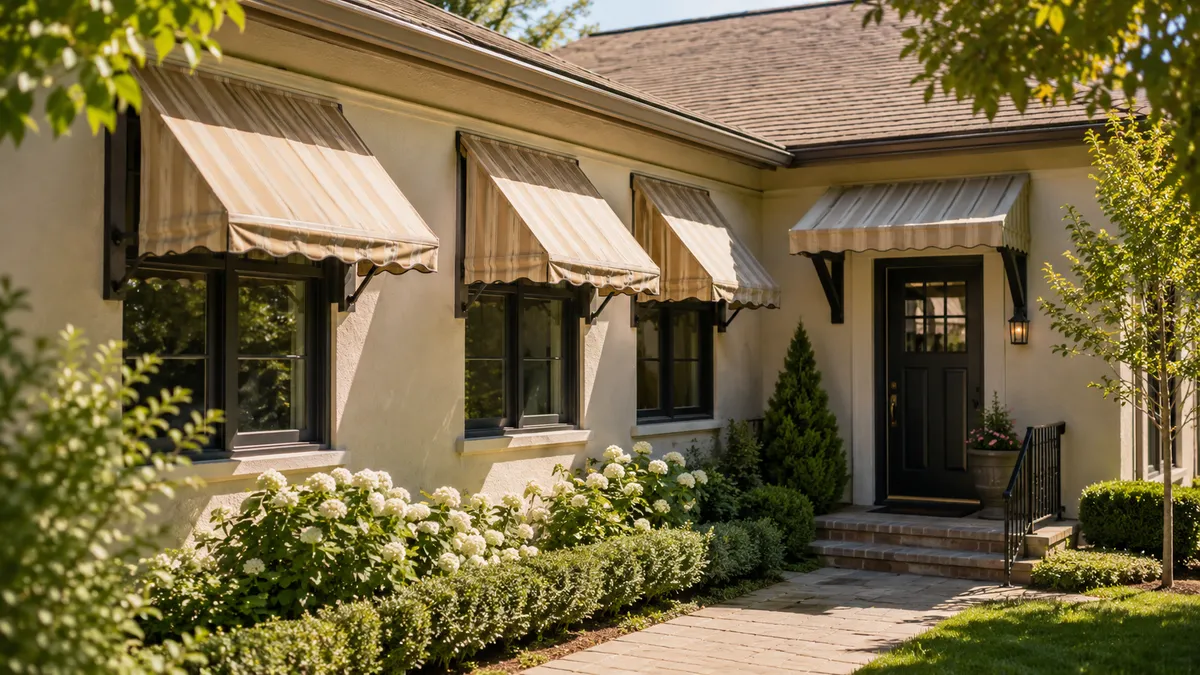
Window Awnings and Door Awnings
Window awning types (fixed, drop-arm, retractable, metal, polycarbonate), how wide to size one and installed cost, plus door canopies and solar screens.
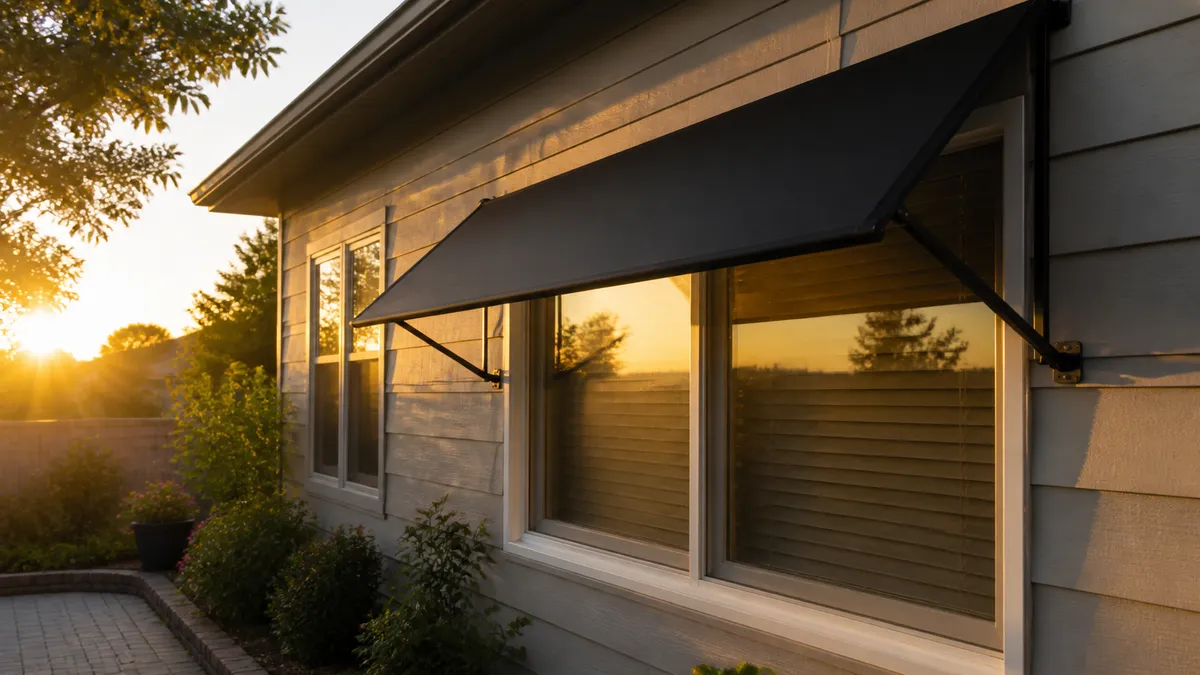
Awnings for West-Facing Windows
Choosing an awning for a west-facing window: when it works, when exterior solar shades work better, what it costs and which options let winter sun in.
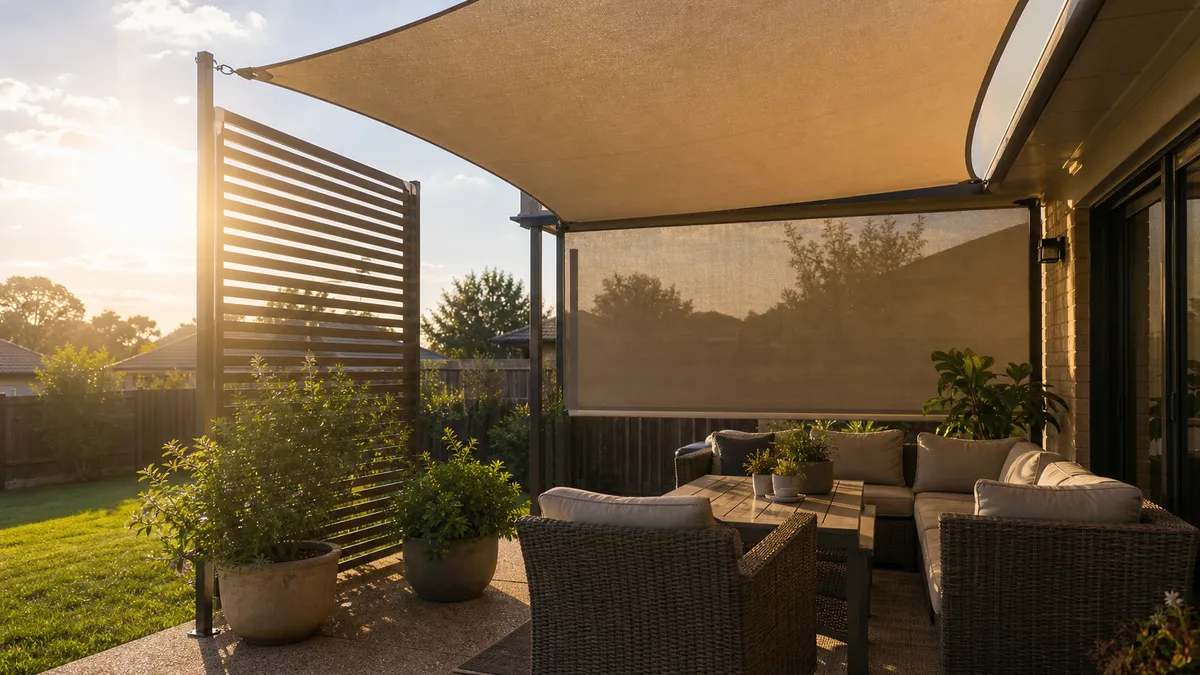
West-Facing Patio Shade
West-facing patio shade that works: solar roller shades, awnings with drop valances and tilting umbrellas, plus where the evening sun really comes from.
Questions
FAQ
What openness should I choose for exterior solar shades?
About 10% openness (90% blockage) suits most patios and porches. Choose about 5% (95%) for harsh west sun or daytime privacy, and about 20% (80%) when the view and airflow matter more than heat control.
Can you see through outdoor solar shades at night?
Yes, from outside, when the area behind the shade is lit. Solar screens give daytime privacy because it is brighter outside; after dark the effect reverses, so add curtains or an indoor shade for night privacy.
Are outdoor roller shades wind resistant?
Free-hanging shades are not: they handle light wind with tie-downs and should be rolled up before strong wind. Zipper-track shades hold the fabric in side channels and carry manufacturer wind ratings, such as up to 60 mph for one heavy-duty track.
Should exterior shades be inside or outside mount?
Patio shades are almost always outside mount on the beam or header. On windows, inside mount works when the frame has at least about 1 1/4 in of flat depth; otherwise mount outside and add 1 to 1 1/2 in per side to cut light gaps.
Do exterior solar shades reduce heat?
Yes, more than indoor shades, because they stop sunlight before it reaches the glass. Phifer rates its exterior sun control fabrics at 65 to 97% of the sun's heat and glare blocked before the glass, depending on the fabric.