
Quick Answer
Afternoon patio sun: the short version
Patio shade for afternoon sun often fails because the sun is low and sideways, not because the overhead cover is too small. Watch the patio during the failed hour, mark where the sun line crosses chairs, then decide whether the fix must be vertical, movable or overhead. Do not drill brackets until support, wind, clearance and renter or HOA approval are clear.
Use vertical or movable shade when late sun enters from the side; use overhead shade only when the failed hour is still exposed from above.
Diagnosis
Most common problems
Check the symptom before buying another shade product.
Sun comes under the patio roof after 4 p.m.
Low side sun is slipping below the roof line, so wider overhead fabric will miss the glare.
Seats are shaded at 3 p.m. but exposed at 5 p.m.
The shadow is moving off the people before the meal or evening sitting time ends.
Glass doors or paving heat the patio before the air feels hot
Stopping sun before it hits glass and hard surfaces reduces heat gain better than treating glare indoors.
Glare is harsh but the view still matters
Open-weave screen fabric can cut glare while keeping some view and airflow.
Diagnose the failed hour before choosing shade
Start outside during the hour that actually fails. Afternoon patio shade is often judged too early in the day, when the roof, sail or pergola still looks useful. By late afternoon, west or southwest sun may come below the cover and hit eyes, chair backs, glass doors or paving.
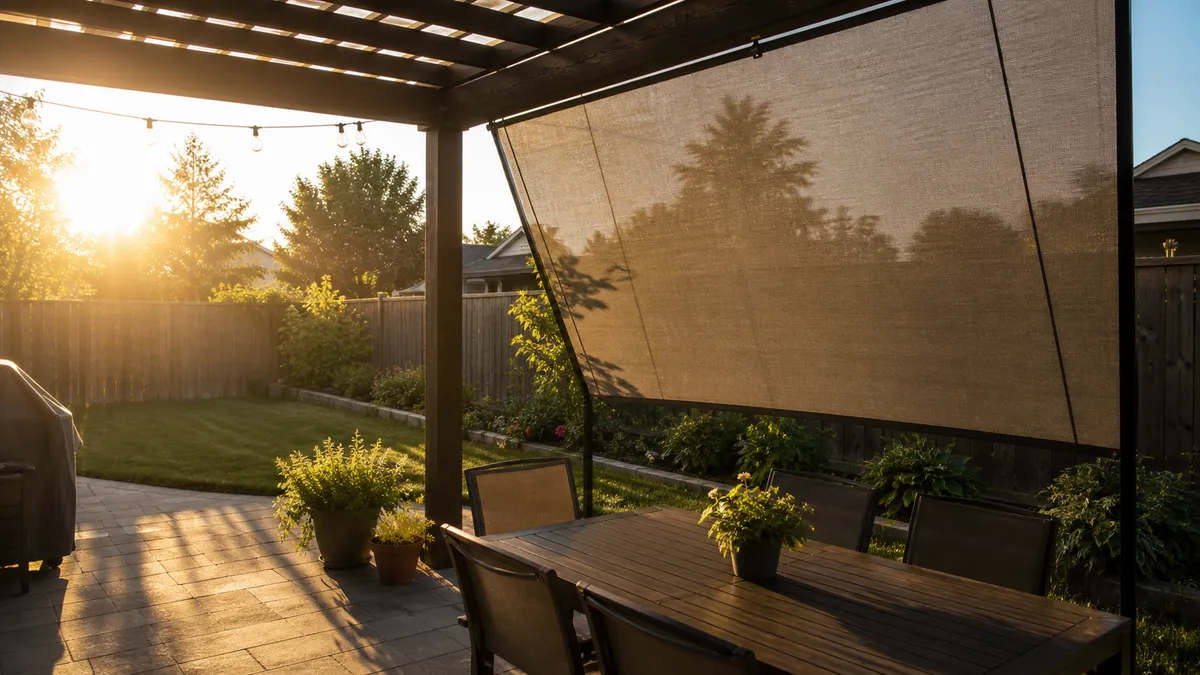
Mark the sun line on the floor, railing, wall or chair back. If the line crosses faces from the side, the first test is vertical shade. Hold a sheet, cardboard panel or spare curtain at the patio edge for ten minutes. If the glare disappears, the fix is a side screen, outdoor curtain, exterior roller shade, side awning or drop valance before it is a wider roof.
If the sun is still coming from high above, overhead shade can still work. If the heat starts at glass doors or dark paving, shade the surface from outside before buying thicker fabric for the seating area. Cancer Council NSW notes that shade must be planned for the area and time of day, and that good shade should extend beyond the area of use as shadows move.
- Stand on the patio at the failed hour, not at noon.
- Mark where glare hits eyes, glass, paving and chair backs.
- Test a temporary vertical line before adding overhead fabric.
- Keep door swings, grill lids and chair pullback in the test.
- Record wind exposure before choosing loose fabric.
Diagnosis
Afternoon sun symptom, cause and first test
Use this table before buying parts. The visible symptom tells you whether the fix should be vertical, overhead, movable or postponed.
| What you see | Likely cause | First test | Best first fix | Stop sign |
|---|---|---|---|---|
| Sun comes under the roof after 4 p.m. | Low side sun | Hold a temporary screen at the west or southwest edge | Exterior roller shade, outdoor curtain, side screen or drop valance | Do not buy wider overhead fabric until you know where the side line lands |
| Seats are shaded at 3 p.m. but exposed at 5 p.m. | Shadow has moved off the chairs | Mark chair backs and the table edge during the failed hour | Move seating, aim a tilting umbrella or extend vertical side shade | Do not size shade from the tabletop alone |
| Glass doors or paving heat the patio | Sun hits hard surfaces before shade catches it | Touch the glass, threshold and paving before the air feels hot | Exterior screen, awning or roller shade outside the glass | Indoor curtains alone will not cool hot exterior paving |
| Glare is bad but the view matters | Solid fabric would over-darken the edge | Compare mesh from the chair, not from the package photo | Solar screen or mesh side panel | Do not promise exact heat reduction without a named screen spec |
| No drilling is allowed | Permission is the real limit | Read lease, condo and HOA rules before exterior holes | Freestanding screen, weighted umbrella or removable curtain | Do not add permanent brackets without written approval |
| Sail fabric flaps, sags or holds water | Anchor, tension, slope or closure routine is failing | Look for anchor movement, turnbuckle travel and runoff direction | Retension, add drainage slope, reduce size or use vertical shade | Do not hang loads from a sail or leave it up in storms |
| The screen blocks a door, grill or walkway | Clearance failed | Open doors, pull chairs out and lift the grill lid before buying | Narrow side screen, movable umbrella or shorter panel | Do not solve glare by blocking normal patio use |
Why overhead shade often fails in afternoon sun
A roof, pergola, awning or flat shade sail blocks high sun first. That is useful at lunch, but afternoon sun can arrive from the side at chair height. YourHome's shading guidance treats low east and west sun differently from high north-facing sun because fixed overhead shading struggles when the sun sits low.
This is why a covered patio can feel broken even when the roof is doing its job. The cover may shade the table surface while glare still reaches faces under the front beam. A deeper awning can help only if the front edge drops low enough or includes a valance. A flat sail can make the patio darker overhead and still miss the side path.
Use a temporary vertical interception line before adding structure. If a sheet held at the west edge fixes the problem, buy for that line. If the sheet does nothing and the sun still falls from above, then overhead coverage, a larger umbrella arc or a better-positioned sail may be worth comparing.
- Low sun patio shade usually needs a side element.
- A flat overhead sail may darken the wrong part of the patio.
- A drop valance works only if it reaches the glare line.
- The deeper low-angle mechanics are covered in the low-sun guide.
Best fixes ranked by effort and cost
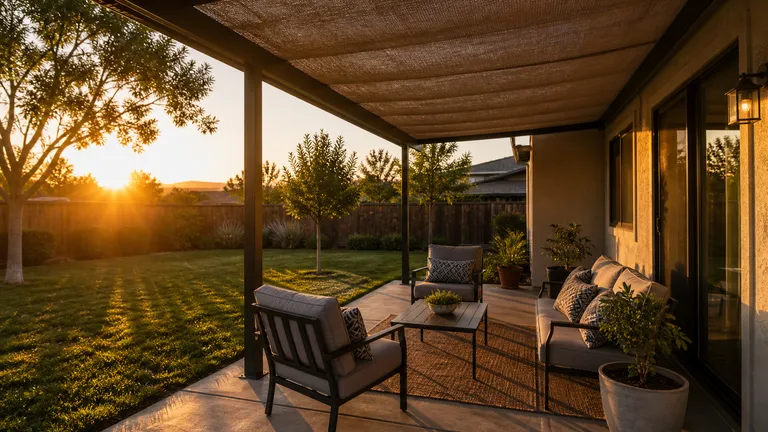
Rank the fix by commitment before ranking products. A movable umbrella or freestanding screen can prove the sun path in one afternoon. A side awning, exterior roller shade or shade cloth panel needs more measuring, but it can still avoid major posts or wall work. A permanent sail, retractable awning or pergola should come last because the anchor points, bracket loads and permissions are harder to undo.
Cancer Council NSW recommends thinking about shade movement through the day and extending shade beyond the area of use. On a patio, that means shading the chair path and faces, not just the tabletop. If the table is shaded but people lean back into sun, the fix is placement or vertical coverage.
The cost band below is relative because real cost changes with wall substrate, post work, electrical controls, fabric size and local labor. Use it to decide whether to test, attach brackets or build posts.
Ranked Fixes
Shade for afternoon sun ranked by commitment
Start with the lowest commitment that proves the sun path. Move to permanent work only when the test points there.
| Effort / cost band | Fix | Best when | Avoid when | Named limit |
|---|---|---|---|---|
| Low | Move seating or rotate the table | Only one chair line gets hit late | The glare crosses the whole patio edge | Chair pullback and walking path |
| Low | Tilting or cantilever umbrella | The failed zone is small and movable shade can aim low | Wind is strong or the base blocks the door | Base weight and trip clearance |
| Low | Freestanding side screen | No drilling is allowed and glare comes from one side | The screen would act like a sail in gusts | Wind and storage routine |
| Low to medium | Outdoor curtain on an existing pergola or beam | The support already exists and fabric can slide open | The curtain traps heat or blocks a grill path | Airflow and flame clearance |
| Medium | Exterior roller shade or solar screen | Glare and heat come through a side opening or glass | The view matters less than full blackout | Mesh openness and mounting surface |
| Medium | Retractable side awning | One exposed edge needs shade only during late sun | The side case cannot attach to solid structure | Wall plate, post or fence support |
| Medium | Shade cloth panel on an existing frame | A pergola, fence line or gazebo already gives attachment points | The fabric would stay loose in wind | Tie points and edge reinforcement |
| Medium to high | Lower-side shade sail | Strong anchors can intercept the low sun line with drainage slope | There is no solid low anchor or weather removal plan | Anchor point, tension and runoff |
| High | Retractable awning with drop valance | The hot zone sits close to a load-bearing house wall | The wall, fascia or mounting height is uncertain | Bracket load and front-bar height |
| High | Pergola with vertical screens, louvers or planting | The patio needs a long-term afternoon pattern, not a quick patch | Approval, drainage or neighbor impact is unclear | Posts, drainage and approvals |
Choosing side shade without making the patio hot or awkward
Side shade solves many afternoon problems, but dense fabric can create a hot pocket. The U.S. Department of Energy notes that exterior screens can reduce solar heat gain, UV damage and glare while still allowing view and light transmission. Larger fabric openings keep more view and air, but they give up some heat and glare control.
Outdoor curtains are enough when the opening is already framed, the fabric can slide out of wind, and full view is not needed. Use tiebacks and bottom restraint so the curtain does not whip into chairs or a grill. Choose breathable fabric when heat is trapped near a wall. Solid blackout fabric can feel good for glare and still make a still patio hotter.
An exterior roller shade or side awning is cleaner when the same edge fails every day. Mark the cassette, crank or side rail location before buying. The shade must clear door handles, grill lids, chair pullback and the walking route. If it needs to be down only from 4 p.m. to 6 p.m., make sure one person can deploy and retract it quickly.
- Use mesh when view and airflow matter.
- Use solid fabric when glare and privacy matter more than view.
- Use light-colored opaque awning fabric when reflection and ventilation are priorities.
- Keep lower edges away from flames, hot grills and foot traffic.
- Do not let a screen become a permanent wind catch.
When a shade sail or awning is the right answer
A shade sail can be the right shade for afternoon sun when it intercepts the low path instead of floating high above it. That usually means one side or corner sits lower, with enough clearance for people and enough slope for water to run away from doors and furniture. One sail manual gives a 20-30 degree runoff angle as an example and warns to remove the sail during severe weather.
Do not use a sail when the only anchors are weak fence boards, fascia, thin railing or posts that move by hand. Fabric tension loads the corners all season. The manual source also warns not to hang loads from the sail and not to treat it as waterproof unless the product says so.
A retractable awning is better when the failed patio zone sits near a house wall and daily retraction matters. The U.S. Department of Energy describes awnings as exterior shelters that can shade windows from heat and glare and can also shade outdoor living spaces. For low afternoon sun, look for a drop valance or side shade; a standard projection may still let glare come under the front bar.
Awning manuals are clear about weather limits. Awntech warns that retractable awnings should not stay extended in wind, rain, snow or ice, and that pooling water can stretch fabric. Treat every awning as a sun product first unless the exact manual says otherwise.
- Use a lower-side shade sail only with solid anchors and a drainage slope.
- Use a retractable awning when the wall can carry brackets and the shade zone sits near the house.
- Add a drop valance or side screen when glare comes below the awning edge.
- Pause the project if the substrate, mounting height or weather routine is unclear.
Heat, UV, glass and hard paving need separate attention
Glare, heat and UV are related, but they are not the same problem. A mesh side screen can make the patio easier to look across while still allowing heat through. A solid curtain can stop glare and trap warm air. An awning can protect glass and a nearby table, but it cannot cool paving that stays exposed beyond the shade edge.
If glass doors make the patio hot, shade the glass from outside first. YourHome's passive cooling guidance emphasizes preventing heat gain before it enters or hits hard surfaces. The Department of Energy gives a west-facing window awning example with up to 77 percent reduction in summer solar heat gain, but that is a window claim. Do not treat it as a patio-wide cooling promise.
UV also needs care. EPA's shadow guidance is useful in the field: short shadows usually mean stronger UV, while taller late-day shadows can still come with glare and heat. EPA also notes that UV can burn on cloudy days. Shade helps, but it does not make sunscreen, hats, eye protection or time limits irrelevant.
- Shade glass and paving before they absorb heat.
- Do not turn a window heat-gain number into a patio cooling claim.
- Choose airflow when a side screen makes the seating area feel still.
- Treat UV protection as layered, not solved by fabric alone.
What will not fix afternoon sun
Wider overhead fabric is the most common wrong purchase. It can make the patio darker at noon and still miss the late side line. If the test sheet works at the patio edge, spend the money on vertical shade before buying another roof-like cover.
Darker fabric is also not a cure by itself. It may reduce visible brightness, but the shade edge still has to land on the chairs and glass. Dark dense material can reduce airflow and make a still seating area feel hotter.
A flat sail is not a low sun fix unless its edge catches the side path. A permanent awning is not a shortcut when the wall, fascia or permission is not confirmed. Indoor-only blinds can reduce glare inside, but they do little for exterior paving that is already absorbing sun. A product list that ignores the failed hour is just shopping noise.
- Do not buy a wider roof when the sun enters sideways.
- Do not expect darker cloth to fix missed placement.
- Do not install a flat sail without a low-side intercept.
- Do not drill a permanent mount before support and approval are confirmed.
- Do not use dense side screening if the patio already lacks airflow.
Permission, wind and safety before drilling
Renters, condo residents and HOA homes need written approval before exterior holes. Justia notes that leases often restrict improvements or alterations without written consent. Balcony and community rules can add more limits for railings, facade changes, mounted planters, hooks, screens and visible fixtures.
HOA review can also involve neighbor impact. Example HOA guidelines evaluate exterior changes by view, sunlight, ventilation, drainage, color, scale and materials. That matters for posts, side screens, awnings, trellises and drainage changes. Get written approval before buying a permanent item that changes the outside face of the home.
Wind is the other stop sign. Loose curtains, umbrellas, shade sails and awnings need a close, tie-down, retract or removal routine. If nobody will close the shade before a storm, choose a smaller removable fix or a screen that can stay out of the wind. Stop before drilling if the wall, post, fascia, railing, slab or fence cannot carry the chosen shade.
- Get written approval before exterior holes, facade changes or visible permanent screens where rules apply.
- Do not attach shade to fascia, railing or fence boards unless the product and structure allow it.
- Retract or remove loose fabric before strong wind, heavy rain, storms or snow.
- Keep runoff away from doors, thresholds, neighbors and walking paths.
- Hire qualified help when the wall, post or slab support is uncertain.
This won't fix it
Do not skip these checks
- Wider overhead fabric will not stop low side sun if the glare line crosses chair backs.
- Loose curtains, umbrellas, sails and awnings need a wind closure or removal routine.
- A shade sail needs secure anchors, firm tension and runoff slope before it is used as a permanent fix.
- Written permission matters before exterior holes, railing attachments, posts or visible screens where lease, condo or HOA rules apply.
- Shade reduces exposure but does not remove UV risk.
Read Next
Related fixes
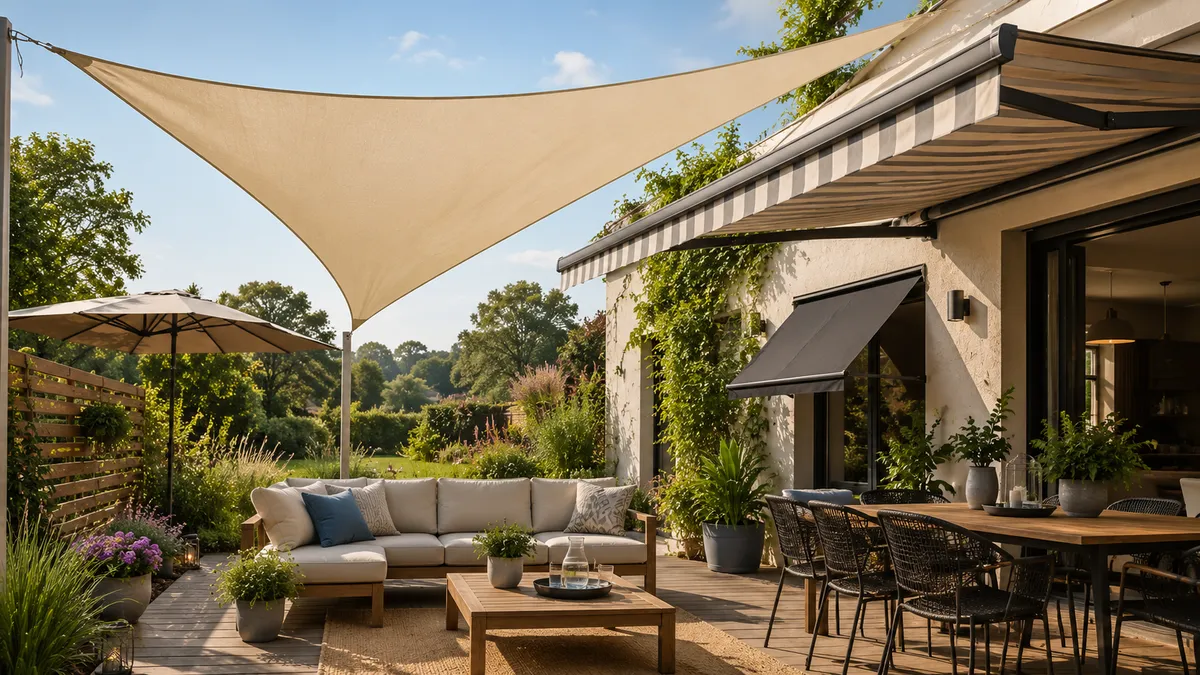
Patio Shade Ideas
Use this when patio shade ideas is closer to the real constraint than the current page.
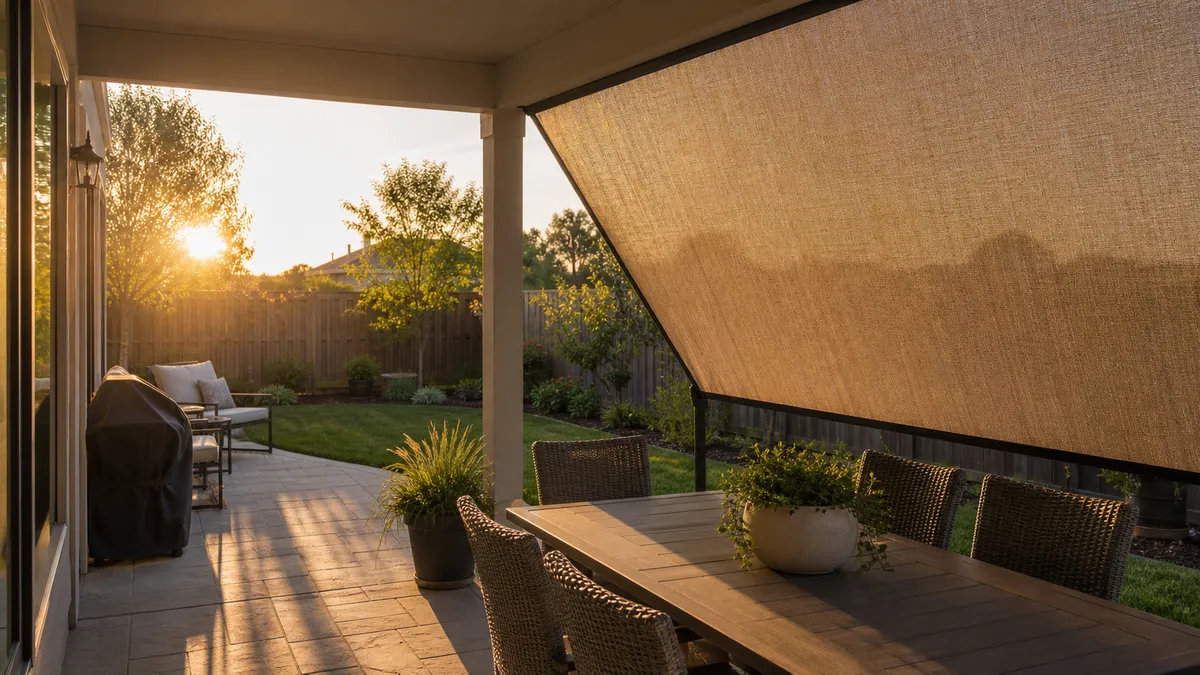
How to Block Low Afternoon Sun on a Patio
Use this next if the low sun angle itself is the main problem.
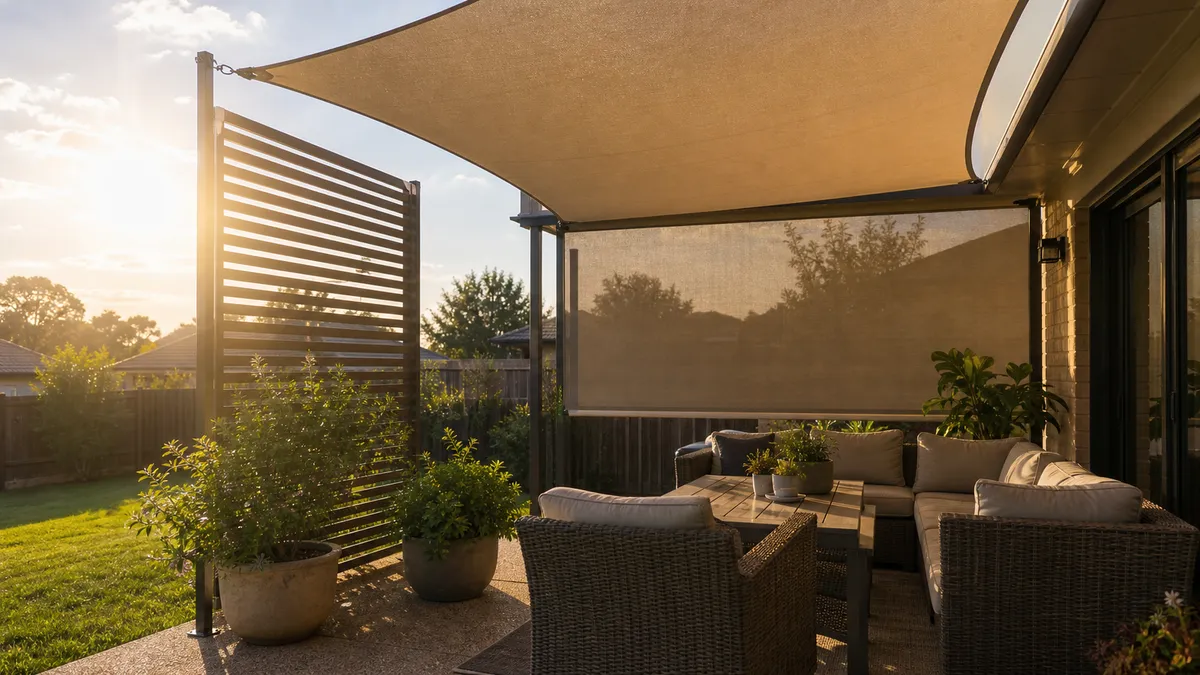
West-Facing Patio Shade
Use this when west facing patio shade is closer to the real constraint than the current page.
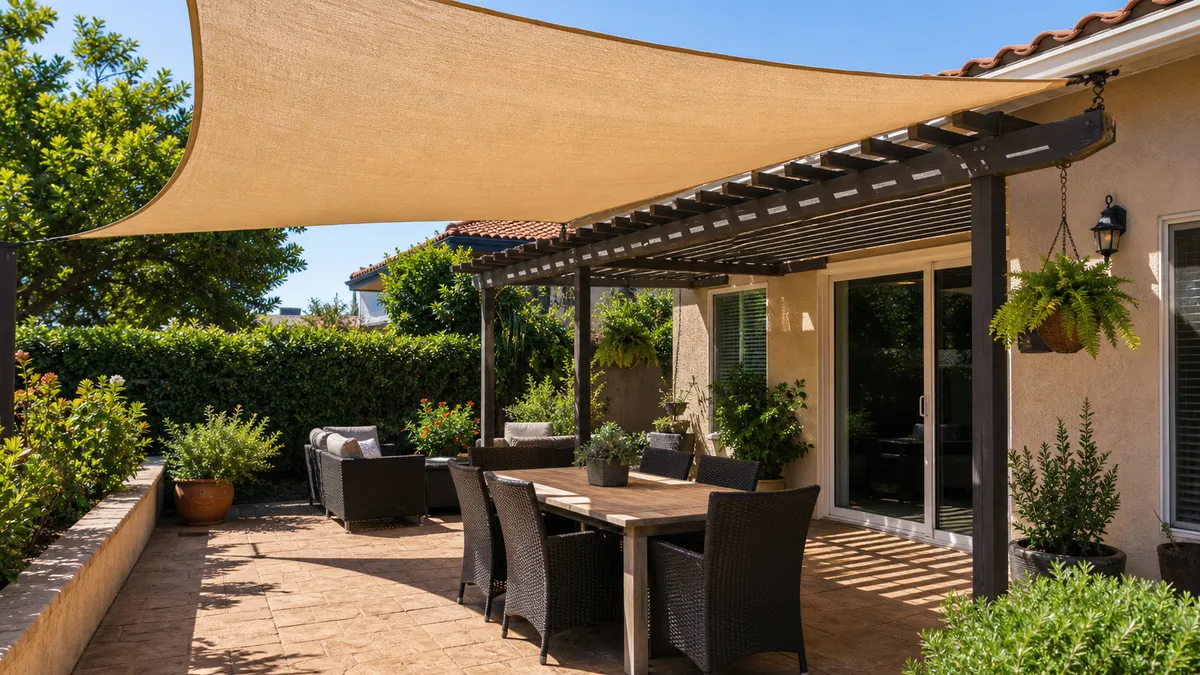
South-Facing Patio Shade
Use this when south facing patio shade is closer to the real constraint than the current page.
Questions
FAQ
Why does my covered patio still get afternoon sun?
The sun is probably entering below the roof, sail or awning edge. Low west or southwest sun can hit chair backs and faces while the floor still looks partly shaded. Test the side line during the failed hour before adding more overhead cover.
Is a shade sail good for afternoon sun?
A sail can work if one edge or corner intercepts the low sun path and the anchors, tension and drainage slope are solid. A high flat sail often misses late glare. If the sail has no secure low anchor or weather routine, use side shade or movable shade first.
What is the easiest no-drill fix for afternoon patio sun?
Start with a freestanding side screen, weighted tilting umbrella, movable planter screen or outdoor curtain on an existing frame. The fix still needs wind control and clear walking space. Read lease or HOA rules before clamping anything to railings or exterior walls.
Are solar screens better than outdoor curtains for low sun?
Solar screens are better when you want glare reduction with some view and airflow. Outdoor curtains block more light and privacy gaps, but they can trap heat and catch wind. Choose after testing the failed edge from the actual chair position.
Will darker shade cloth make my patio cooler?
Not by itself. Placement, airflow and whether sun hits glass or paving matter more. Dark dense fabric can reduce brightness but may make still air feel hotter. Light opaque awning fabric or breathable mesh may work better when heat buildup is the main complaint.