
Quick Answer
4x4 awning: the short version
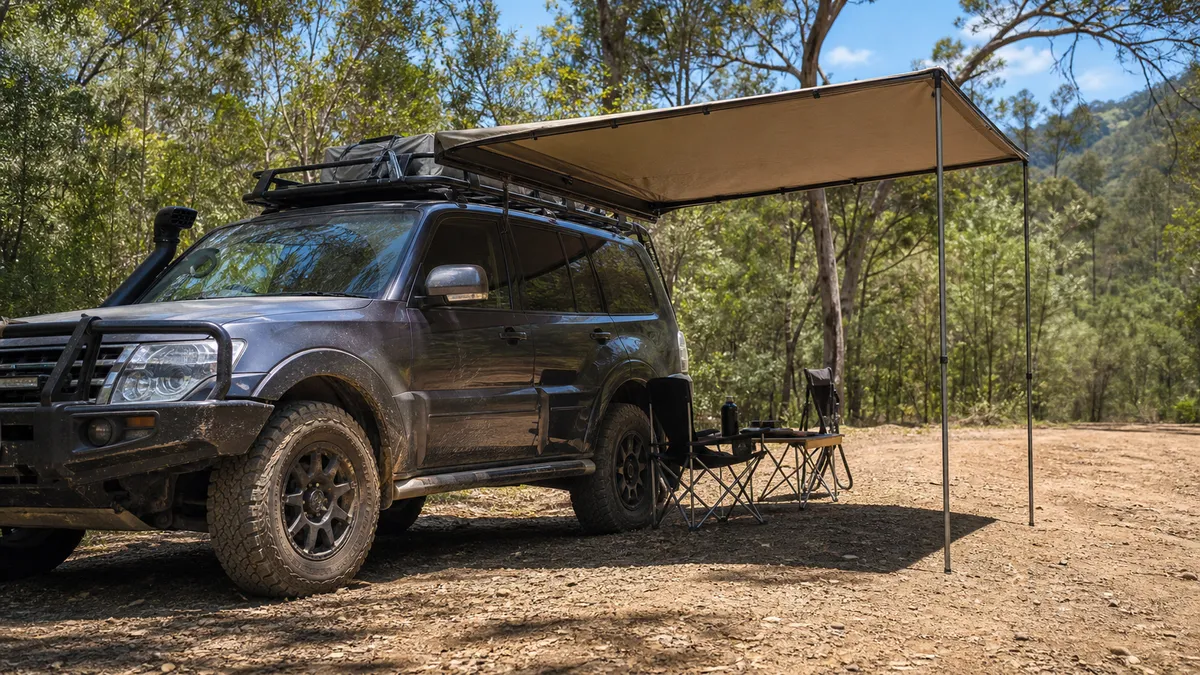
Choose a straight side awning for fast shade and lighter rack load, a 180-degree awning for wider side or rear-corner shelter, and a 270-degree awning only when rear camp work is frequent. Check rack capacity, bracket spacing, case length, door clearance and weather pack-down before buying.
Choose the straight side awning unless side-and-rear camp work is routine and the rack, brackets, clearance and weather routine can support a 180 or 270-degree awning.
Buying Direction
What to buy for a 4x4 awning setup
Use this table after rack load, bracket spread, clearance and camp-side checks are known.
| Situation | Buy / use this | Why |
|---|---|---|
| Quick stops, light roof rack or mostly side-door cooking | Buy a straight side awning before looking at larger wraparound models. | Yakima and Rhino-Rack examples show roughly 20-22 lb straight awnings with about 36-55 sq ft of shade. |
| One side needs wider shelter, but rear coverage is occasional | Compare a 180-degree awning after checking case length and bracket spread. | Rhino-Rack lists a 180-degree Batwing at 54.5 lb, an 86 in packed length and about 90 sq ft of shade. |
| Rear drawers, tailgate cooking and side kitchen are used on most trips | Buy a 270-degree awning only after the rack, brackets and tailgate clearance pass. | Rhino-Rack and 23Zero examples put many 270-degree awnings near 64-70 lb with about 110-132 sq ft of shade. |
| Shade must sit away from the vehicle or rack capacity is unknown | Skip the mounted awning for now and use a tarp, shelter or rack upgrade first. | A mounted case becomes road cargo, and NHTSA treats unsecured roof-carried items as a serious road-safety risk. |
Straight, 180 or 270: what each awning really buys
A 4x4 awning is worth buying only when the opened fabric matches how the vehicle is used at camp. If the stop is usually lunch beside one door, a straight side awning does the job with less roof weight. If chairs, a table or a kitchen sit along the side and rear corner, a 180-degree awning can add useful shelter without carrying full wraparound hardware. If rear drawers, a tailgate kitchen and a side work area are used on most trips, a 270-degree awning starts to make sense.
The weight gap is large enough to check before comparing brands. Yakima lists the SlimShady 6 ft 6 in by 6 ft 6 in awning at 20 lb and 36 sq ft. Rhino-Rack lists the Sunseeker 2.5 m at 22 lb and about 55 sq ft. Rhino-Rack also lists the Batwing 180 at 54.5 lb and about 90 sq ft, while the Batwing 270 is listed at 69.9 lb and about 132 sq ft. Those examples are not universal specs, but they show the buying trade: shade area rises with side weight, case length and bracket demand.
Do not choose the largest open fabric just because the photos look comfortable. A daily-driven 4x4 still has to carry the awning case through vibration, trail brush, parking garages and road speed. A lighter overlanding awning can be better when the vehicle moves often, the rack already carries a roof tent or the camp setup changes every night.
Buying Table
Which 4x4 awning type fits first?
Use this as the practical filter before comparing fabric color, brand, walls or lighting.
| Awning type | Best 4x4 setup | Coverage | Spec examples | Avoid if |
|---|---|---|---|---|
| Straight side awning | Quick stops, side-door cooking, light racks, daily drivers | One rectangular side panel | Yakima SlimShady: 20 lb and 36 sq ft; Rhino-Rack Sunseeker 2.5 m: 22 lb and 55.38 sq ft | You need shade behind the tailgate or around rear drawers every trip |
| 180-degree awning | Wider side shelter or rear-corner shade without full wraparound bulk | Side arc or half-wrap | Rhino-Rack Batwing 180: 54.5 lb, 86 in packed length, about 90 sq ft | The rack cannot support a long side case or the rear hatch path is tight |
| 270-degree awning | Rear drawers, tailgate kitchen, side kitchen and longer basecamp stops | Side plus rear wraparound | Rhino-Rack Batwing 270: 69.9 lb and about 132 sq ft; 23Zero Onyx 270 example: 64 lb and 110 sq ft | You rarely use the rear work area or cannot confirm brackets, side choice and tailgate clearance |
| Tarp or freestanding shelter | Shade away from the vehicle, occasional trips or unknown roof capacity | Detached shade with poles and anchors | No permanent side case on the roof rack | You need one-person fast setup beside the vehicle in frequent short stops |
Choose by camp job, not by biggest coverage
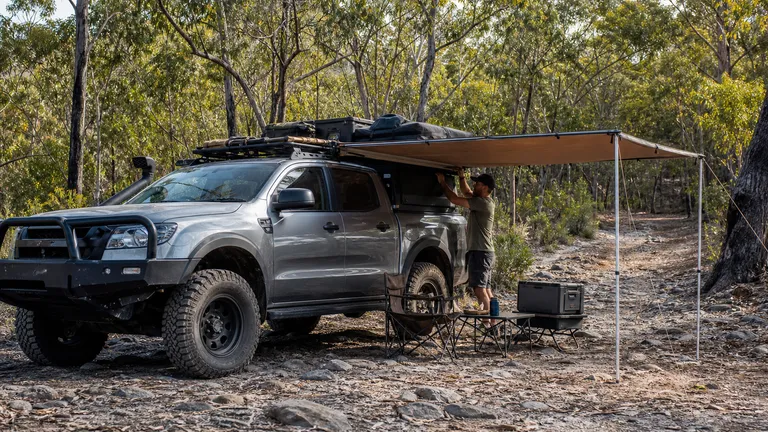
Start with the actual camp job. A straight side awning suits quick coffee stops, lunch breaks, dog shade, a side-door kitchen and a small table. It can be packed quickly and asks less from the roof rack. It is also easier to live with on a vehicle that still parks at work, clears a garage or carries skis, boards or cargo boxes between trips.
A 180-degree awning belongs in the middle. It is useful when one side of the 4x4 needs more shelter than a rectangle can provide, but the rear tailgate is not the main kitchen. The longer case and heavier arms still require a stronger mount than a small pull-out awning. Buy it for a real side or rear-corner camp job, not because it feels safer than committing to a 270.
A 270-degree awning earns its weight when the side and rear of the vehicle work together. Rear drawers, fridge slides, tailgate cooking, shower access, a side kitchen and repeated basecamp stays are the reasons to carry that bulk. If that is your camp routine, read the 270-degree awning guide for deeper 270-specific detail. If not, the lighter straight awning often makes the better 4x4 purchase.
- Use straight side shade when the shaded work area is beside one door.
- Use a 180-degree awning when one side needs wider shelter but the rear is not the main workspace.
- Use a 270-degree awning only when rear plus side coverage is used often.
Rack load, brackets and case length before buying
Check load before checkout. Rhino-Rack's load calculator separates vehicle roof rating, rack rating, on-road rating, off-road rating and static parked rating, and it says accessory or holder weight counts against the cargo allowance. Yakima defines dynamic load as the maximum rack plus load weight while the vehicle is moving, then subtracts towers, bars and accessories from the listed limit. Static parked capacity may be higher, but it does not make a heavy side case acceptable on rough roads.
Count everything on the roof: platform rack, crossbars, awning brackets, the awning case, roof tent, solar panel, recovery boards, shovel, fuel, water, cargo box and quick-release hardware. Use the lowest relevant rating. If the rack maker gives an off-road rating, use that for corrugations, washboard tracks and trail driving. If the remaining capacity is unknown, do not buy the awning yet.
Bracket spacing matters because a long awning case acts like a lever. ARB's install guidance gives a maximum awning overhang of 27 in and shows the overhang calculation from bracket distance and awning length. The same ARB guide requires checking door, tailgate and hood clearance before final tightening, then tightening nuts after 1,000 miles and periodically afterward. Off Road Tents adds practical installer advice: spread brackets as far apart as possible, consider three brackets for 270-degree awnings 2.5 m or longer, and use thread-lock where vibration can loosen T-slot hardware.
Do not mount a 4x4 awning to bare roof trim or unsupported decorative parts. Front Runner Dometic support says the Easy-Out 2.5M needs a roof rack or load bar that can accommodate the awning. If the rack instructions, awning instructions or bracket instructions do not clearly allow the combination, fix the roof rack plan first and use the roof-rack awning guide for bracket detail.
- Use the lowest relevant vehicle, rack, bracket and off-road rating.
- Subtract rack, brackets, awning, roof tent, solar panel and cargo before buying.
- Reject a case position that leaves excessive overhang or cannot be tightened and inspected.
Category research
4x4 awning categories to compare
Use these category searches after rack load, side orientation, packed length and wind routine are clear.
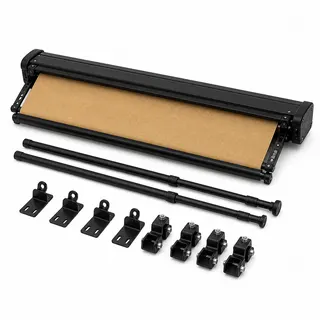
Straight awning
4x4 Side Awning
For simple camp shade along one side of the vehicle.
- Compact side coverage
- Lower weight than wraparound styles
Check:Rack length, bracket spacing and door clearance.
Search on Amazon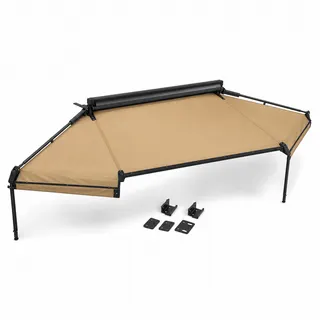
Wraparound
270 Degree Awning
For side and rear camp kitchens when coverage matters more than pack size.
- Side plus rear shade
- More weight and hardware
Check:Rack load, hinge support and pack-down routine.
Search on Amazon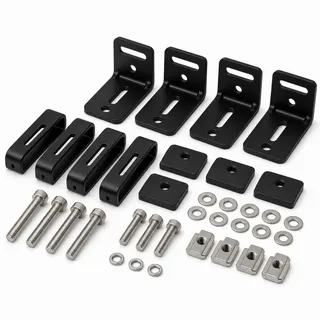
Mounting
Vehicle Awning Mounting Brackets
For matching the awning case to bars, platforms or roof racks.
- Bracket fit matters
- Hardware changes clearance
Check:Rack channel, bolt pattern and corrosion exposure.
Search on AmazonClearance checks for doors, tailgate, roof tents and solar
Open every door before tightening brackets. A case that clears the garage can still block the hood, rear hatch, side door, tailgate, ladder or fridge slide. The problem often appears only when the awning is partly deployed, because arms, hinges, legs and wall panels move through a wider path than the closed case suggests.
Roof tents and solar panels add fit conflicts that are easy to miss on a product page. A roof tent ladder may need the same side as the awning. A tent entry can sit under the hinge path. Solar panels may be shaded by open fabric, blocked by wall kits or hard to service once the awning brackets are tightened. 23Zero's Onyx 270 example is side-specific and RTT-oriented, with right-side fit, RTT pass-throughs and a pre-install check for roof load, rack capacity and deployment clearance.
Check road-side camping as well as camp comfort. A right-side 270 might fit the vehicle, but it can open toward a traffic lane in some roadside stops. A left-side awning may work better for one route and worse for another. Choose the side that matches where doors, cooking gear, tailgate access, tent entry and safe camp space usually sit.
Fit Check
Clearance checks before final tightening
Run these checks with the vehicle parked level, doors open and the rack loaded as it will travel.
| Part to check | What can go wrong | Action before buying |
|---|---|---|
| Doors and hood | The case or bracket blocks the door edge, hood lift or side mirror line | Open each door and hood through its full path before marking brackets |
| Tailgate or hatch | A rear hatch hits the case, arm, hinge or wall-kit edge | Test tailgate clearance with the awning side and rear corner mapped |
| Roof tent | The ladder, tent door or annex needs the same side as the awning hardware | Lay out ladder, entry and bracket positions before choosing side orientation |
| Solar panel | The open awning shades the panel or blocks cleaning and service access | Check panel access with the awning open and with walls packed nearby |
| Rear kitchen or fridge slide | Drawers or slides open into legs, walls, poles or guy lines | Pull the slide fully out and mark where legs and guy lines land |
| Garage, trail and roadside side | The case adds width, catches brush or opens into unsafe roadside space | Measure closed case width and choose the camp side before ordering |
Awning types worth comparing
Use these gear prompts after the rack, bracket and clearance checks are settled. Treat them as category searches to compare fit, mounting style and pack-down routine.
Gear guide
Category fit checks
| Awning category | Compare when | Check first | Avoid if |
|---|---|---|---|
| Straight side awnings | Fast shade beside one side of a 4x4 with lower side weight and simpler brackets. | Usable rack length, bracket spacing, door swing and spare dynamic load. | Rear drawers or tailgate cooking need shade on most trips. |
| 180-degree awnings | One side of camp needs wider shelter without the full wraparound bulk of a 270. | Case length, hatch swing, bracket spread and how the rear corner opens. | The rear hatch path is tight or the rack cannot support a long case. |
| 270-degree awnings | Rear drawers, tailgate cooking and side kitchen work happen often enough to justify the weight. | Rack load, side orientation, tailgate path, hinge load and guy-line points. | Capacity, side choice, tailgate clearance or wind routine is uncertain. |
Wind, rain, walls and pack-down routine
Freestanding does not mean ignore weather. Rhino-Rack lists brackets, pegs, guy ropes and optional poles with Batwing 180 and 270 awnings, and the Sunseeker includes poles, ropes and pegs. Treat freestanding setup as a calm-weather convenience. When gusts, storms or exposed camps are possible, use legs, poles, guy lines, stakes and sand anchors or pack the awning away.
Rain needs a path out. Rhino-Rack lists the Sunseeker with water-resistant 210D rip-stop canvas, PU 2000 mm water resistance and Velcro tensioning tabs to aid runoff. Front Runner Dometic lists Easy-Out fabric as 400D oxford or polyester ripstop, UV-resistant, PU-coated and 1500 mm water-repellent. Those fabric claims do not make a vehicle awning a storm shelter. Low pitch, loose fabric or walls can still collect water and load the arms.
Wall kits add privacy and weather screening, but they also add cost, packed bulk and wind surface. Yakima's MajorShady wall-kit instructions warn against high-wind deployment, water collection, engine exhaust with walls in place, and camp stoves or propane heaters under fully walled awnings. Do not run the engine into an enclosed awning space, and do not cook under fabric unless the exact manufacturer instructions allow that setup.
Plan for the weather you will actually leave the awning in. If you leave camp for a hike, drive away from the vehicle, sleep through changing wind or camp on soft sand without proper anchors, a large 180 or 270 is more risk than comfort. Pack down before gust fronts, storms, high wind, water pooling or long unattended periods.
- Carry guy lines, stakes and sand anchors that match the campsite surface.
- Pitch the fabric so water cannot pool against the case or arms.
- Do not use enclosed wall kits with exhaust, open flame, stoves or propane heaters unless the manual allows it.
Accessories and cost traps
The awning is rarely the whole purchase. Count brackets, quick-release mounts, extra poles, guy lines, ground stakes, sand anchors, wall kits, storage bags, lighting, replacement fabric, spare hinge parts and any professional install. Do not compare a bare straight awning against a fully walled 270-degree setup as if the only difference is open shade area.
A cheap 4x4 awning stops being cheap if it forces a platform rack upgrade. The same is true when a roof tent, solar panel or cargo box needs moving to make bracket spacing work. Price the roof changes before choosing the awning, because the rack may become the expensive part of the project.
Quick-release brackets are useful when the awning is carried only for trips, but they add another connection to inspect. Clamp and U-bolt methods can suit lighter side awnings when the rack maker allows them. Heavy 180 and 270 awnings need more careful bracket spread and stronger hardware. If the installation depends on drilling an unapproved rack part, stop and check the rack instructions before buying.
- Budget hardware and rack changes before fabric size.
- Choose wall kits only when the exact awning model, storage space and weather routine fit.
- Treat quick-release hardware as another road-load connection that needs inspection.
When not to buy a 4x4 awning
Do not buy when capacity is unknown. If the vehicle roof rating, rack rating, bracket rating or off-road rating is missing, find the rating or fix the rack hardware before ordering a larger awning. NHTSA reports unsecured loads cause about 850 deaths and nearly 19,000 injuries annually, and notes unsecured-load laws across all states and DC. A loose awning case is not only camp inconvenience.
Do not buy when the awning blocks the vehicle. Tailgate clearance, hatch swing, hood lift, roof tent entry, solar access, rear kitchen slides, garage height and trail width all matter. If the case or arms interfere with normal vehicle use, choose a smaller straight awning, change the rack plan or use detached shade.
Do not buy a large mounted awning for shade that needs to stay away from the 4x4. A tarp, freestanding shelter or driveaway shelter is better when camp stays put while the vehicle leaves. Use the broader vehicle-awning guide when the setup is really a campervan, RV, car or mixed vehicle decision rather than a 4x4 roof-rack purchase.
- Use a tarp or shelter when shade must sit away from the vehicle.
- Upgrade the rack first when brackets, load rating or case support are uncertain.
- Choose the broader vehicle guide when the vehicle is not a roof-rack 4x4 setup.
Watch-outs
Before you buy or install
- Do not drive if the case, brackets, bolts, zipper cover, fabric or quick-release mount moves during a shake check.
- Do not deploy a 180 or 270-degree awning in gusts, storms, high wind, water pooling conditions or unattended camp.
- Do not use walled awnings with a running engine, exhaust near the enclosure, propane heater, stove or fire pit unless the manufacturer instructions allow that exact setup.
- Do not mount an awning to bare roof trim, unsupported rails or drilled rack parts unless the rack and awning instructions approve it.
Read Next
Related guides if your situation is different
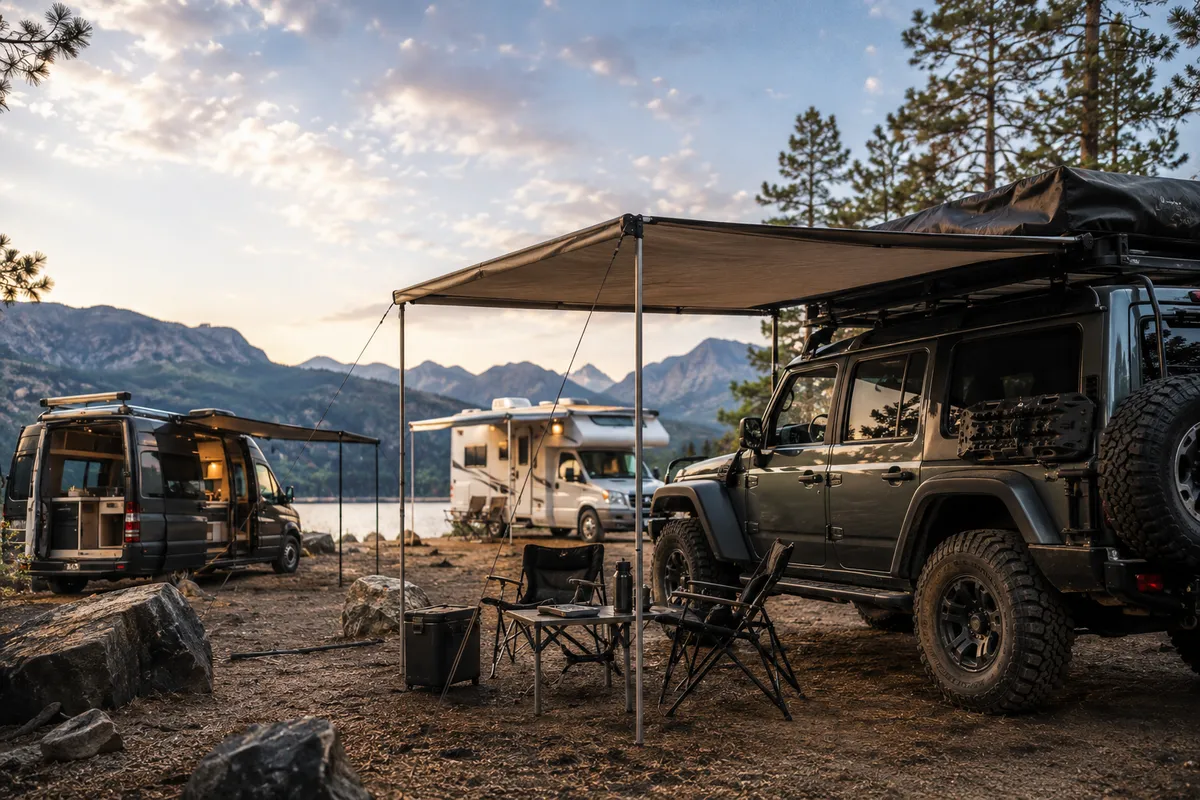
Vehicle Awning Guide
Use this when the setup is not strictly a roof-rack 4x4 decision and you need campervan, RV, car and broader vehicle-awning routing.
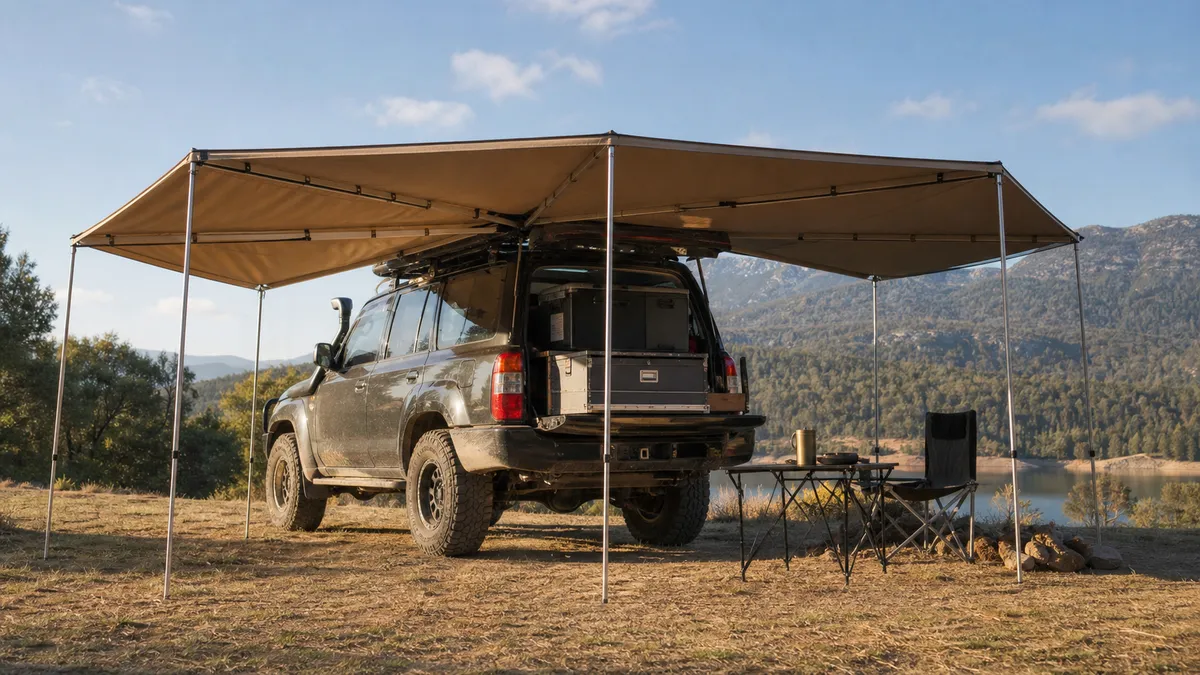
270-Degree Awning Guide
Use this when the 4x4 setup really needs side-plus-rear shade and the next check is 270-degree weight, hinge support, side orientation and wind routine.
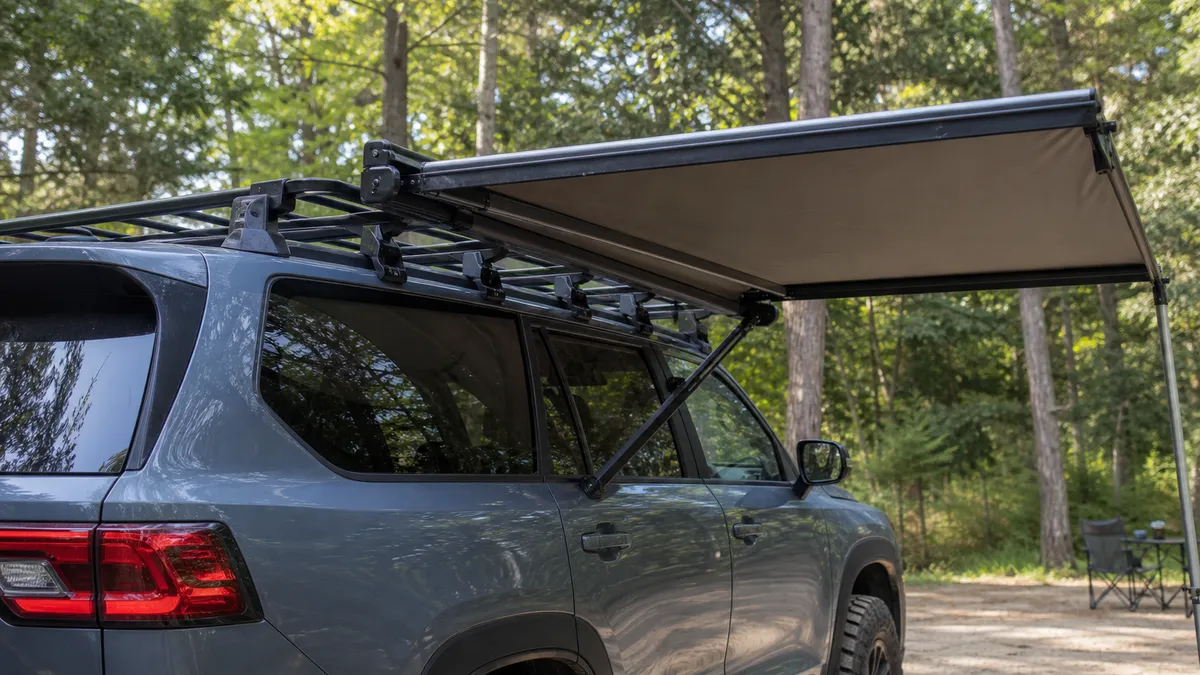
Roof Rack Awning Guide
Use this when the buying decision depends on crossbars, platform racks, brackets, quick-release mounts, case overhang or rough-road hardware checks.
Questions
FAQ
Is a 270-degree awning worth it on a 4x4?
Yes, but only when rear drawers, tailgate cooking and side kitchen use happen often. If most stops need quick side shade, a straight side awning is lighter and easier. If side coverage matters but rear shade is occasional, a 180-degree awning may be enough.
Can factory crossbars carry a 4x4 awning?
Sometimes a small straight awning can work if the vehicle manual, rack instructions and awning brackets all allow it. Heavier 180 and 270-degree awnings often need stronger load bars or a platform rack. Use the lowest relevant rating and count the brackets and other roof cargo.
What case length should I choose?
Choose case length from usable rack length, bracket spacing, overhang, door swing and tailgate clearance. Open shade area is secondary. ARB gives a 27 in overhang limit in its universal-bracket guidance, so a long case with narrow bracket spacing is a warning sign.
Can I use a 4x4 awning with a roof tent or solar panel?
Yes, if the ladder, tent entry, bracket positions, solar access, panel shading and total roof load still work. Lay out the roof tent, solar panel and awning case together before ordering. Side-specific 270-degree awnings make this check more important.
Are freestanding 180 or 270 awnings safe in wind?
Freestanding is a setup style for calm conditions, not permission to skip support. Use poles, legs, guy lines, stakes or sand anchors when weather can change. Pack down before gusts, storms, high wind, water pooling or any long unattended period.