
Quick Answer
Quick answer for patio awnings
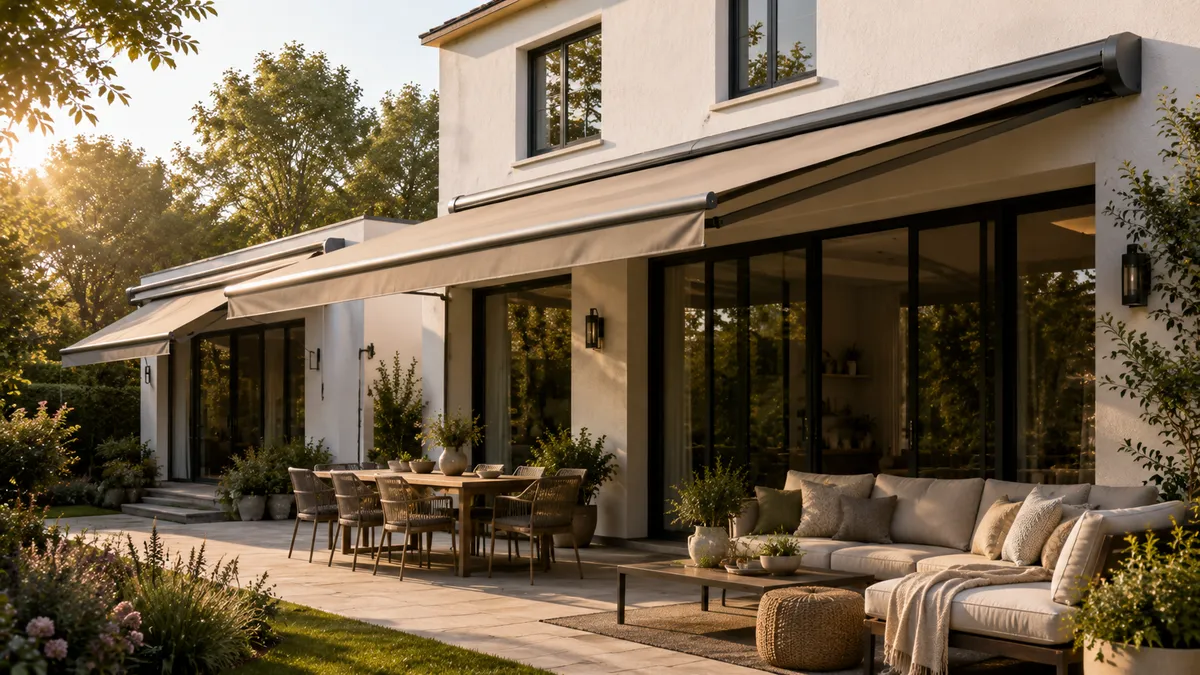
This wall-mounted awning fits when a structural wall or approved soffit can carry the brackets, the projection reaches the seats or doors that need shade, the controls are easy enough for daily closing, and the fabric can close before wind or heavy rain. Choose cassette style, fabric and accessories only after those checks pass.
Choose a retractable awning for adjustable shade beside a verified wall; use fixed, vertical, freestanding or no-drill shade when structure, low sun or weather routine fails.
Guide path
Choose the awning path
Start with the condition that can stop the project before comparing fabric colors, remotes or cassette housings.
Solid wall and overhead patio sun
Keep reading here when the seating zone sits near the house and the wall, ledger, masonry or structural framing can be verified.
Reachable crank and occasional use
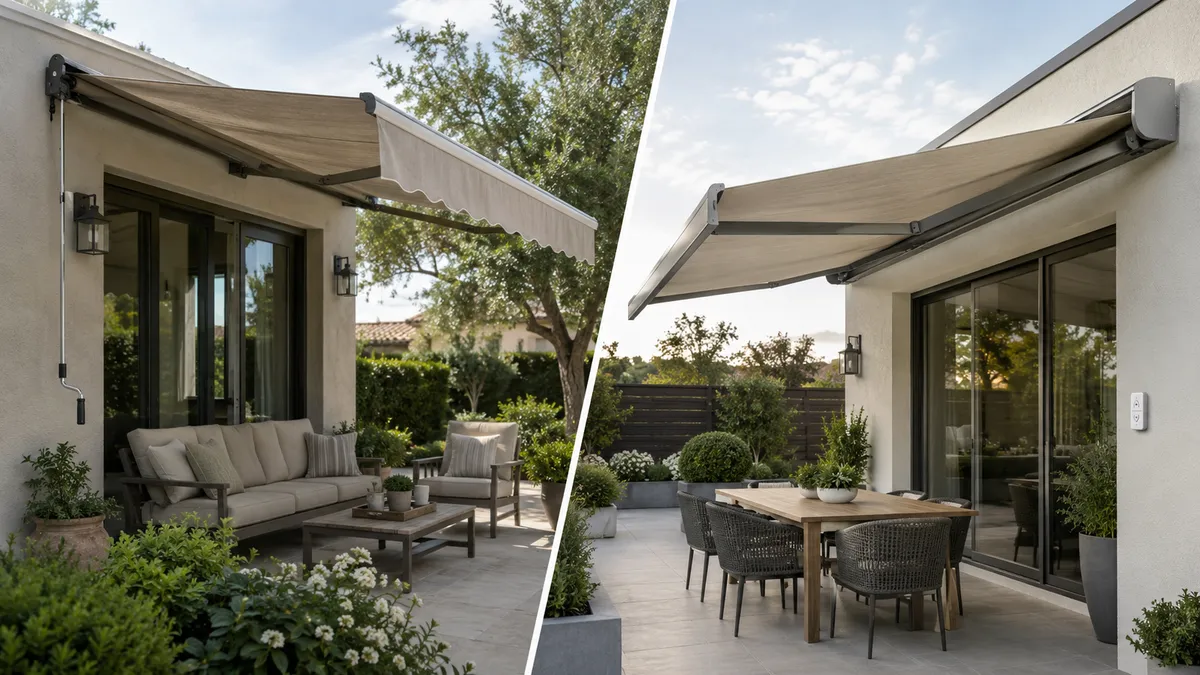
Use the manual versus motorized guide when crank reach, arm strength and seasonal use decide whether a simpler awning is enough.
Daily use, high mount or sensor interest
Use the control guide when frequent operation, accessibility, remote control, override access or wind sensor testing will decide the controls.
Not sure fixed or retractable fits
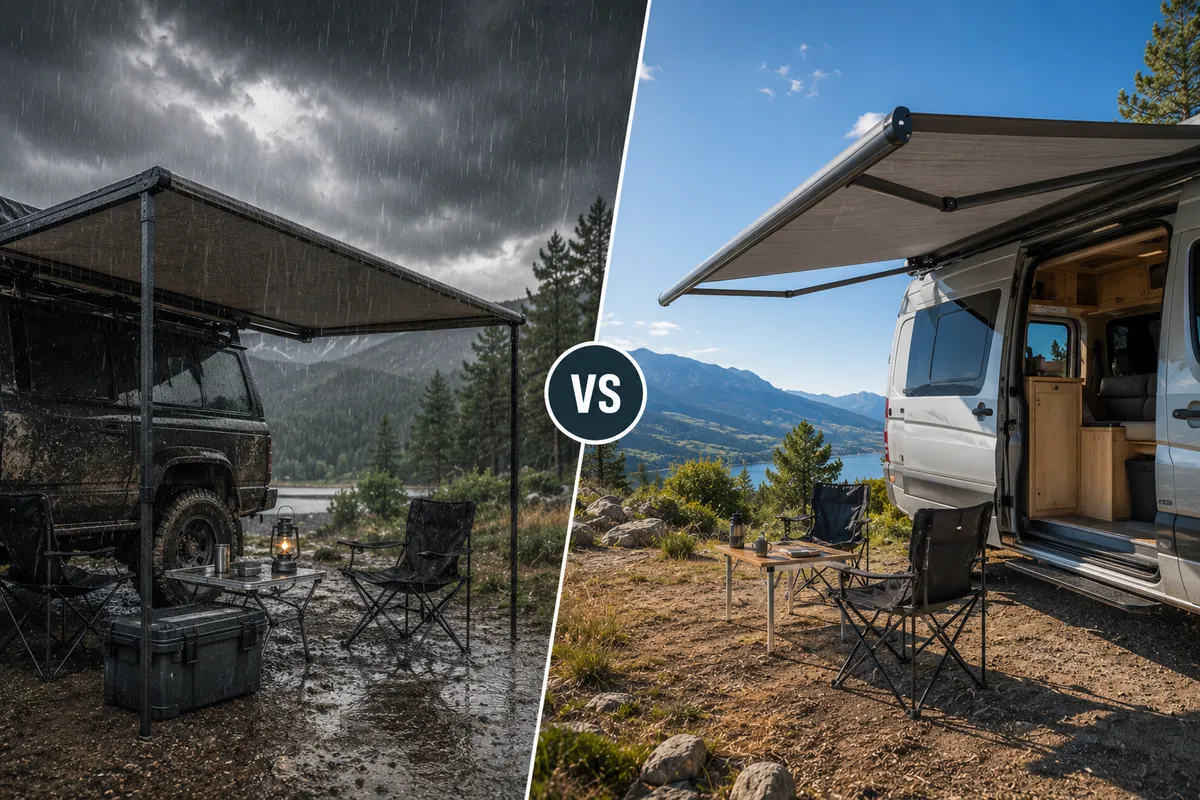
Use the fixed versus retractable comparison when the job may be permanent rain cover rather than adjustable patio shade.
Ready for product criteria
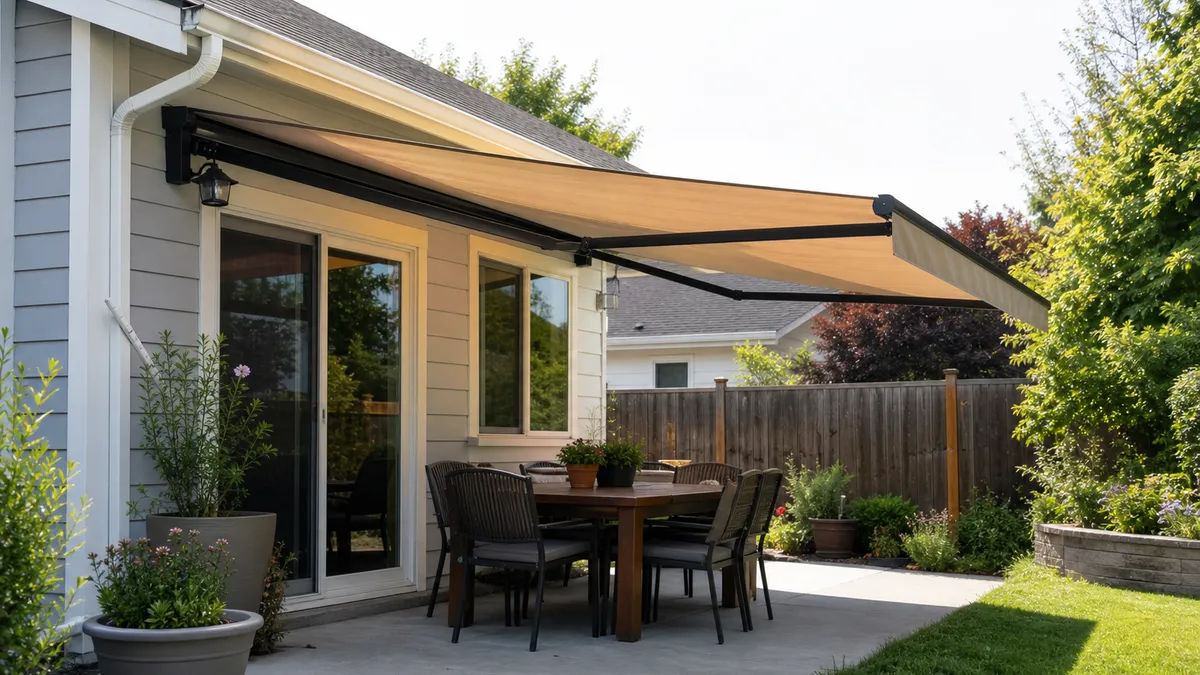
Use the buying guide only after wall support, projection, cassette exposure and weather habits are known.
Glare comes from the side
Use vertical shade, a drop screen or side screen when east or west sun slips under the front bar.
Weak wall, rental balcony or unknown cladding
Pause the wall-mounted awning. Use freestanding shade, approved no-drill shade or a professional assessment instead.
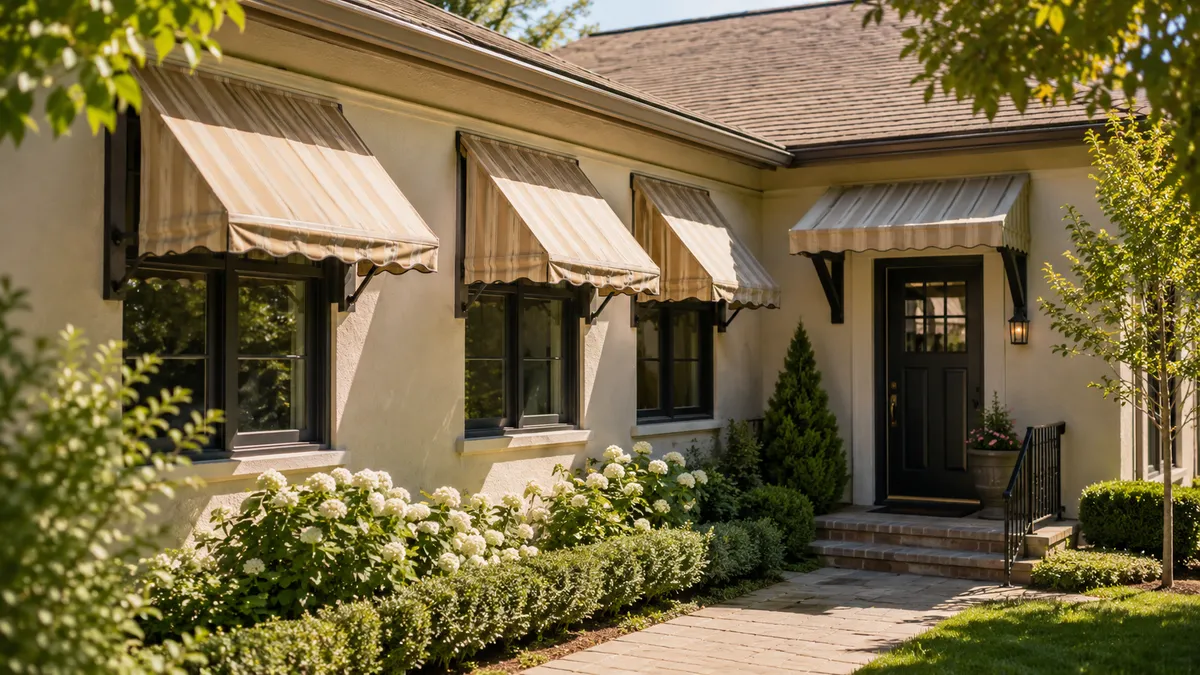
Door or window rain cover is the real job
A small fixed door or window awning usually handles everyday drip protection better than a large retractable patio awning.
Manual, motorized, open, semi-cassette or full cassette?
A retractable patio awning has two separate choices that are often mixed together: how it moves and how it stores when closed. Manual crank operation suits occasional shade when the crank eye is reachable and someone can close the fabric quickly. Motorized operation suits frequent use, high mounting points or mixed household reach, but it adds control setup, service access and sometimes power planning.
SunSetter's Platinum examples include both manual hand-crank and remote-control operation, with model widths from 8 ft to 20 ft and projections around 10 ft 2 in. to 13 ft 1 in. Treat those as one product-line example, not a universal catalog rule. The practical point is simple: a wider, deeper awning is harder to operate casually and needs a dependable closing routine.
Cassette style is the storage question. Lippert/Solera describes open or no-cassette awnings as leaving fabric and arms exposed, semi-cassette designs as protecting the fabric more than an open awning, and full cassette designs as enclosing both fabric and arms. Angi also names cassette design as a price and protection driver. Pay for more enclosure when the closed awning sits on an exposed wall, but do not let cassette protection distract from the open-awning wind and rain limits.
- Manual crank: simpler and lower-cost when reach and closing effort are realistic.
- Motorized: better for frequent use, accessibility or sensors, but control setup and override access matter.
- Open cassette: exposed storage; inspect fabric and arms more often.
- Semi-cassette: more fabric protection without enclosing every moving part.
- Full cassette: cleaner storage and more protection at a higher cost and larger case size.
Type check
Control and cassette choices
Use this table to separate operation from storage before comparing product lines.
| Choice | Best fit | Main caution |
|---|---|---|
| Manual crank | Reachable crank, smaller or occasional-use awning, and someone present to close it before weather changes. | A hard-to-reach crank makes the awning stay open when it should be retracted. |
| Motorized | Daily patio use, high mount, wide fabric or easier operation for mixed reach and strength. | Sensors and remotes need setup, power planning, testing and manual override access. |
| Open or no cassette | Sheltered walls where lower upfront cost matters and routine inspection is acceptable. | Fabric and arms remain more exposed while stored. |
| Semi-cassette | Walls that need better closed-fabric protection without the largest enclosure. | Arms or underside parts may still be partly exposed depending on design. |
| Full cassette | Exposed walls where clean storage and hardware protection are worth the premium. | The case adds cost, bulk and bracket planning; it does not make the open awning storm-safe. |
Size, projection and useful shade
Start sizing from the failed sun hour, not the product name. Measure the seating, dining, door or deck zone that needs shade, then compare that to clear wall width, mounting height and projection. YourHome's shading guidance is useful here because it treats climate, orientation and sun angle as part of the shade design. If the sun arrives low from the east or west, overhead fabric can miss the glare line even with a deep projection.
Mounting height is a first-pass filter. SunSetter's measuring guide lists 7 ft 6 in. from deck or patio floor to roof, eave or overhang for many of its models, with a separate 7 ft note for the 1000XT. Use that as a brand-specific example that shows why the wall height check comes before color, not as a rule for every manufacturer.
Width needs the same caution. SunSetter notes that some models are wider than the named size and that fabric width can be narrower than awning width. A 12 ft label does not guarantee 12 ft of useful shade across the fabric. Lippert/Solera lists patio projections commonly in the 8 to 12 ft range in its guide, while SunSetter's Platinum examples run roughly 10 ft 2 in. to 13 ft 1 in. for that line. The final size still comes from the specific manual and quote.
Check front-bar clearance with the awning pitched, not only retracted. Doors, lights, gutters, vents, trim, security cameras, downspouts and chair pullback can all interfere with brackets or the moving front bar. A deeper projection may shade the table, but it can also lower the front edge, add exposed fabric and make rain behavior more sensitive to pitch.
- Measure wall width, fabric width, projection and front-bar clearance as separate numbers.
- Use the exact product manual for bracket spacing, mounting height and pitch.
- Move to the awning size guide when the main question is width, projection or clearance.
Mounting surface and clearance checks
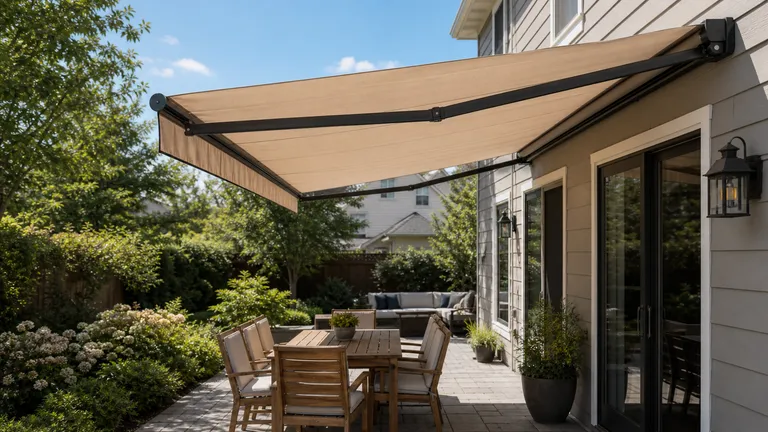
A wall-mounted patio awning is a bracket and arm load before it is a fabric purchase. Alutech's manual tells installers to check the load-bearing capacity of the mounting base before assembly. That warning matters because the arms create leverage when the awning is extended, and the wall has to carry that load through real structure.
Good candidates include solid masonry or concrete where the manual allows it, structural timber, studs, a ledger or other framing that the installer can identify. SunSetter's measuring guide separates wall and soffit bracket approaches and calls for clear horizontal mounting space that changes by model and hood or cassette style. Do not assume a soffit, fascia or trim board is structural because it looks strong from the patio.
Cladding needs a pause. The DIY SC4000/SC5000 instructions for clapboard, vinyl and aluminum siding focus on finding studs, cutting away compressible material where needed and building out to structure instead of fastening only to the siding skin. The same instructions warn that some brick faces are only facades, so brick veneer should not be treated as automatically structural.
Balcony and rental installs need written permission as well as structure. A balcony rail, glass panel, decorative trim or unknown exterior wall is not enough. If the installer cannot identify the structural load path, or if the HOA, condo board or landlord will not approve the exterior attachment, use freestanding shade, a no-drill option or professional assessment before buying the awning.
- Proceed only when each bracket reaches approved structure.
- Stop for fascia, gutters, trim, decorative brick veneer or compressible siding without a structural build-out.
- Use a qualified awning installer or structural professional when the load path is unclear.
Wind, rain and sensors
Treat wind and rain as load problems, not just fabric problems. Alutech warns that an extended awning transfers wind and rain forces through the mounting brackets into the assembled structure. The researched manuals do not support a universal safe wind speed, so the safest general rule is to follow the product manual and retract before strong or gusty weather.
Rain language must stay product-specific. Alutech gives one model-specific warning to retract in rain if pitch is below 14 degrees and frames awnings as sun protection, not strong wind, rain, hail or snow cover. DIY SC4000/SC5000 instructions describe sun protection and occasional supervised light rain, but say to retract if water pools and not to leave the awning extended when away.
Sensors are backup protection, not permission to ignore weather. Somfy's Eolis documentation says the sensor detects vibration caused by excessive wind and sends a radio command to retract when vibration exceeds the set point. The same documentation warns that incorrect motor direction can make the awning extend during windy conditions and cause serious damage, and Somfy's support instructions call for testing by simulating wind on the front bar until retraction begins.
Do not use this fabric awning as a grill shelter. The DIY manual specifically warns not to barbecue under the awning. If the patio job involves open flame, heavy rain cover, snow load, hail exposure or an unattended storm shelter, this product family is the wrong starting point.
- Retract before strong wind, heavy rain, snow, hail or leaving home.
- Retract immediately if water pools on the fabric.
- Test wind sensors and motor direction after installation and during seasonal checks.
- Keep grills and open flame out from under the awning unless the specific manual allows it.
Cost, accessories and what changes the quote
Use published cost ranges only as planning numbers. HomeGuide lists installed manual models from $200 to $3,000 and motorized models from $1,000 to $6,000. Angi gives a professional installation planning range of $1,000 to $3,500 and says width and projection affect both shade and price. Your quote can land outside those ranges when the wall, labor market or product package differs.
Separate the product from the installed total. The awning itself may be manual or motorized, open or cassette, narrow or wide, but the quote can also include labor, bracket corrections, siding build-out, masonry repair, a hood or cassette, wind sensor, drop screen, LED lighting, app controls, remote controls, replacement fabric grade and service access. A cheap fabric price does not help if the wall needs correction before brackets can be installed.
Cassette and accessory upgrades should solve a real exposure or use problem. Angi names full cassette as more protective and more expensive, and SunSetter describes a semi-cassette housing as an aluminum cover that protects retracted fabric from dirt, wind and snow. A drop screen or side screen can be worth more than extra projection when the issue is low glare. A wind sensor can help when the awning is motorized, but it still needs testing and a manual routine.
If the job is a small door or window rain cover, compare door and window awnings before pricing a large retractable patio awning. HomeGuide separates door and window awnings from larger deck, porch and patio awnings in its cost framing, and that distinction matches the real job.
Cost check
What changes an awning quote
Use sourced ranges for planning, then ask installers to itemize the wall, control and accessory pieces.
| Cost area | Planning context | What to ask before approving |
|---|---|---|
| Small manual install | HomeGuide lists installed manual models from $200 to $3,000. | Confirm crank reach, bracket substrate and whether labor is included. |
| Motorized package | HomeGuide lists installed motorized models from $1,000 to $6,000. | Ask about remote, override, outlet path, sensor compatibility and service access. |
| Professional patio install | Angi gives a $1,000 to $3,500 professional installation planning range. | Check whether width, projection, wall correction and cassette are included. |
| Cassette upgrade | Angi names cassette design as a protection and price driver. | Decide whether the closed awning is exposed enough to justify more enclosure. |
| Wall correction or build-out | No single range covers uncertain siding, veneer, framing or masonry repairs. | Price the structural work before ordering the awning. |
These are planning ranges from cost guides, not quotes for a specific home.
Fabric, cleaning and maintenance
Fabric choice affects glare, heat and maintenance, but it does not solve bad structure or weather use. The U.S. Department of Energy says modern awning fabrics include acrylic and polyvinyl laminates, and recommends opaque, tightly woven, light-colored fabrics for sunlight reflection. DOE also says awnings that retract can be rolled up in winter to admit sun, which is one of the real advantages over fixed cover.
Maintenance starts before dirt becomes embedded. Sunbrella/Glen Raven care guidance says awning fabric can be cleaned on the frame by brushing off loose dirt, hosing down, using mild soap, rinsing thoroughly and letting the fabric air dry completely. That complete drying step matters before long storage, especially when the awning is closed for a season.
Mildew risk is usually about dirt and foreign material. Sunbrella notes mildew may grow on dirt or other substances on the fabric even if the fabric itself does not promote mildew. Inspect seams, valances, front bar alignment, arm movement, sensor batteries, remote controls and fasteners at the start of the warm season and after storms.
- Brush loose dirt before washing fabric.
- Use mild soap, rinse thoroughly and air dry completely before long closed storage.
- Inspect arms, fasteners, sensor function, fabric alignment and cassette drain points seasonally.
When not to buy a retractable awning
Do not buy this awning when the real problem is side glare. YourHome's passive shading guidance explains that low-angle east or west sun often needs vertical or adjustable shading. A drop screen, side screen, exterior roller shade or planting can fix glare that a deeper overhead projection still misses.
Do not buy one when the wall is weak, the exterior surface is unknown or the install is not approved. A freestanding umbrella, weighted canopy, shade sail on proper posts or renter-friendly no-drill shade is better than hiding a bad anchor behind more fabric. This is especially true for apartment balconies, brick veneer, foam-backed finishes, fascia lines and rail-only attachment ideas.
Do not buy one for storm cover, heavy rain cover, snow cover, hail cover or grill cover. Choose a fixed door/window awning for small everyday drip protection, a pergola or roofed structure for durable rain planning, or an umbrella/freestanding shade when the zone sits away from the house wall. A retractable model is strongest when it gives adjustable sun shade and can disappear before weather gets rough.
- Use side shade for low glare under the front bar.
- Use fixed door or window cover for rain-first small openings.
- Use freestanding or no-drill shade when wall permission or structure is unresolved.
- Use a roofed structure, not retractable fabric, for unattended storm or snow cover.
Where to go next
Use this hub to decide whether wall-mounted retracting shade still fits the wall, sun and weather routine. If the next unknown is control method, read the manual versus motorized guide. If the next unknown is whether a permanent cover would be better, read the fixed versus retractable comparison. If the site fit is already clear and you are ready to compare buying criteria, move to the patio buying guide.
Use the awning size guide when width, projection, fabric width, mounting height or front-bar clearance is the bottleneck. Use the door and window awning hub when the job is a small opening rather than a patio or deck zone. Keep the next step narrow: a broad hub should send you to the right awning question, not pretend every awning problem has one product answer.
- Control choice: manual versus motorized awning.
- Format choice: fixed versus retractable.
- Product criteria: patio buying guide.
- Measuring bottleneck: awning size guide.
- Small rain-cover opening: door and window awnings.
Watch-outs
Before you buy or install
- Do not fasten brackets only to siding, fascia, trim, gutters or decorative brick veneer.
- Do not treat a wind sensor as permission to leave the awning open in bad weather.
- Do not grill or use open flame under the fabric unless the specific manual allows it.
- Do not use one brand's clearance, projection or pitch number as a universal rule.
Read Next
Related hub
Patio Awning Guide
Use this when patio awning is closer to the real constraint than the current page.
Manual vs Motorized Awning
Use this when manual vs motorized awning is closer to the real constraint than the current page.
Fixed vs Retractable Awning
Use this when fixed vs retractable awning is closer to the real constraint than the current page.
Best Retractable Awning for Patio
Use this when best retractable awning for patio is closer to the real constraint than the current page.
Awning Size Guide
Use this when awning size guide is closer to the real constraint than the current page.
Door and Window Awnings
Use this when door and window awnings is closer to the real constraint than the current page.
Questions
FAQ
Is this type of awning worth it for a patio or deck?
It is worth considering when the shade zone sits near a verified structural wall, retraction adds real value and someone will close it before bad weather. It is not the right purchase for weak cladding, low side glare, unattended storm cover or a patio that sits too far from the house.
Should I choose a manual or motorized patio awning?
Choose manual when the crank is easy to reach, the awning is used occasionally and lower cost matters. Choose motorized when daily use, high mounting, accessibility needs or sensor integration changes whether the awning will actually open and close. Then read the dedicated manual versus motorized comparison.
What is the difference between open, semi-cassette and full-cassette awnings?
Open awnings leave fabric and arms more exposed when closed. Semi-cassette designs protect the fabric more than open designs, while full cassette designs enclose more of the fabric and hardware. Protection and price generally rise with enclosure, but cassette storage does not make an extended awning storm-safe.
Can I leave the awning out in rain or wind?
Follow the exact manual. The researched manuals frame these awnings as sun shade with strict weather limits. Light supervised rain may be allowed for some products, but pooling, strong wind, snow, hail or leaving home with the awning extended should trigger retraction.
Can this awning be mounted on siding, brick veneer or a balcony?
Only when the fasteners reach approved structure and the installation follows the product manual and building rules. Siding skin, trim, fascia, decorative brick veneer, glass railings and unknown balcony surfaces should stop the project until an installer or structural professional verifies a real load path.
How much does an installed patio awning cost?
Use cost guides as planning ranges, not quotes. HomeGuide lists installed manual models from $200 to $3,000 and motorized models from $1,000 to $6,000, while Angi gives a $1,000 to $3,500 professional installation planning range. Width, projection, cassette, sensors, labor and wall correction drive the final quote.