
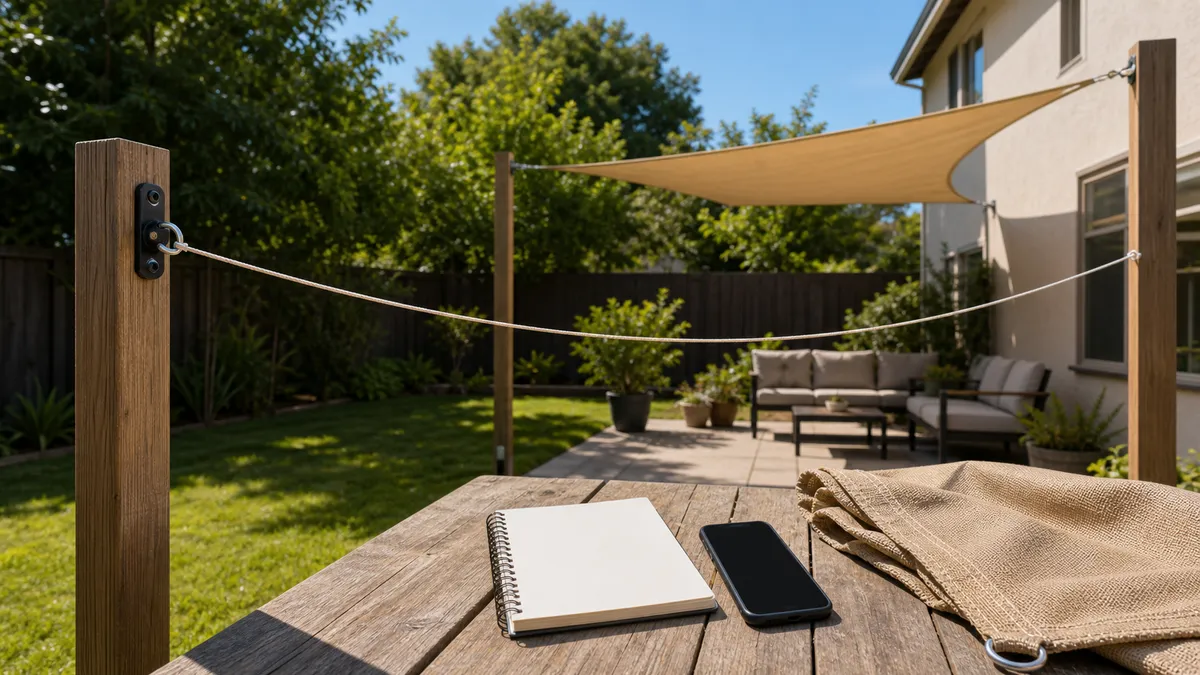
Quick Answer
Quick size estimate
Use the shade sail size calculator for a planning fabric estimate after hardware allowance. Before ordering, confirm fixing-point measurements, shape, hardware gap, slope, clearances and support strength. A supplier measuring sheet still controls custom orders.
Order fabric only after anchor-to-anchor measurements, hardware room, slope, clearances and support strength all match the selected sail maker's instructions.
Interactive Tool
Shade sail size estimator
Use this as a planning tool before checking manufacturer instructions.
Result Guide
How to read your result
Use the number as a planning estimate, then check shape, hardware gap and anchors before ordering fabric.
| Result / situation | What it means | Check before ordering |
|---|---|---|
| Four anchor points surround a dining table | Rectangle estimate can work | Confirm hardware gap, slope and structural anchors. |
| Only three reliable corners exist | Triangle estimate may fit, but coverage drops | Check the shaded area at the failed hour. |
| Waterproof fabric is being considered | Size is not enough | Confirm high and low anchors before ordering. |
How to read the size estimate
The result is estimated fabric size, not the distance between posts, walls or trees. A sail sits inside the fixing points because turnbuckles, shackles, D-rings, snap hooks and adjustment travel need room outside the fabric. If the calculator subtracts 1.5 ft on each side from a 12 ft by 16 ft anchor spread, the planning rectangle is near 9 ft by 13 ft before catenary edges and supplier rules.
Use the number to test whether the shaded area still covers the furniture or walkway that actually fails in the sun. A listed fabric dimension does not mean every inch below it gets shade, especially near curved edges. Shade Sails LLC and ShadeClothStore both note that custom sail edges are curved, so a chair placed near the edge may still sit outside the useful shade.
Do not turn this result into a production drawing. Shade Sails LLC tells customers to measure from installed fixing eyes and follow its measuring method for custom sails. ShadeClothStore also notes that custom dimensions, hardware, stretch and production tolerance affect the final order. The calculator narrows the range; the maker's sheet decides the final drawing.
Result checks
What each result still needs
Read the calculator output as a planning step, then make the matching check before ordering fabric.
| Result | What it means | Before ordering check |
|---|---|---|
| Rectangle or square estimate | Estimated fabric inside four fixing points. | Check hardware gap on all sides and measure diagonals to catch skew. |
| Triangle estimate | Three-corner fabric with less center area than the bounding rectangle. | Confirm all three anchors are reliable and the shadow still reaches the failed hour. |
| Irregular or custom layout | Width and depth are not enough for final production. | Label corners, measure every side and use the supplier measuring sheet. |
| Waterproof or rain-exposed layout | Size is incomplete without slope and runoff. | Confirm high-low anchors, drainage direction and low-edge clearance. |
Hardware gaps and fixing-point measurements
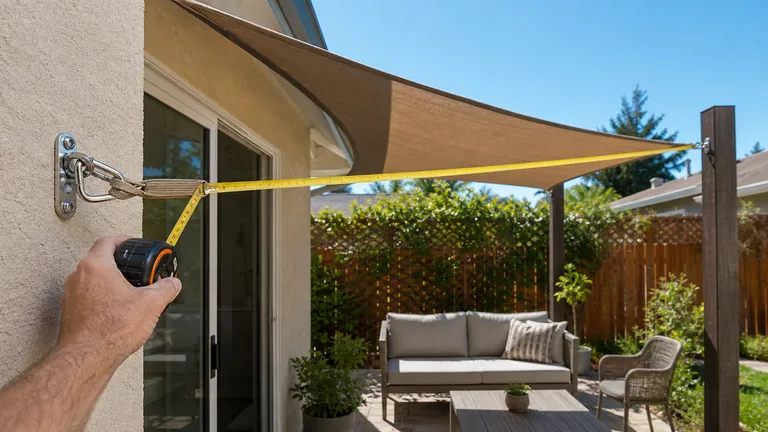
Measure fixing eye to fixing eye when the anchors already exist. Wall-surface, post-outside or fence-panel measurements can be several inches away from the point that actually holds the sail. Mississippi State University Extension tells readers to measure before buying and identify an anchoring point for each corner. The calculator needs the same thing: real corners, not a product photo.
Hardware allowance is product-specific. Home Depot's installation guide gives 10 to 15 inches per side as one example for tensioning hardware. Above & Beyond gives 35 cm minimum and 100 cm maximum corner-to-fixing examples in its own size guidance. Treat those as examples, not universal numbers. Your selected turnbuckle length, shackle size, D-ring position, stretch allowance and maker instructions set the input.
If the calculator result becomes too small after a realistic hardware gap, do not erase the gap to make the sail fit on paper. Move a post, choose another shape or use a different shade. For broader common-size and measuring examples, use the shade sail size guide after this estimate.
- Use final fixing-eye locations when they are installed.
- Reserve room for the turnbuckle to tighten and later adjust.
- Do not use a zero hardware gap to make a too-large sail appear to fit.
Triangle, rectangle and irregular layouts
A triangle result often looks small because a triangle has roughly half the area of the rectangle around it. That does not make the calculator wrong; the shape covers a different patch of patio. Three reliable anchors can solve an awkward corner, but they may leave the far side of a dining table or pool edge exposed.
A rectangle or square needs four credible fixing points. A four-sided custom layout also needs diagonal measurement. Shade Sails LLC asks for diagonals on four-sided sails because a skewed shape can show similar width and depth while the opposite corners sit out of square. If the diagonals disagree, do not order from simple width and depth alone.
Keep the shape choice narrow here. Use this page to interpret the size result, then use the triangle versus rectangle shade sail guide if the real question is coverage, anchor count, wind exposure or whether a triangle leaves too many gaps.
Slope, wind and structural limits
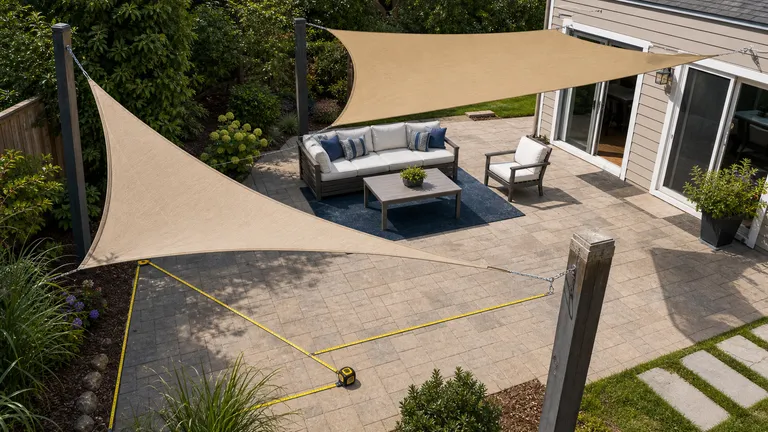
The calculator cannot approve a post footing, fascia board, fence post, tree anchor, wall plate, masonry fixing, wind exposure or local approval. Coolaroo advises builder or engineer advice when structural soundness is uncertain. Its planning guide also says requirements vary with soil, anchor points, wind conditions and local rules. Mississippi State University Extension similarly warns that posts must be sturdy enough for wind.
Waterproof or rain-exposed fabric needs slope before size. Home Depot's use and care manual gives a 20 to 30 degree runoff angle example and says the product is not waterproof or rainproof unless stated. Coolaroo's FAQ gives a minimum 20 degree runoff angle for weatherproof cloth and warns that waterproof performance is not guaranteed when fixing and pooling issues remain. Above & Beyond gives 25 cm of fall per meter as its own guidance. Follow the selected product, not an average pulled from several guides.
Stop before ordering if the low edge blocks a door, head clearance, walking route, furniture pullback, pool edge or runoff landing zone. Also stop if the shade would sit over grills, heaters or hot exhaust. The post and support guide is the better next page when the sizing result depends on new posts, wall anchors, fascia doubts or wind exposure.
Manual fallback for skewed patios
If the patio is skewed, stepped or interrupted by doors, label the proposed corners with tape before using the calculator result. Measure every side from fixing eye to fixing eye, then measure both diagonals on four-sided layouts. Note the height of each corner, because a size that fits flat can fail once one corner drops for runoff.
Run a string outline at the planned edge and watch the shadow at the hour that actually bothers you. This catches a common mistake: a sail that is mathematically large enough but shifted too far from the table, lounge chair, walkway or pool step. If the string misses the target, move the anchors before ordering a larger panel.
Use the supplier measuring sheet after the manual check. Include clearances for door swing, walking routes, head height, furniture pullback, pool edges, runoff direction and heat sources. If one corner depends on fascia, a fence, a tree or unknown masonry, get the support reviewed before treating any fabric size as order-ready.
- Label corners before measuring.
- Measure all sides and diagonals for four-sided layouts.
- Record high and low corner heights for rain-exposed fabric.
- String-test the shade at the failed hour before ordering.
Watch-outs
Before you buy or install
- A calculator output is not structural engineering and does not approve anchors, posts, footings, wall plates, fascia, masonry or wind exposure.
- Supplier measuring sheets override this planning estimate for custom sails, hardware compatibility, stretch and tolerance.
- Waterproof fabric needs product-approved fall and runoff; sizing alone cannot fix level anchors or pooling.
- Do not place shade fabric over grills, heaters or hot exhaust as a normal installation.
Measurement Guide
Measure between fixing points first
Use fixing-eye or anchor-to-anchor spacing, not the patio edge or furniture footprint. Leave the hardware allowance required by the selected sail, turnbuckles, shackles and D-rings before treating the fabric size as order-ready.
For four-corner sails, check both diagonals so a skewed layout does not hide inside a simple width and depth. Then confirm low-edge clearance, high-low slope and runoff direction before ordering, especially when the fabric may see rain.
Next Guides
Read next
Shade Sail Guide
Use this when shade sail is closer to the real constraint than the current page.
Shade Sail Size Guide
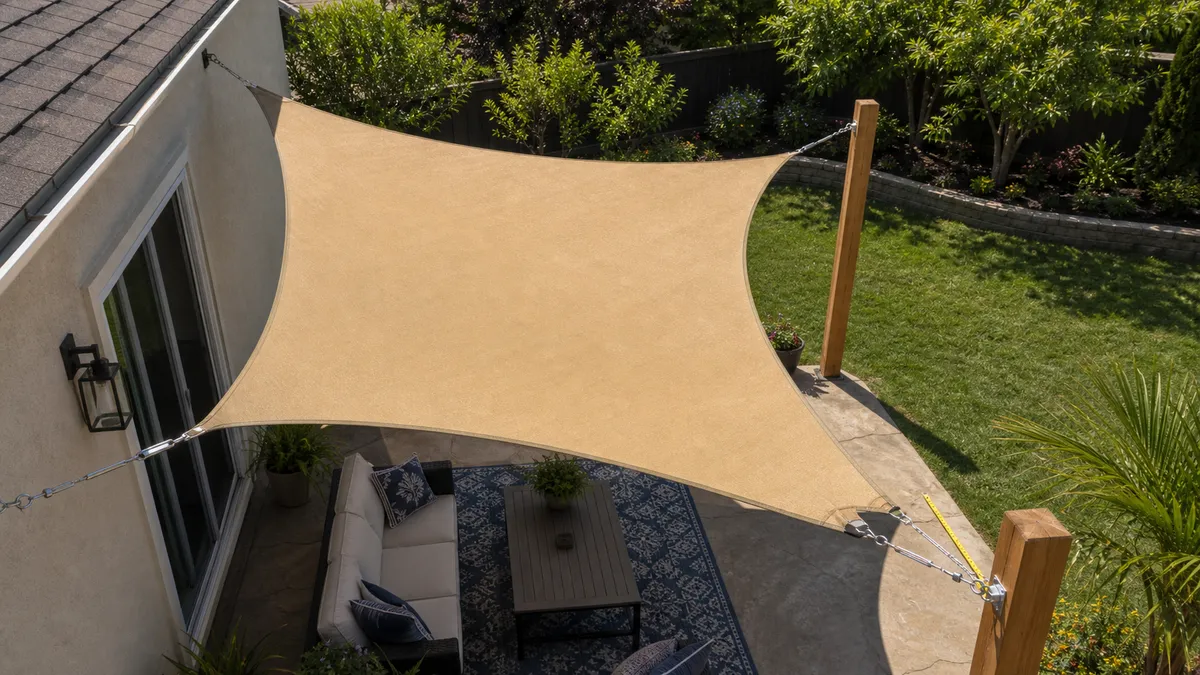
Use this when shade sail size guide is closer to the real constraint than the current page.
Triangle vs Rectangle Shade Sail
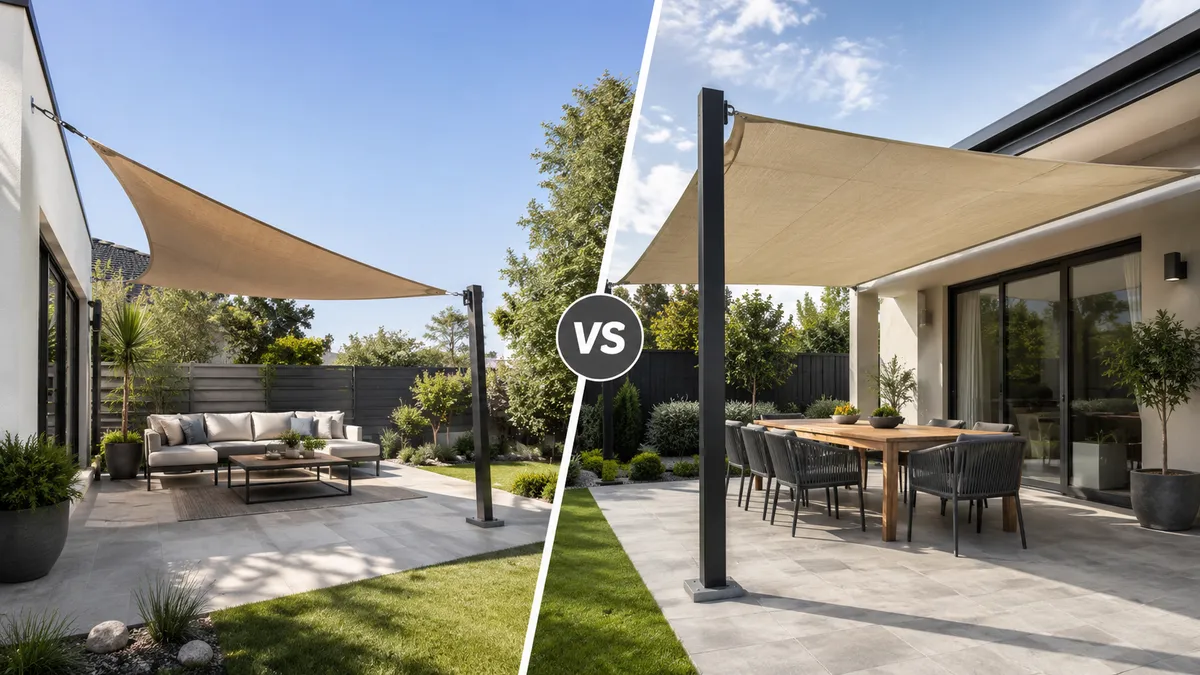
Use this when three usable anchors leave shade gaps near the table, pool edge or walkway, and a four-corner sail may cover the dining area better.
Shade Sail Posts
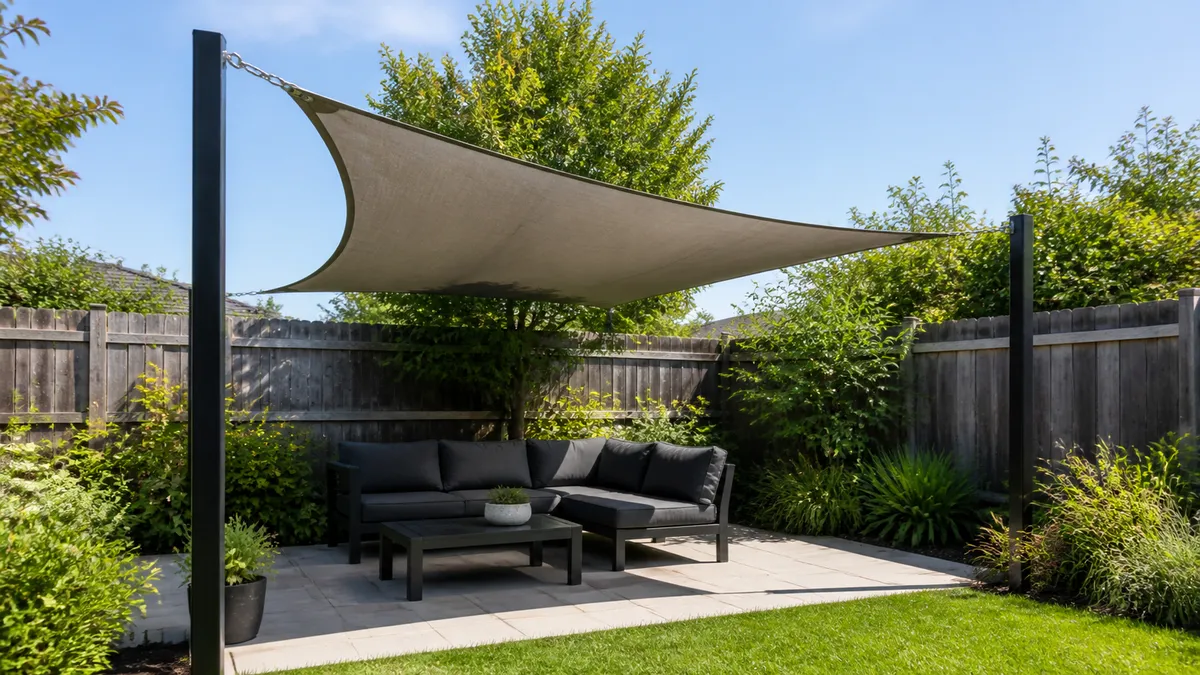
Use this when shade sail posts is closer to the real constraint than the current page.
Questions
FAQ
How much smaller should a shade sail be than the anchor spacing?
It must be smaller by the hardware and tensioning allowance required by the selected sail and fittings. Home Depot gives 10 to 15 inches per side as one example, while other makers use different corner gaps. Use the maker's instructions, not a universal number.
Should I measure wall to wall or fixing eye to fixing eye?
For custom orders, use final fixing-eye measurements when possible. Surface-to-surface measurements can miss the actual load point by several inches. Shade Sails LLC specifically points customers toward fixing-eye measurements and supplier measuring sheets for custom sails.
Why does the triangle result shade less area than a rectangle?
A triangle covers a different shape, not just a smaller version of a rectangle. With similar longest sides, the triangle leaves more open area near one side and often less usable center shade. Use the shape guide if coverage gaps matter more than fitting three anchors.
Can the calculator tell me whether my posts or wall anchors are strong enough?
No. It cannot judge post footing, fascia strength, masonry condition, wall backing, wind exposure or local rules. Coolaroo recommends qualified builder or engineer advice when structural soundness is uncertain. Resolve that before ordering fabric.