
Quick Answer
Quick answer for shade sail sizing
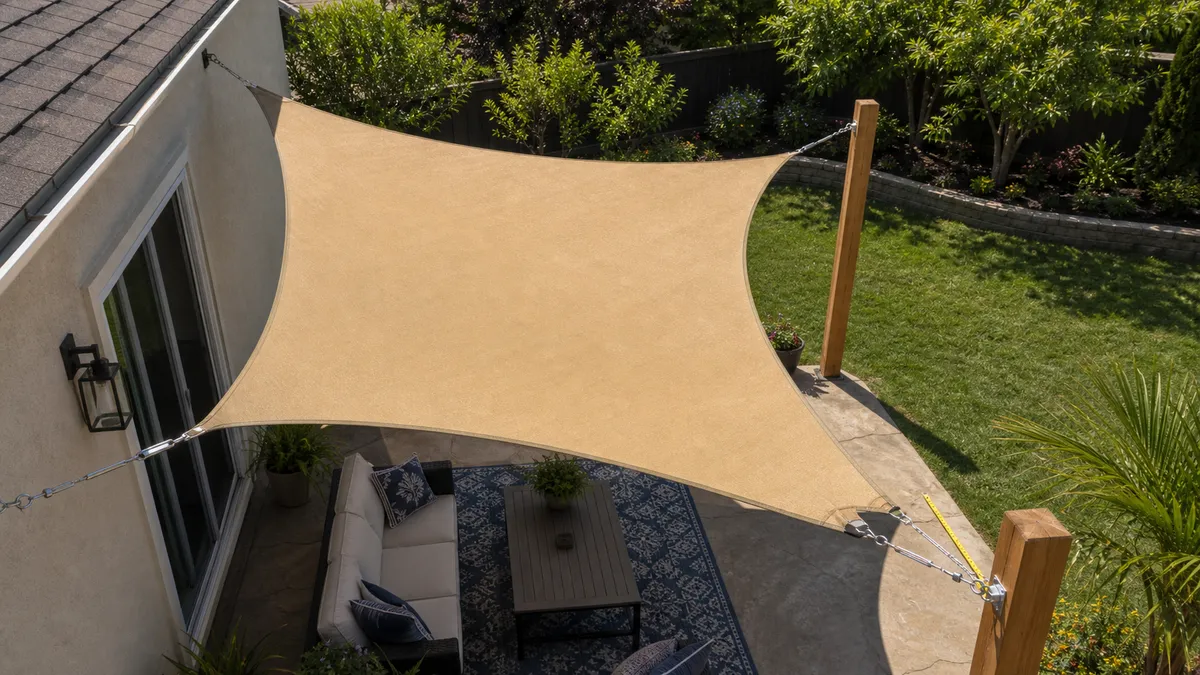
Choose a shade sail size by measuring anchor-to-anchor, then subtracting room for turnbuckles, shackles, snap hooks and tension. A 3x3, 4x4 or 5x5 label is fabric size, not mounting span. Use the calculator when heights, gaps or side lengths are uneven.
Start with anchor span and hardware gap; use common sizes only when every corner keeps tensioning room and a clear runoff slope.
Start here
Choose the measuring path before choosing the sail
Start with the area you need shaded, then test whether the anchor points, hardware gap and shape can actually support that size.
Compact seating or bistro table
A 3x3 shade sail can suit two chairs or a small table only when the anchors sit wider than the fabric and still leave room for corner hardware.
Four-seat dining table
A 4x4 shade sail or modest rectangle gives broader center shade than a triangle, but chair pullback and curved edges still reduce the useful shade.
Long deck or walkway
Use a rectangle when one dimension matters more than total area. Keep low corners, chains and turnbuckles away from doorways and walking lines.
Pool edge or open yard
Pause before sizing up. Open sites need proven anchors, a storm plan and a clear edge where runoff or low hardware will not land in the path.
Corner shade or partial cover
A triangle shade sail needs three anchors and can shade one corner well. It will not cover the middle of a table like a square or rectangle.
Calculator route
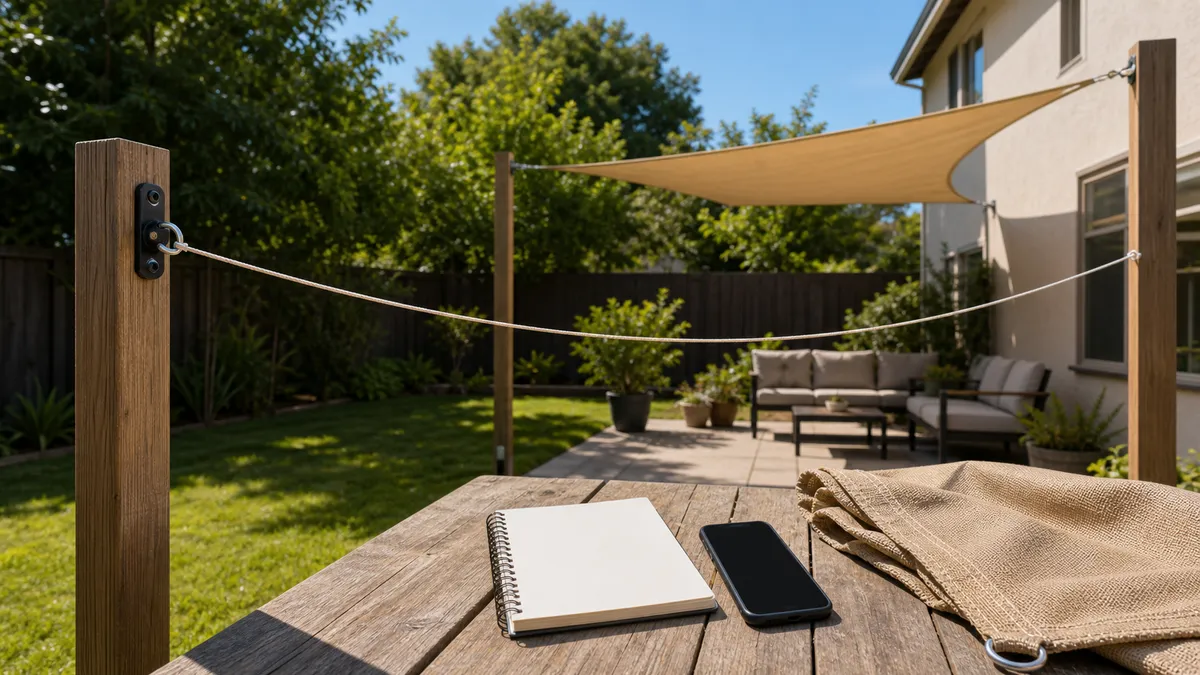
Use the size calculator when side lengths differ, anchor heights vary, two common sizes look close, or the hardware gap is already tight.
Measure anchor-to-anchor, not just the patio
The first measurement is not the patio slab, deck board run or dining table. Measure from fixing point to fixing point. Mississippi State University Extension says to measure before buying and identify one anchor point for each corner. A triangle needs three fixing points; a square or rectangle needs four.
For custom sails, use real fixing points, not guesses. Shade Sails LLC tells customers to measure eye-to-eye from the installed fixing points and warns that measuring wall surface to wall surface can give the wrong sail. That is why a shade sail size guide starts with anchors before it talks about common shade sail sizes.
Four-sided sails need more than four side lengths. Shade Sails LLC asks for diagonal measurements too, because two layouts with equal sides can still pull into different shapes. If the diagonals do not agree with the planned square or rectangle, use the calculator or get the supplier drawing checked before ordering.
Do not flatten the job onto the ground. When one corner is higher for slope, the actual line between anchors changes. A ground-level patio rectangle can look right while the eye-to-eye span above it is longer, shorter or skewed.
- Mark the likely fixing point at each corner before picking fabric.
- Measure eye-to-eye or anchor-to-anchor after the anchor positions are known.
- For four-sided sails, record all sides and both diagonals.
- Recheck the measurement after adding height difference for slope.
Leave room for turnbuckles, shackles and tension
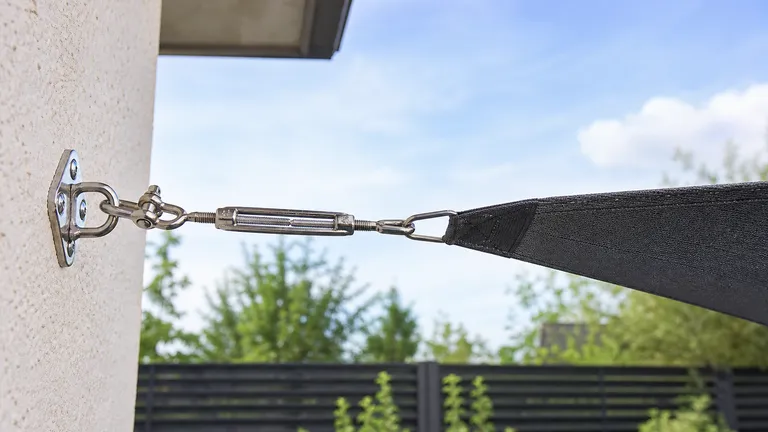
A listed size is the sail, not the mounting span. KGorge describes order size as the finished sail size measured along the edge between corner rings. Tenshon makes the same practical point: relaxed sail dimensions, hardware offset and stretch all have to be allowed before posts or anchors are placed.
Published hardware allowances are not identical, so use them as planning ranges. One Home Depot-hosted installation guide gives 10-15 inches on each side for tensioning hardware such as turnbuckles and snap hooks. Cool-Off gives a percentage example of about 10% of the sail side length between sail corner and mounting point.
For a simple 12 ft anchor-to-anchor side, a 12 ft sail edge is too large if the hardware needs about 1 ft at each end. The fabric would reach the anchors before the turnbuckle has room to pull. In that case, the practical sail edge is closer to 10 ft before the maker's own instructions are applied.
Start turnbuckles with adjustment travel still available. If the hardware starts nearly closed or maxed out, the sail has no useful tuning range after the first stretch, storm removal or seasonal reset.
- Use the sail maker's hardware instructions before ordering custom fabric.
- Treat 10-15 inches per side and about 10% as source examples, not universal rules.
- Downsize or move anchors when the fabric leaves no hardware gap.
Category research
Shade sail size categories to compare
Use category searches after anchor gap, hardware allowance and useful shaded area are measured.
Standard kit
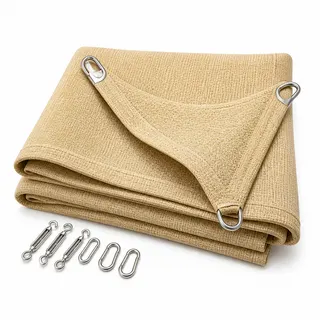
Shade Sail Kit
For common patio sizes after anchor spacing is known.
- Common sizes
- Hardware allowance needed
Check:Actual fixing-point distance.
Search on AmazonCustom
Custom Shade Sail
For nonstandard anchor geometry or exact coverage needs.
- Better fit
- More measuring
Check:Curved edges and hardware gap.
Search on Amazon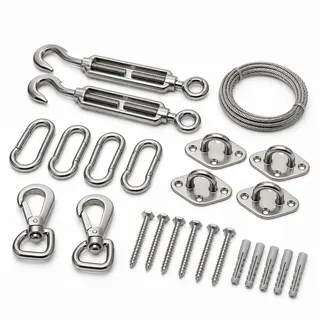
Hardware
Shade Sail Hardware Kit
For sizing the corner gap around turnbuckles and plates.
- Completes sizing
- Not optional
Check:Turnbuckle length and anchor type.
Search on AmazonWhat common 3x3, 4x4 and 5x5 sails actually cover
Common shade sail sizes are useful labels, not shade guarantees. A 3x3 m sail has 9 sq m of nominal fabric, a 4x4 m sail has 16 sq m, and a 5x5 m sail has 25 sq m. Those numbers are only fabric math before hardware gap, concave edge, slope and sun angle reduce the usable shade on the ground.
AMGO notes that shade sails have concave sides and are narrower in the center. That curved edge looks clean under tension, but it cuts into the rectangle you may have imagined. A dining chair near the edge can still sit in sun even when the listed sail size sounds large enough.
For patios, start smaller and more exact before buying the biggest fabric that seems to fit. A 3x3 shade sail can work over compact seating. A 4x4 shade sail may cover a small dining table if the anchors sit wide enough and chair pullback stays shaded. A 5x5 shade sail needs more confidence in posts, slope, wind exposure and removal.
For a pool edge or open deck, useful shade is not just area. Keep the shadow off slippery pinch points, leave head clearance at the low corner, and avoid putting hardware where people walk, climb steps or carry towels and food.
Common sizes
Common shade sail sizes and realistic uses
Use this as a first screen. Final sizing still depends on anchor-to-anchor span, hardware gap, edge curve, slope and sun direction.
| Listed size | Nominal fabric area | Good fit | Do not use it when |
|---|---|---|---|
| 3x3 m / about 10x10 ft | 9 sq m before gaps and edge loss | Compact seating, bistro table, small deck corner or partial pool-side shade. | You expect it to shade a full 3x3 m seating or dining area after curved edges and sun shift. |
| 4x4 m / about 13x13 ft | 16 sq m before gaps and edge loss | Four-seat dining, small lounge set or square patio when anchors sit outside the furniture line. | Chair pullback sits under the concave edge or the hardware gap is already tight. |
| 5x5 m / about 16x16 ft | 25 sq m before gaps and edge loss | Larger patio, pool-side rest area or open yard only after anchors, slope and wind exposure are checked. | You are sizing up to compensate for weak placement, no runoff slope or questionable posts. |
| 3x4 m or 4x5 m rectangle | 12-20 sq m before gaps and edge loss | Long dining table, narrow deck, walkway edge or rectangular seating area. | The diagonals are not checked or one long side would need loose rope or chain to reach. |
Shape changes the size answer
A triangle shade sail can be the right size when the real job is corner shade. It uses three anchors and can work over two chairs, a lounge corner or a small patch near a pool. It is the wrong shortcut when the goal is broad center shade over a dining table.
A square shade sail or rectangle shade sail usually gives more usable center coverage, but it asks more from the site. Four anchors must be measured, diagonals need checking, and the high-low corner plan must give water somewhere to run. Home Depot's guide points triangles toward smaller areas and square or rectangular sails toward larger coverage.
Do not choose shape by fabric area alone. A triangle with a similar longest side can leave a large uncovered wedge. A rectangle can look perfect on paper, then fail when one diagonal is too short or one low corner blocks a door.
Use the full triangle-versus-rectangle guide when the shape itself is still undecided. This page should get you to a plausible size range; the shape guide handles the coverage tradeoff in more depth.
- Choose a triangle for partial shade when three reliable anchors match the shaded corner.
- Choose a square or rectangle when center coverage matters and four anchors are realistic.
- Check diagonals before assuming a four-sided sail will pull square.
Stop before buying
Signs the sail is too large for the anchors
A larger sail will not fix poor anchor placement. If one of these checks fails, change the anchor plan, reduce the fabric size, use the calculator or read the installation guide before ordering.
- No corner gap remains for turnbuckles, shackles or snap hooks.
- Turnbuckles would start nearly closed, maxed out or out of adjustment travel.
- Two or more corners need long rope, chain or cable leaders to make the sail reach.
- The side lengths seem to fit, but the diagonals show a twisted four-sided layout.
- A waterproof or rain-exposed sail would sit flat with no clear runoff edge.
- The only anchors are fascia, trim, light fence posts, railings, trees or unknown masonry.
- The site is open, windy or storm-exposed and the sail cannot come down quickly.
Sag, slope and a sail that is too large
Sag often starts before the sail is installed. If the fabric is almost the same size as the anchor spacing, the hardware cannot pull the edge tight. Mississippi State University Extension says to tighten until there is no slack; Home Depot warns that flapping can damage the sail. Both points assume the hardware still has room to work.
Slope changes sizing too. Shade Sails LLC warns against measuring from ground level because slope changes the real dimensions. Cool-Off gives about 1 ft of fall for every 10 ft of attachment distance to help runoff and reduce pooling. Treat that as one planning example and follow the manual for the sail you buy.
Waterproof and rain-exposed sails need extra restraint. A flat waterproof sail can hold water, stretch corners and make a too-large sail look even looser. If you cannot say where runoff exits, do not buy the larger size yet.
Long leaders are not a normal sizing fix. Shade Sails LLC warns that extending two or more corners with cable, rope or chain can add movement in wind and shock loads. Move the anchor, choose a smaller sail or get the layout checked instead.
- Use the installation guide for posts, wall anchors, slope and tensioning sequence.
- Do not attach to fascia, trim, light fence posts or unknown masonry as a shortcut.
- Keep grills, fire pits and heaters out from under or near fabric unless manuals and local rules allow it.
When to use the size calculator instead
Use this guide when the site is simple and a common size is clearly smaller than the anchor span. Use the shade sail size calculator when the answer needs numbers across several measurements. The calculator is better for uneven spans, different anchor heights, tight hardware gaps, sun-direction checks and close calls between two standard sizes.
The calculator does not approve the structure. It estimates fabric inside the fixing points. You still need to confirm that each post, wall plate, masonry anchor or bracket can carry the load and that the sail maker's measuring sheet agrees with the result.
If you are asking, what size shade sail do I need, and two sizes both look possible, run both through the calculator. Compare the remaining hardware gap and useful shade, not only nominal square metres. A smaller sail that tensions cleanly is usually better than a bigger sail that starts with no adjustment room.
Stop sizing and switch guides when the hard question is structural, windy or installation-specific. Posts, walls, slope, storm removal and hardware choice belong in the installation guide or with qualified help, not in a simple size table.
- Use the calculator for uneven side lengths or different anchor heights.
- Use the calculator when a standard 3x3, 4x4 or 5x5 sail almost fits but leaves little gap.
- Use the installation guide when anchor strength, wind exposure, slope or hardware controls the decision.
Next checks
Use the right next guide when sizing gets complicated
Move to the narrower guide when the question is no longer a simple fabric-size choice.
Estimate uneven or tight spans
Use the calculator when side lengths, corner heights or hardware gaps need a numeric planning estimate.
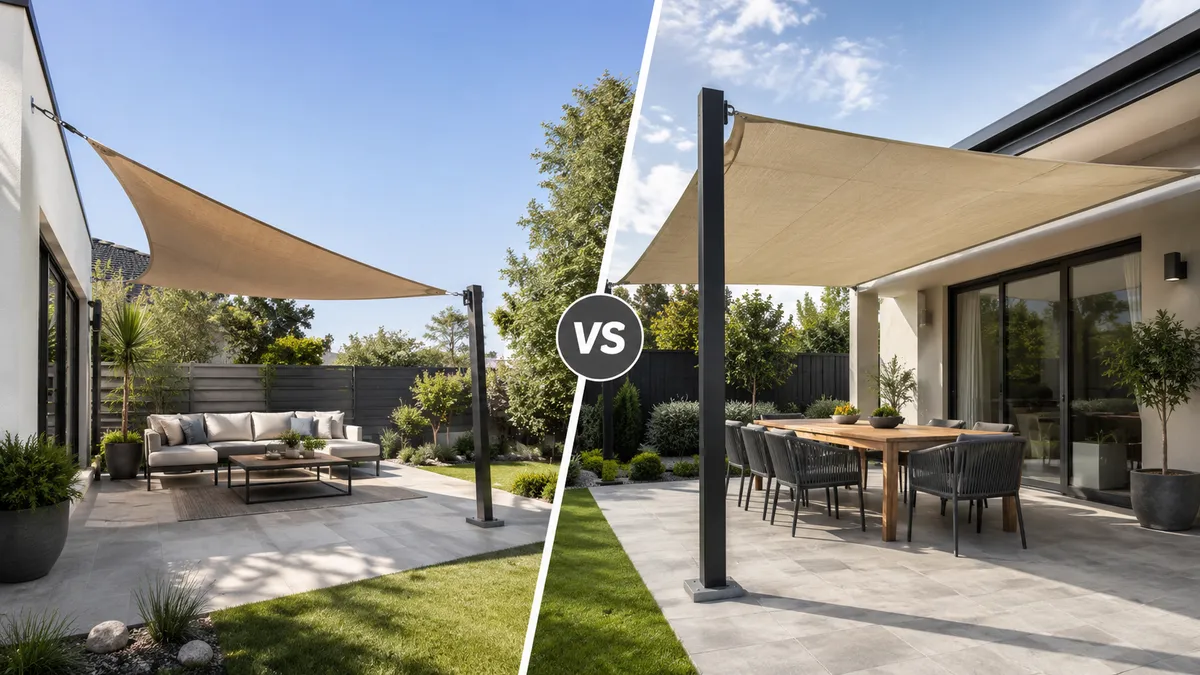
Compare triangle and rectangle coverage
Use the shape guide when three anchors, four anchors, center shade or edge gaps decide the sail.
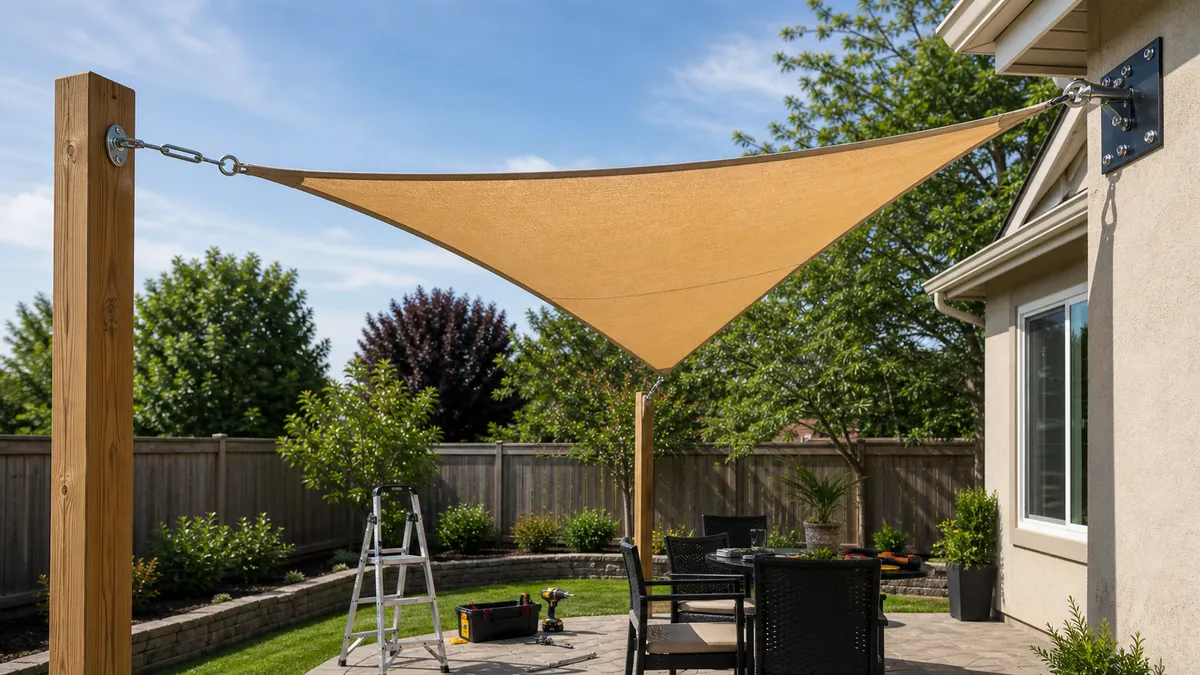
Check anchors, slope and tension
Use the installation guide when posts, wall plates, fascia risk, runoff or storm removal controls the answer.
Watch-outs
Before you buy or install
- Do not buy a sail that leaves no room for turnbuckles or shackles.
- Do not use long leaders on multiple corners to rescue an oversized sail.
- Do not treat fascia, trim, light fence posts, railings, trees or unknown masonry as proven anchors.
- Do not install a flat waterproof sail until runoff and slope are solved.
Read Next
Related ideas
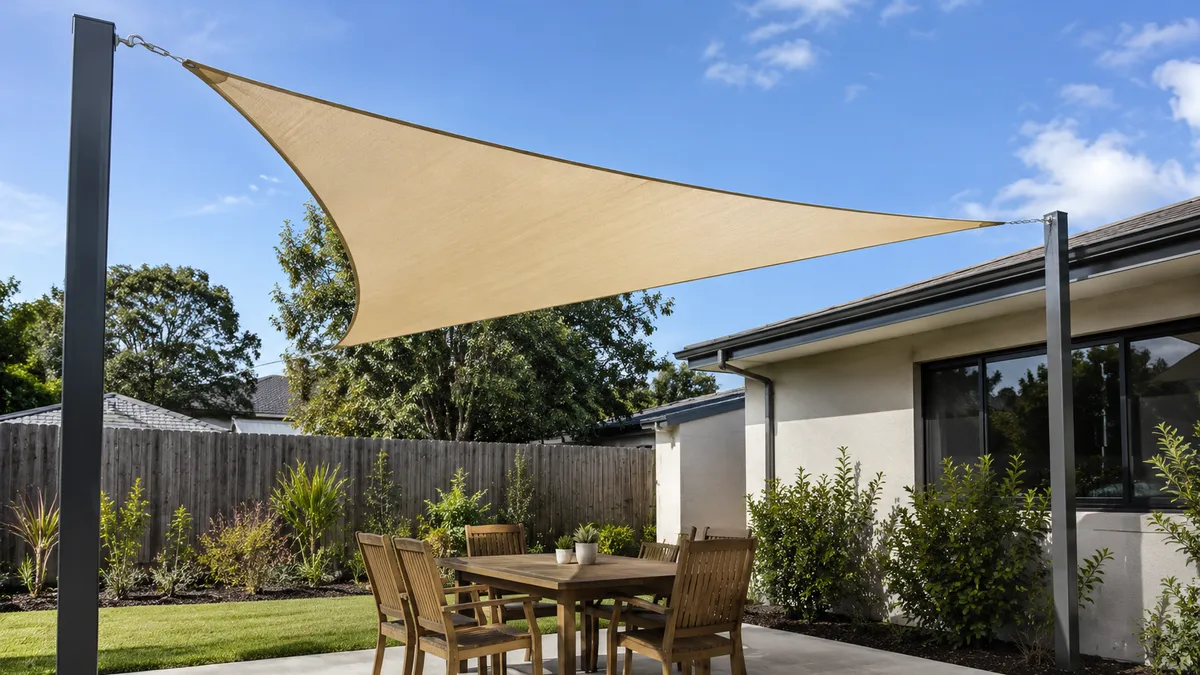
Shade Sail Guide
Use this when shade sail is closer to the real constraint than the current page.
Shade Sail Size Calculator
Use this when shade sail size calculator is closer to the real constraint than the current page.
Triangle vs Rectangle Shade Sail
Use this when triangle vs rectangle shade sail is closer to the real constraint than the current page.
Shade Sail Installation Guide
Use this when shade sail installation is closer to the real constraint than the current page.
Questions
FAQ
Should a shade sail be the same size as the space between anchors?
No. The sail is usually smaller than the anchor-to-anchor space because turnbuckles, shackles, snap hooks and tensioning room sit between the fabric corner and the fixing point. If the sail edge equals the anchor span, there may be no room left to tighten it.
How much smaller should a shade sail be than the anchor span?
Use the maker's instructions first. As planning examples, one Home Depot-hosted guide gives 10-15 inches per side for hardware, while Cool-Off uses about 10% of side length. Tight or uneven spans should go through the size calculator before ordering.
Is a 3x3, 4x4 or 5x5 shade sail better for a patio?
A 3x3 shade sail suits compact seating or a small corner. A 4x4 shade sail can fit a dining area if anchors sit outside the chair line. A 5x5 shade sail needs stronger anchors, slope, wind planning and enough space for hardware.
Why does my shade sail cover less area than its listed size?
The listed size is fabric size, not guaranteed ground shade. Hardware gap, concave edges, curved edges, slope and sun angle all reduce usable shade. A square sail can leave sunny strips near chairs or pool edges even when the corner measurements look wide.
When should I use the shade sail size calculator?
Use the calculator when side lengths differ, anchors are at different heights, the hardware gap is tight, two common sizes look close, or a custom sail may be needed. It gives a planning estimate, then the supplier's measuring sheet still decides the final order.