
Quick Answer
Quick answer for sidewall awnings
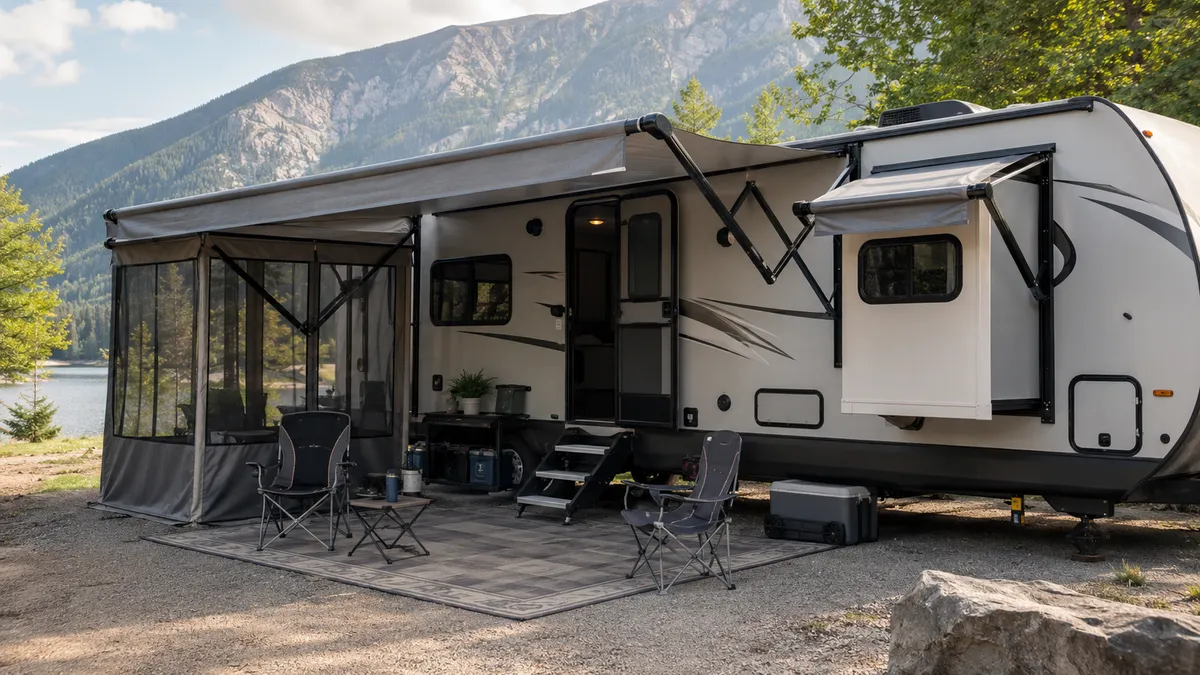
Use this hub to choose the next path before buying a full patio awning, replacement fabric, shade screen, privacy panel or slide-out topper. First check the awning rail, support arms, roller tube, fabric size, door and slide clearance, manual or electric operation, and whether the awning can retract before high wind or heavy rain.
Start with the existing awning parts: keep sound arms and rail, replace only worn fabric when the hardware is solid, and move to service or a different shade setup when wind routine, wall condition, wiring or campsite clearance is not solved.
Choose First
Choose the campsite awning route first
Start with the actual RV problem: main patio shade, low-sun screening, privacy, fabric wear, powered operation, slide-room protection or a broader vehicle setup.
Main RV patio awning
Start here when the wall-mounted awning is missing, worn out or no longer shades the campsite patio.
Stay on this page for types, sizes, cost ranges, fabric checks and service triggers before shopping.
Best when:The question is the main campsite shade beside a motorhome, trailer or fifth wheel.
Check first:Awning rail condition, support arms, roller tube, pitch arms, door clearance and how fast it retracts.
Shade screen
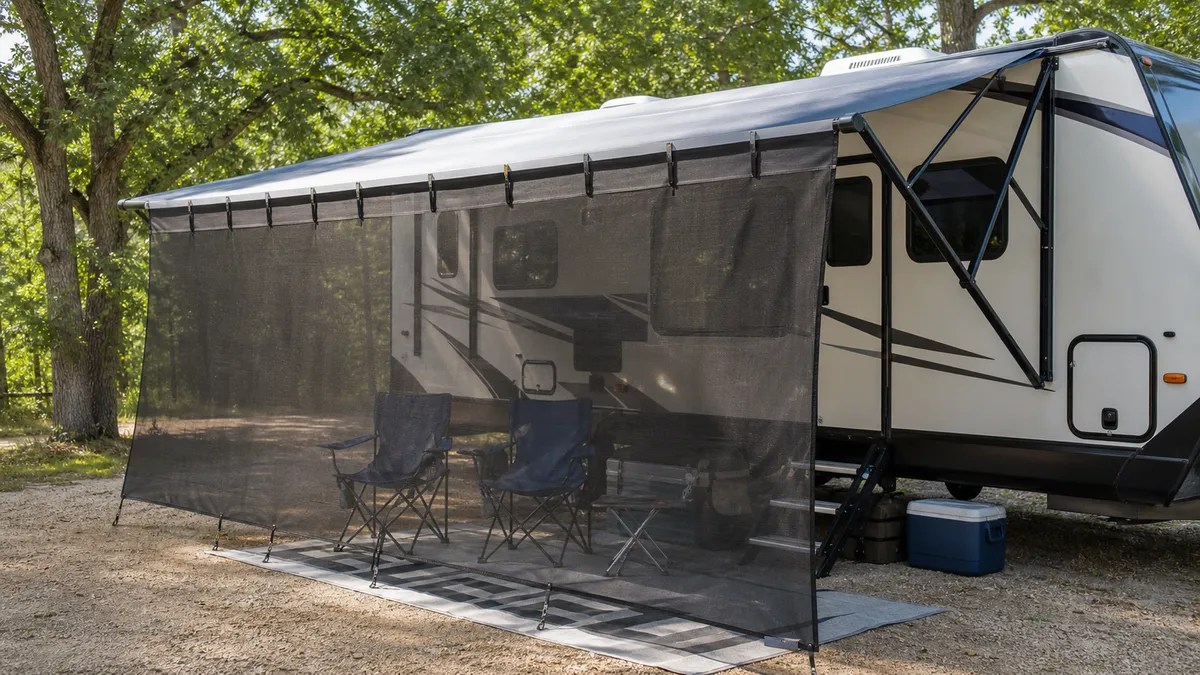
Use a drop shade when the patio awning is sound but low sun, glare or heat still reaches the chairs.
The dedicated guide goes deeper on mesh, front panels, side panels, size and wind trade-offs.
Best when:The existing patio awning works, but the sun comes under the front edge.
Check first:Fabric width, awning height when fully projected, tie-outs and exposed wind.
Watch out:A screen adds sail area to the awning and should come down before gusts.
Read the shade-screen guideRV privacy screen
Use this route when the problem is neighbor sightlines, campsite spacing or a more private patio zone.
Treat privacy as a campsite-boundary and wind question, not just a darker mesh purchase.
Best when:The awning already shades well, but visibility from the front or side is the issue.
Check first:Front panel versus side panel, tie-outs, walking paths, neighbor space and campground rules.
Watch out:Skip panels that cross the site line, create trip hazards or pull on the awning in wind.
Replacement fabric and maintenance
Start here when the vinyl or acrylic fabric is torn, stained, loose or rolling unevenly.
Fabric replacement is reasonable only when the rail, arms, brackets and roller tube are still sound.
Best when:The fabric is the worn part and the hardware still opens, supports and retracts correctly.
Check first:Arm-center measurement, fabric retention, roller alignment, ladder access and spring or tube handling.
Manual vs electric operation
Start here when you are comparing pull-strap/manual operation, 12V power, remote, switch, wind sensor or manual override.
Keep the decision at operation level; wiring faults and motor failure belong in the manual or RV service lane.
Best when:Convenience, reach, motor parts or manual backup are driving the purchase.
Check first:Battery power, switch location, manual override access, motor condition and travel-lock behavior.
Slide-out topper
Use this route when the question is a cover over a slide room, not campsite patio shade.
A slide-out topper moves with the slide-out, needs its own clearance checks and should not be allowed to collect dirt, leaves or debris.
Best when:Leaves, debris or water on the slide room are the problem.
Check first:Slide-room measurement, fabric condition, anti-billow behavior and the slide manufacturer's instructions.
Watch out:Do not size or judge a slide topper like the main patio awning.
Broader vehicle awning
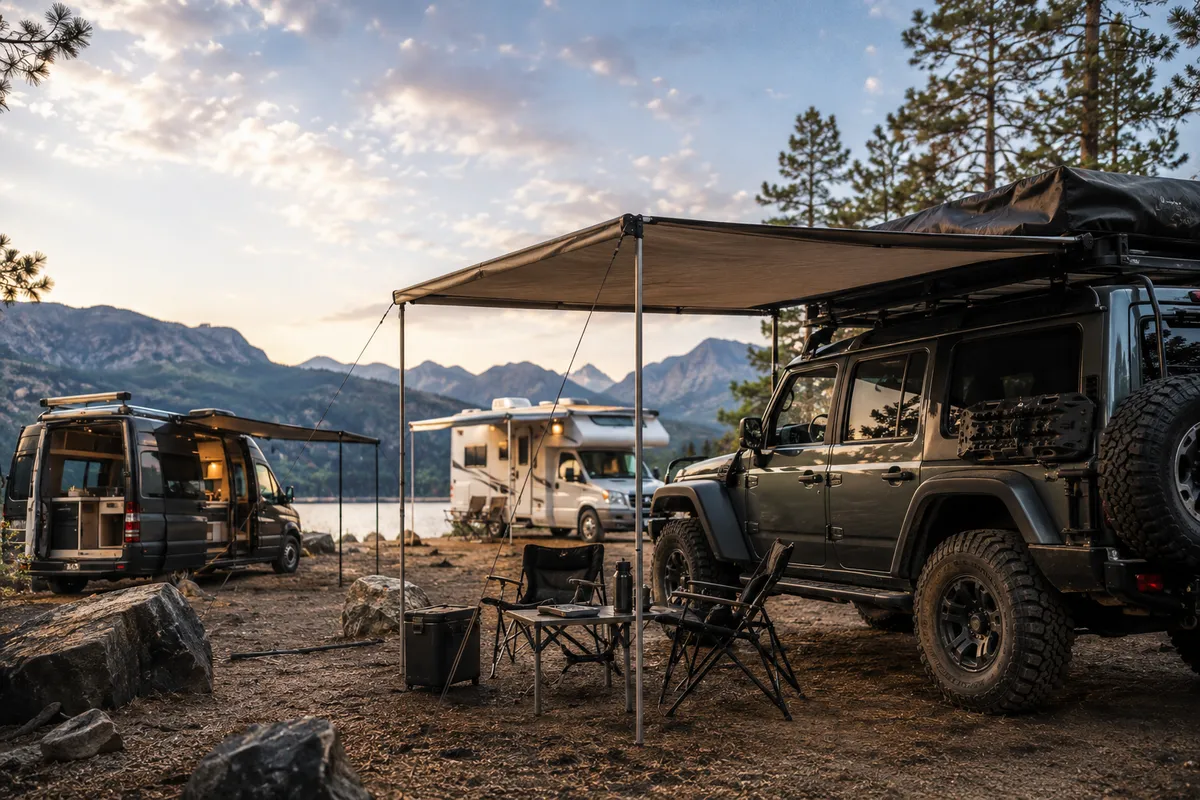
Use the broader vehicle hub when the shade is not a factory-style RV patio awning on a sidewall rail.
Those pages cover vehicle-mounted cases and travel hardware; they do not replace RV awning rail, arm, roller tube and clearance checks.
Best when:The shade mounts somewhere other than a factory-style RV sidewall rail.
Check first:Vehicle type, mount style, door or hatch clearance and how the shade packs for travel.
Compare broader vehicle awningsTypes and operation basics
The phrase usually means the main patio awning on the curb side of the RV, but the family is wider than that. Lippert's awning support library separates manual pull-strap awnings, 12V power awnings, hybrid units, wind-sensor power models, accessories, slide toppers and window awnings. Carefree's Freedom manual also treats patio, window and over-door awnings as related but separate products.
The main patio awning is the campsite shade. It uses an awning rail, support arms, a roller tube, fabric, pitch arms and either manual or powered operation. A manual unit is simpler and avoids motor parts, but it still needs correct latch, spring and travel behavior. A powered unit adds a motor, switch or remote, sometimes a wind sensor, and a manual override procedure for power loss or motor failure.
Keep slide-out toppers in a different lane. Dometic's Slide Topper manual treats the topper as slide-room hardware that opens and closes automatically with the slide-out, needs adequate clearance and should not be allowed to collect dirt, leaves or other debris. That is not the same job as a patio awning that shades chairs, a mat and the door area. Window and over-door awnings are also smaller shade or rain-control pieces, not replacements for the main patio awning.
- Patio/main awning: campsite shade from the RV sidewall.
- Manual or electric: how the same broad patio awning opens, closes and backs up during power loss.
- Slide-out topper: slide-room cover, not a patio shade room.
- Window or door awning: local shade or drip control for one opening.
Size, fabric and clearance measurements
Do not treat the advertised awning size as the shaded campsite width. The arms, roller tube, pitch, sun angle and screen drop all change the usable shade. Start with the RV parts: awning rail, support arms, roller tube, door swing, windows, slide rooms, storage doors, lights and the walking path under the fabric.
For Solera replacement fabric, Lippert QR-113 says to measure between the horizontal centers of the two support arm assemblies. If that arm-center measurement is 10 feet, the quick reference says to order 10-foot replacement fabric. The same Lippert sheet warns that the fabric received is shorter than the ordered awning size; one example lists a 10-foot ordered size with fabric measuring 9 feet 2 inches. It also lists one-foot sizing increments from 10 to 21 feet.
Screen fit is its own measurement. Lippert's Solera shade-panel instructions say to measure the awning fabric width and the awning height when fully projected, then choose the smaller size when between offered screen sizes. A front panel that is too wide, too tall or poorly tied out can pull on the roll tube or arms instead of hanging cleanly.
- Replacement fabric: use the manufacturer measurement method, not only the old fabric width.
- Projection and drop: check how far the fabric reaches and how low the front edge or screen hangs.
- Clearance: confirm doors, windows, slide rooms, lights and storage doors before ordering fabric or panels.
- Patio space: leave room for tie-outs, stakes, chairs and the walking path beside the RV.
Fit Checks
What to measure before buying
Use the exact product manual when ordering. These checks keep the common RV parts separate.
| Part or accessory | Measure or inspect | Why it matters |
|---|---|---|
| Replacement fabric | Arm-center measurement between support arm assemblies, then manufacturer size chart | Ordered awning size can be wider than the fabric you receive |
| Main patio awning | Awning rail, support arms, roller tube, pitch arms and door or slide clearance | A wider awning is not useful if it blocks openings or cannot pitch and retract cleanly |
| Shade screen or front panel | Fabric width and awning height when fully projected | The screen has to hang and tie out without overloading the arms in wind |
| Slide-out topper | Slide-room dimensions and the slide topper manual | A topper follows the slide room; it is not sized like a campsite patio awning |
Cost ranges and when fabric replacement is enough
Use cost ranges as scoping numbers, not quotes for a specific RV. HomeGuide's 2026 cost guide gives an average replacement range of $250 to $2,500. It separates fabric-only replacement at about $150 to $750, installation labor at about $100 to $500, parts-only full assemblies at about $500 to $2,500, and installed full-assembly totals that can reach about $1,000 to $3,000.
Fabric-only replacement is the honest path when the support arms, brackets, roller tube, motor or manual hardware, and awning rail are sound. It is not the honest path when bent arms, loose brackets, a damaged rail, a broken roller tube, motor failure or severe fabric misalignment are already visible. HomeGuide flags roller tube, arms, brackets and motor damage as reasons a larger repair or full assembly replacement may be needed.
Manual and powered awnings price differently. HomeGuide lists installed manual patio awnings around $650 to $1,600 and power patio awnings around $1,000 to $3,000, with powered models often 30% to 50% more than manual. It also lists slide-out toppers around $250 to $700, window awnings around $200 to $600 and door awnings around $200 to $500. Those smaller products solve different jobs, so a cheaper slide topper is not a cheaper patio awning.
Cost Ranges
Cost ranges to scope the project
Ranges are from HomeGuide's 2026 cost guide and should be checked against local labor and the exact RV model.
| Item | Typical range | Use the range this way |
|---|---|---|
| Fabric-only replacement | $150-$750 | Reasonable when the arms, rail, brackets and roller tube are still sound |
| Installation labor | $100-$500 | Budget for ladder work, fabric handling and correct alignment |
| Full awning assembly | $500-$2,500 parts; installed totals up to $1,000-$3,000 | Use when hardware, motor, brackets or tube damage makes fabric-only work false economy |
| Manual patio awning | $650-$1,600 installed | Simpler operation, fewer electrical parts |
| Power patio awning | $1,000-$3,000 installed | Convenient for daily use, but motor, switch, sensor and override issues add service questions |
| Slide-out, window or door awning | Slide topper $250-$700; window $200-$600; door $200-$500 | Use only for the smaller opening or slide-room job, not as a main patio-awning substitute |
Materials, screens and accessory specs
Awning fabric language is usually about vinyl, acrylic or woven acrylic, and sometimes polyester or vinyl-coated fabric. Do not buy from the material word alone. Check the awning brand, model, roller tube, polycord or fabric attachment, seam style, color, size and the manual's compatibility notes. Lippert's Solera brand page gives one concrete example: 13.5 oz vinyl replacement fabric with heat-welded seams and cold-crack testing to minus 25 degrees Fahrenheit.
Shade screens and privacy panels add another material layer. Lippert's Solera Classic Shade Front Panel example is a 6-foot-high screen offered in widths such as 8, 10, 13, 15, 17 and 19 feet, with stakes, tie-outs and storage included. Front panels help with low sun and glare under the awning edge. Side panels can help with angle and privacy, but they also change airflow and the space you occupy at the campsite.
Accessories can help only within the awning's limits. Support legs, deflapper-style accessories, straps and tie-outs may reduce movement in light conditions, but they do not turn a fabric awning into a storm shelter. Carefree says vertical support legs can add stability and adjust lead-rail height, while also warning that they do not compensate for harsh wind or heavy rain.
- Fabric: verify vinyl, acrylic or woven fabric against the exact awning model and roller tube.
- Mesh: choose a front or side screen by sun angle, privacy need and tie-out space.
- Hardware: check arms, pitch arms, brackets, fasteners and drive head before adding accessories.
- Compatibility: trust the product manual or brand fit list, not a broad universal claim.
Installation, service and maintenance requirements
These awnings are sidewall hardware, not loose patio fabric. The awning rail, sidewall, support arms, arm brackets, backing, roller tube, pitch arms, drive head, motor, fasteners and fabric/polycord all have to work together. If the rail is loose, the sidewall is soft, arms are bent, brackets move, fasteners are missing, the roller tube is damaged or the powered unit will not operate normally, stop shopping for screens and get the hardware checked first.
Fabric replacement and inspection often involve ladders, roller tube handling and tensioned parts. CDC/NIOSH ladder safety guidance points to poor ladder angle, wrong ladder selection, poor inspection, overreaching, carrying objects and excessive force as common fall causes. It also describes about a 75-degree extension-ladder angle and proper size and duty rating as stability basics. Use that as a caution, not as a substitute for the awning manual.
Maintenance is simple but not optional. Lippert says wet fabric should be extended and dried as soon as conditions allow, and vinyl or woven acrylic fabric can be cleaned with mild dish soap and water. Carefree also recommends periodic fastener checks, keeping fabric and arms clean, hosing fabric monthly where practical, and letting fabric air-dry before rolling. Harsh cleaners, oil, abrasive scrubbing and storage while wet can shorten fabric life.
- Dry before rolling after rain whenever conditions allow.
- Use mild soap and water unless the model manual allows something else.
- Check fasteners, support arms, brackets, fabric alignment and roller behavior periodically.
- Use RV service for wiring, motor faults, manual override failure, damaged rail, bent arms or spring/tension work.
Wind, rain and when not to choose a new awning or add-on
Do not solve a wind problem by adding more fabric. Lippert warns to retract completely during high wind, heavy rain or extended time away from the RV. Carefree also warns that wind and rain effects are unpredictable and says to retract if wind or extended rain is expected or when leaving the RV unattended for a length of time. A wind sensor, support leg, tie-down or privacy screen is not permission to ignore those warnings.
Rain needs pitch, drainage and judgment. Lippert's power-awning manual describes adjustable pitch and rain-dump behavior, but it also says water, snow or debris on the fabric should be removed carefully with a long-handled tool that will not puncture the fabric before adjusting pitch. If the awning is sagging, pooling water, rolling unevenly or pulling loose from the rail or roller tube, retract when safe and inspect before using it again.
Choose something else when the RV or campsite makes add-ons wrong. Repair the awning rail, support arms or motor before buying a shade screen. Replace fabric only when the hardware is sound. Use freestanding shade if campground spacing, sidewall condition or rental rules make wall-mounted add-ons a poor fit. Skip privacy screens that cross site boundaries, block neighbors or create trip hazards; the National Park Service's camping etiquette guidance asks campers to respect personal space and avoid encroaching on another site.
Keep heat and flame away from the awning zone. Carefree states awning fabric is not fireproof and should be kept away from heat and flame sources. That includes grills, fire rings, heaters, exhaust outlets and anything that can push heat into a screen or hanging panel. Shade the seating area; do not turn the awning into a cooking canopy unless the appliance manual and clearances make that specific setup acceptable.
- Retract before high wind, heavy rain, storms and long periods away from the RV.
- Remove shade screens, privacy panels and tie-outs when gusts make the awning pull or flap.
- Repair loose rail, bent arms, damaged brackets or motor faults before adding accessories.
- Use freestanding shade when the RV sidewall, campsite space or neighbor boundary makes panels a bad fit.
Watch-outs
Before you buy or install
- Do not leave an RV patio awning deployed in high wind, heavy rain, storms or extended time away.
- Do not attempt powered-awning wiring, motor repair or manual override work beyond the exact model manual.
- Do not treat a shade screen, privacy screen, support leg or tie-down as a wind-rating upgrade.
- Keep awning fabric, screens and hanging panels away from grills, fire rings, heaters, exhaust and flame.
Read Next
Related hub
Vehicle Awning Guide
Use this when vehicle awning is closer to the real constraint than the current page.
RV Awning Shade Screen
Use this when rv awning shade screen is closer to the real constraint than the current page.
Patio Awning Guide
Use this when patio awning is closer to the real constraint than the current page.
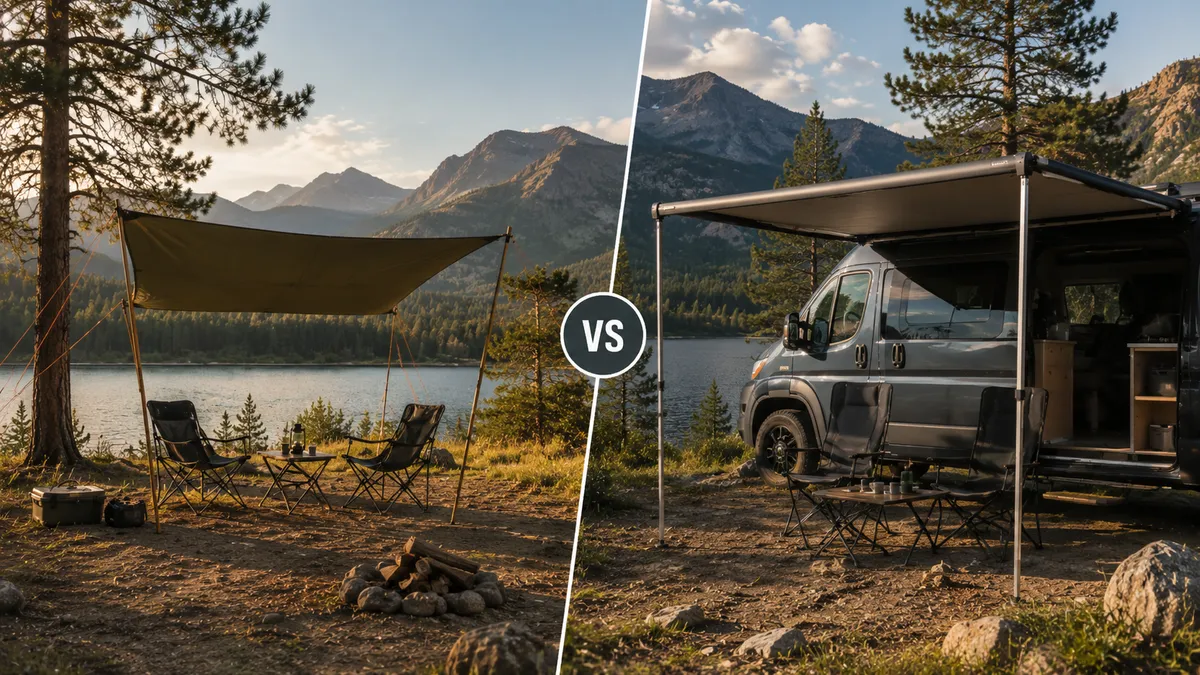
Camping Tarp vs Awning
Use this when camping tarp vs awning is closer to the real constraint than the current page.
Questions
FAQ
How do I know what size replacement fabric I need?
Use the awning manufacturer's method. For Solera replacement fabric, Lippert QR-113 says to measure between the horizontal centers of the support arm assemblies and order by awning size. The fabric you receive can be shorter than the ordered size, so do not measure only the old fabric edge.
Is a shade screen the same as a privacy screen?
They overlap, but the job is different. A shade screen or front panel mainly cuts low sun and glare below the awning edge. A privacy screen adds sightline control from the front or side. Both need correct width, tie-outs, campsite space and removal before wind.
Should I replace the fabric or the whole awning?
Replace fabric only when the awning rail, support arms, brackets, roller tube, motor or manual hardware are sound. HomeGuide lists fabric-only work around $150-$750, but flags damaged arms, brackets, roller tube or motor as reasons a larger repair or full assembly may be needed.
Are electric models better than manual awnings?
Electric awnings are easier to open and close, especially on larger RVs or daily-use campsites, but they add motor, switch, remote, sensor and manual override questions. HomeGuide says powered patio awnings often cost 30% to 50% more than manual. Do not troubleshoot wiring from a general guide.
Is a slide-out topper the same as an RV patio awning?
No. A slide-out topper covers the slide room and moves with the slide-out. Dometic's Slide Topper manual treats it as slide-room hardware that opens and closes with the room and requires debris and clearance checks. The main patio awning shades the campsite area beside the RV, so sizing and failure checks are different.
When should I retract the awning?
Retract before high wind, heavy rain, storms and longer time away from the RV. Lippert and Carefree both warn against relying on the awning in wind or extended rain. Screens, privacy panels, support legs and tie-outs add parts to manage; they do not remove the retraction rule.