
Quick Answer
Quick answer for high-wind pergolas
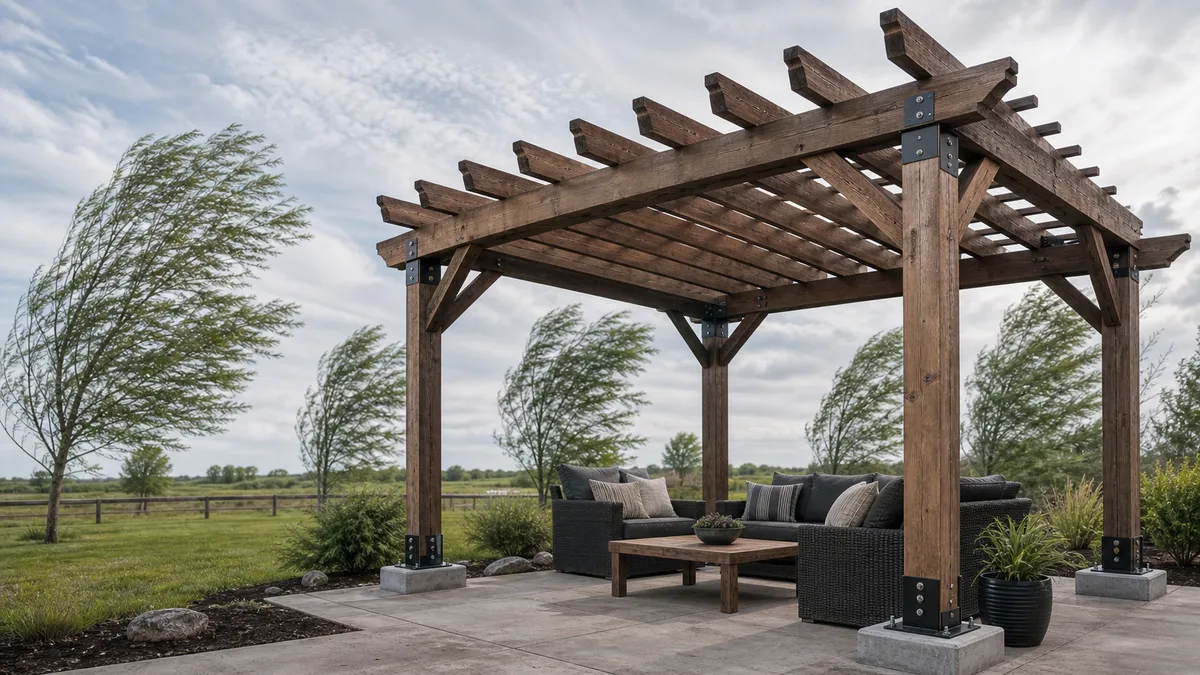
A pergola in a high-wind area usually fails because the site is exposed, the roof or canopy catches gusts, the anchors are weak, or the continuous load path is broken. Inspect posts, footings, anchor bolts, connectors, roof panels, louvers, side screens and the exact manufacturer manual. Stop for exposed, attached, rooftop, deck-mounted, enclosed, undocumented or visibly moving structures.
Use a pergola in a windy yard only when the posts, footings, anchors, roof load, permits and manufacturer manual match the exposed site.
Diagnosis first
Diagnose the wind problem before choosing a pergola
Start with the symptom and the exposure. Do not buy a larger kit, add panels or tighten fabric until you know how wind load reaches the ground or house framing.
| What you see | What it usually points to | Check first | Stop / hire help if |
|---|---|---|---|
| Open field, coastal edge, hilltop, corner lot or wind tunnel between buildings | The site may see stronger gusts than a sheltered backyard | Compare forecast gusts, visible tree movement and local design-wind rules before choosing a kit | The manual or permit drawing does not cover the site exposure |
| Posts sway, beams rack or the frame moves during gusts | The post bases, braces, beam connectors or footings may not be resisting lateral load | Inspect post bases, knee braces, beam-post connectors, anchor bolts and footing condition | Movement repeats after tightening, or a qualified installer has not checked it |
| Base plates lift, anchors loosen, concrete cracks or pavers shift | Uplift is reaching a weak anchor, slab edge, paver base or unknown footing | Confirm anchor embedment, concrete condition, footing size and whether pavers are only a surface layer | The pergola sits on pavers, a thin slab, deck boards or unknown footings |
| Roof panels, polycarbonate sheets, louvers or fasteners rattle | The roof surface is catching gusts or the panel fasteners are not supported for uplift | Read the roof manual, fastener schedule, frame movement notes and permit drawings | Panels have shifted, cracked, lifted or cannot be secured exactly as the manual requires |
| Fabric canopy, shade sail, vines, privacy curtains or side screens pull tight | Extra surface area is turning the pergola into a sail | Remove fabric, open curtains and follow the product-specific storm routine before wind builds | The frame twists, tracks pull loose or fabric has no removal routine |
| Pergola attaches to fascia, trim, weak masonry, a ledger or a manufactured home | The wind load may be entering a structure that was not designed to receive it | Confirm the attachment with the local building department, a contractor or an engineer | The attachment details are missing, improvised or not shown in approved drawings |
| The pergola is on a rooftop, raised deck or upper terrace | Exposure, uplift, deck framing, waterproofing and guard conditions are all higher risk | Pause until someone can review the structure, footings or deck framing | Only deck boards, rail posts, membrane surfaces or small base plates carry the load |
Wind exposure and gusts decide whether a pergola is realistic
Planning a pergola for a high-wind area starts outside, not in a catalog. Stand where the pergola would sit and look for the exposure that creates gusts: open land, a lake or coastal edge, a hill, a corner lot, an upper terrace, or a gap between buildings that funnels wind. A pergola that feels solid in a calm showroom can behave differently when the yard has no shelter.
NOAA's Beaufort land cues help separate comfort wind from structural concern. It describes 25 to 31 mph wind as strong enough that large branches move and umbrellas are difficult to use. It describes 39 to 46 mph as gale wind, and 47 to 54 mph as wind that can cause slight structural damage to lighter structures. Those numbers are not a pergola safety promise; they are a cue to stop treating the problem as ordinary patio discomfort.
Design wind is different from the forecast gust on a weather app. ASCE wind data and local code use site conditions, exposure and adopted rules, not one national wind number. A bare claim that a pergola handles high winds is weak unless it names the exact model, installation, exposure assumptions, anchoring, footing details and code basis.
- Read forecast gusts alongside visible tree movement and past yard damage.
- Treat exposed and elevated sites as higher risk than sheltered ground patios.
- Do not generalize one manufacturer's mph claim to a different frame, roof or footing.
Posts, footings, anchors and connectors carry the wind load
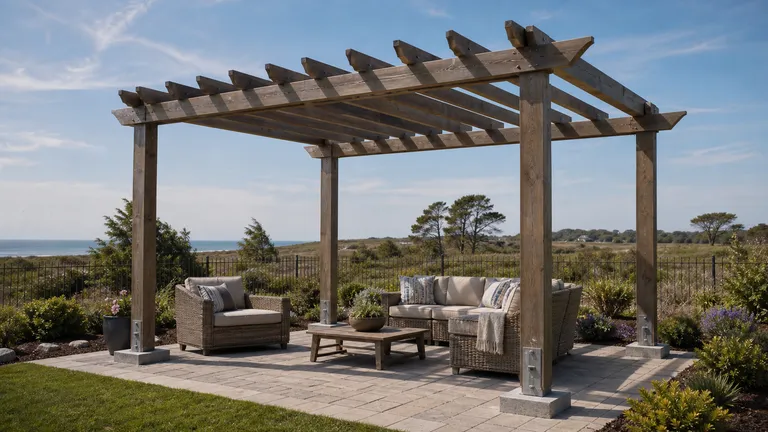
Wind does not only push sideways. It can lift roof panels, pull on fabric, rack the frame and twist connections. FEMA's continuous load path guidance is the useful way to think about a pergola: roof or canopy to rafters, beams, posts, brackets, anchor bolts, footings, slab, deck framing or building wall, then into the ground or host structure.
A weak link can be small. A decorative bracket may look substantial but lack rated capacity. A loose anchor bolt can let a post base work back and forth. A slab edge can crack around an anchor. A deck board can hold a screw while failing to transfer uplift into joists, beams and posts. Pavers are surface units, not proof of a high-wind foundation.
FEMA windstorm guidance warns against relying on improvised fastening for uplift connections in high-wind areas. Simpson Strong-Tie publishes high-wind connector guidance by framing condition and capacity, which reinforces the same point: connectors are chosen for the load and framing, not because a package says heavy duty. For wood pergolas, knee braces and shorter spans can matter, but they do not replace footing and anchor design.
- Inspect the post base, anchor bolt, concrete condition and footing before adding roof area.
- Treat a caisson or footing inspection requirement as a sign that the ground connection matters.
- Do not fix a moving frame by adding more screws to the same weak material.
Attached and freestanding pergolas fail in different ways
An attached pergola is not automatically stronger. It can send uplift and lateral load into a ledger, rim joist, wall framing, masonry, fascia, trim or manufactured home. FEMA guidance for attached roofed structures and manufactured homes is conservative for this reason: added covers can become hazards when they impose loads on a host structure that was not designed for them.
A freestanding pergola is not automatically safer either. It avoids loading the house, but every post still needs a real footing or engineered base, and the frame needs enough bracing to resist racking. A tall freestanding frame on small base plates can move more than a shorter attached cover with a properly designed ledger.
Choose attached only when the attachment is structural and documented. Choose freestanding only when the posts, anchors and footings can carry uplift and lateral load without help from furniture, planters or surface pavers. If either version depends on fascia, thin slab, deck boards or unknown footings, pause before using it in high wind.
- Attached pergolas need verified ledger, wall or masonry support.
- Freestanding pergolas need verified footing, post-base and bracing details.
- Manufactured-home attachments should be handled through approved designs or qualified engineering.
Roof panels, canopies, louvers and side screens can turn shade into a sail
An open-slat pergola usually catches less wind than a solid roof, but open does not mean harmless. The frame can still rack, and any added surface changes the load. Polycarbonate panels, metal roof sheets, closed louvers, shade cloth, vines, curtains, side screens and privacy panels all give gusts more area to grab.
Fabric needs the clearest bad-weather routine. Toja Grid gives one product-specific example: it tells readers to remove its pergola shade sail at 50 km/h / 30 mph winds and in winter. Use that only as evidence that fabric products need a written removal threshold, not as a universal pergola limit. A different canopy, fabric, frame or anchor can require stricter handling.
Louvered roofs need more than a sales claim. Azenco's R-Blade material points to code documents, local permit variation and louvers that rotate up to 90 degrees. Its Miami rooftop example describes engineered high-rise wind conditions and sensors that open louvers so wind can pass through. That kind of wind relief only helps when the frame, controls, power, sensors, maintenance and permit drawings are part of the design.
- Remove or open wind-catching fabric before gusts build, following the exact manual.
- Do not close curtains or screens during storms to protect furniture.
- Treat solid panels and louvered roofs as structural roof surfaces, not accessories.
Ranked fixes
Fixes ranked from simple removal to engineered rebuild
Use the lowest-risk fix that actually matches the failure. Do not use a repair that only hides movement.
| Fix level | First action | Why it helps | Escalate when |
|---|---|---|---|
| Low effort / low cost | Remove canopy fabric, shade sails, side curtains and loose panels before gusts; open louvers only as the manual allows | Less surface area means less uplift and less twisting load on posts and connectors | The frame still moves after fabric and screens are removed |
| Medium effort / moderate cost | Replace missing rated connectors, repair loose post bases, add manufacturer-approved bracing and record anchor details | The repair starts moving load through real hardware instead of loose joints or decorative fittings | The footing, slab, deck framing or wall structure is unknown |
| High effort / high cost | Use an engineered pergola, larger or deeper footings, inspected framing, designed attachment or a permitted louvered roof | Exposed, roofed, tall or attached pergolas need the structure designed as a whole | The local building department, engineer or manual cannot support the proposed installation |
| No permanent pergola | Switch to removable shade, a lower-profile screen or no shade during wind season | Some sites do not give a pergola a safe load path without major structural work | The only way to make the pergola work is to ignore movement, permits or missing documents |
What will not fix a high-wind pergola
Heavier furniture around the posts will not create a footing. Planters can slide, crack pavers or hide movement while the anchor still works loose. Decorative base weights are useful for some temporary shade products, but they are not a substitute for a concrete footing, caisson, engineered deck connection or approved slab anchor.
Extra fabric ties can make the load worse. If a canopy or curtain is pulling hard, tying it tighter may transfer more uplift into weak posts, screws, tracks or fabric seams. Removing the fabric before wind is safer than making a weak frame hold a larger sail.
A larger kit is not a high-wind fix by itself. Pergola Depot lists some engineered Big Kahuna kit claims and concrete anchor details for specific installations, but that does not make every pergola kit equivalent. Use exact documents for the exact model, post size, anchors, footing and roof condition.
Adding a solid roof to an open pergola can create the problem the original frame never had to carry. Roof sheets, polycarbonate and closed louvers can add uplift and fastener loads. If the open frame was not designed for a roof, do not treat panels as a simple shade upgrade.
- Do not bolt post plates to pavers and call the pergola anchored.
- Do not close privacy curtains in storms to protect furniture.
- Do not trust a wind-resistant claim without installation paperwork.
When not to use a pergola in a windy area
Do not use a pergola when the site cannot provide a verified load path. That includes cracked slabs, unknown footing depth, base plates on pavers, deck-board-only mounting, weak masonry, fascia attachment, unsupported rooftop bases, or a house wall that has not been reviewed for the proposed load.
Do not use a pergola when the shade need is seasonal, occasional or mostly comfort-related. A removable canopy, smaller umbrella used only while attended, or lower-profile wind shade may solve the problem with less structural risk. For broader alternatives, read the windy patio shade guide instead of forcing a permanent frame into a bad site.
Do not use a pergola when the roof, side screens or privacy curtains must stay closed in storms. If the shade only works by leaving fabric, louvers or panels in a high-gust position, the routine is wrong. The safer answer may be no permanent overhead shade for that exposed spot.
- Choose removable shade when permanent posts or anchors cannot be verified.
- Skip roof panels if the frame was sold only as an open pergola.
- Treat visible sway, lifted bases or cracked concrete as stop-use triggers.
Permits, inspections and engineer triggers
Permit rules vary by location, so do not assume pergolas are exempt. The City of Robins brochure is one clear example: it requires a permit for pergolas, calls for local wind-load resistance, lists minimum 42-inch-deep footings and requires footing inspection before concrete plus final inspection before use. That number is Robins-specific, not a universal footing rule.
Other local pages show the same pattern. Erie asks patio cover and pergola drawings to show footings, materials, dimensions and connectors, with connectors meeting wind uplift criteria and engineering for listed higher-risk cases. Johnstown lists footing, rough framing, roofing final when applicable and final building inspections. Douglas County asks structural plans to show posts, beams, rafters, ledger details, roof covering and caisson footing details for patio covers.
Use an engineer or qualified contractor before ordering when the pergola is attached, roofed, tall, over a deck, on a rooftop, in a coastal or exposed site, enclosed with side screens, wired for electrical, attached to a manufactured home, visibly moving, damaged by prior wind, or missing model-specific installation paperwork. FEMA notes that ASCE 7 wind provisions are referenced by I-codes, and AWC high-wind wood manuals exist because high-wind structural design is not just a post-size guess.
- Call the local building department before buying a roofed, attached or exposed-site pergola.
- Ask for footing, anchor, connector and roof paperwork before approving a kit.
- Stop use after wind damage until post bases, anchors, fasteners, panels and bracing are inspected.
This won't fix it
Do not skip these checks
- Stop using the pergola if posts sway, base plates lift, anchors loosen, concrete cracks or roof panels shift.
- Do not attach a pergola to fascia, trim, deck boards or a manufactured home without approved structural details.
- Do not leave canopy fabric, privacy curtains or side screens closed in gusts unless the exact manual allows that condition.
- Do not use one kit's published wind claim for another frame, footing, roof or site exposure.
Read Next
Related fixes
Questions
FAQ
Is a pergola safe in a high-wind area?
It can be safe only when the full load path is verified: roof or canopy, beams, posts, connectors, anchors, footings and the structure receiving the load. Weight, metal framing and a permanent look do not prove safety. Exposed, roofed, attached or moving pergolas need local permit and professional checks.
What published wind limit should I look for on a pergola?
Look for model-specific documents that state the design conditions, exposure assumptions, anchoring, footing requirements, roof condition and applicable code or evaluation report. Do not treat a single mph claim as universal. The same kit can behave differently on concrete footings, a slab, a deck or an exposed rooftop.
Can I bolt a pergola to an existing patio slab or pavers?
Treat pavers as a surface, not a high-wind foundation. Existing slabs need caution because thickness, reinforcement, edge distance, cracks and anchor embedment matter. Some local rules require footings or caissons for pergolas. If the slab details are unknown, get the footing and anchor plan checked before adding roof or fabric.
Is an attached pergola better than a freestanding pergola in wind?
Neither type is automatically better. An attached pergola can load the house wall, ledger, rim joist, masonry or fascia. A freestanding pergola still needs bracing, anchors and footings that resist uplift and racking. The safer version is the one with documented load transfer into the ground or building structure.
Should I remove a pergola canopy, curtains or open louvers before storms?
Follow the exact manual. As one product-specific example, Toja Grid tells readers to remove its shade sail at 50 km/h / 30 mph winds. That is not a universal pergola limit. Fabric, screens and louvers need their own written routine, and damaged parts should be inspected before reuse.