
Quick Answer
Quick answer for manual or motorized awnings
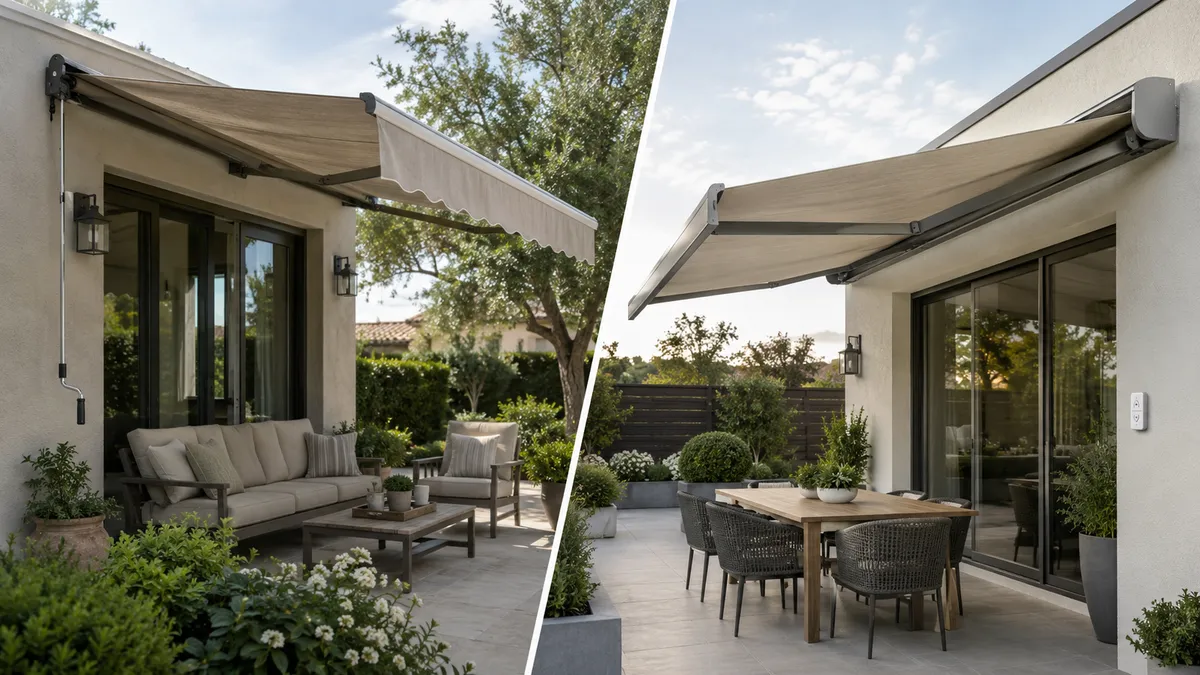
Manual fits a modest awning with an easy-to-reach crank and fewer electrical parts. Motorized earns its cost when the awning opens daily, sits high, spans wider or deeper, or is used by people with different reach or strength. Neither choice is ready until the wall, outlet, override and weather routine are solved.
Choose motorized for frequent, high or wide patio use with planned power and override access; choose manual when the crank is reachable, use is occasional and electrical work is not worth adding.
Side by Side
Fast comparison snapshot
| When this matters | Choose | Why |
|---|---|---|
| Daily patio use, high crank point or mixed user strength | Choose motorized after confirming outdoor power and a usable manual override. | A remote or wall switch makes opening and closing more likely when shade is used every day. |
| Occasional use, reachable crank loop and smaller projection | Choose manual and keep the closing routine simple. | A crank awning avoids motor, remote, sensor and outlet troubleshooting when the effort is manageable. |
| No nearby protected GFI/GFCI outlet or hardwire path | Stay manual for now or delay motorized until an electrician checks the power route. | Plug-in cords, weather covers, drip loops and permanent wiring need planning before the motor matters. |
| Wide or deep awning where cranking would discourage use | Lean motorized, then verify mount height, wall support and override clearance. | Convenient controls help only if the awning can still be mounted, serviced and closed safely. |
| Windy or rain-prone site where fabric may be left open | Choose neither until the retraction routine is reliable. | Sensors can help, but manufacturer manuals still warn against relying on open fabric in bad weather. |
Manual and motorized awnings compared first
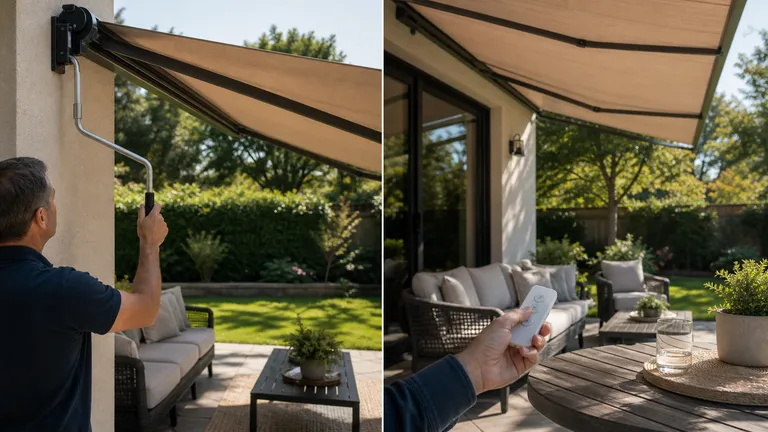
Settle manual versus motorized before fabric color, cassette style or product listings. Both choices can shade the same patio, but they change whether the fabric gets opened, how quickly it can be closed and what has to be maintained. SunSetter's FAQ separates hand-cranked models from motorized models that open and close by remote, which is the core buying split here.
Manual is the cleaner fit when the crank eye hangs where a person can stand and turn it without moving furniture. The Shadeline manual describes a crank pole hooked into a gear eye; that sounds simple, but the test is reach, shoulder effort, crank side and whether someone will close the awning before leaving the house. A small, occasional-use awning can be easier to live with as a crank unit than as an electrical project.
Motorized makes sense when convenience changes behavior. If the awning is mounted high, used every afternoon, wider than a small doorway cover or shared by people with different strength, a remote or wall switch can make retraction more consistent. SunSetter publishes example motorized widths from 8 ft to 20 ft with projections from 7 ft to 10 ft 1 in, and its measuring guide lists a 7 ft 6 in minimum wall-height condition for many models. Treat those as model examples, not universal limits, but they show why reach and projection matter.
- Compare crank operation against powered control within retractable awnings.
- Check crank side, crank height, furniture clearance and user strength before choosing manual.
- Check outlet path, override access, sensor plan and service access before choosing motorized.
Side by side
Manual crank and motorized awnings compared
Use this table before comparing models, fabric, cassette protection or accessories.
| Decision point | Manual crank awning | Motorized/electric awning | What decides it |
|---|---|---|---|
| Daily effort | Best when cranking is occasional and physically comfortable. | Best when remote or switch control makes daily use realistic. | How often the awning opens and closes during a normal week. |
| Mount height and crank reach | Needs a reachable gear eye and enough standing room for the crank wand. | Reduces repeated cranking, but still needs service and override access. | Wall height, furniture, door swing, user reach and the control side. |
| Width and projection | Can feel tedious on wider or deeper fabric even when the size is allowed. | More useful as size and projection make hand operation less appealing. | Published model dimensions, front-bar clearance and wall support. |
| Power and outlet planning | Avoids motor power, switches, remotes and exterior wiring. | Needs a planned grounded outdoor power path or qualified electrical work. | Outlet location, GFI/GFCI protection, in-use cover, drip loop and cord route. |
| Wind and rain response | Relies on someone turning the crank before weather arrives. | Can pair with wind or rain sensors, but sensors are backup help only. | Whether the awning will be retracted before gusts, storms or extended rain. |
| Power failure | No electrical failure mode, though the crank/gearbox still needs care. | Some models include manual override; the tool and access point must be checked. | Whether the awning can be closed during an outage, trip or motor fault. |
| Installed cost | Usually lower installed cost and fewer accessory lines. | Adds motor, controls, sensors, outlet or electrician costs where needed. | Full installed total, not catalog price. |
| Maintenance | Gear loop, crank, arms, bolts, fabric alignment and over-cranking risk. | Motor limits, remote, switch, sensor batteries, moisture trips and override checks. | How much troubleshooting the owner is willing to own. |
Cost and accessories on an installed basis
Compare installed totals, not product-only prices. HomeGuide's 2026 guide lists installed manual retractable awnings at about $200-$3,000 and installed motorized retractable awnings at about $1,000-$6,000. For deck, porch and patio examples, it lists manual at about $600-$3,000 and motorized at about $1,000-$6,000. Use those as broad quote-checking context, not as a promise for a specific wall, width or region.
Motorization adds more than a motor. SunSetter says one motorized line uses a remote and an 18 ft cord to a grounded outlet, and it lists wind sensors, rain sensors, wireless wall switches, LED lights, covers and hoods as optional accessories. Those items can be useful, but each one adds a part that can be misplaced, lose power, need batteries, need setup or need service.
Manual is not free of maintenance cost. A crank awning still has arms, bolts, fabric alignment, pitch, wall brackets and a gearbox. Shadeline warns against over-cranking after the arms lock out because fabric can sag, roll incorrectly and become damaged. The fair comparison is not simple versus complex; it is reachable manual effort versus powered convenience with more parts.
- Ask for a full installed quote that includes brackets, labor, controls and power work.
- Price sensors, wall switches, hoods and covers as accessories, not automatic inclusions.
- Keep service access in the budget when the awning is high, wide or hard to reach.
Cost check
What changes the real cost?
Use sourced ranges and accessory categories to compare quotes without inventing exact local prices.
| Cost line | Manual crank awning | Motorized/electric awning | Check before buying |
|---|---|---|---|
| Base installed range | HomeGuide lists broad installed manual examples at about $200-$3,000. | HomeGuide lists broad installed motorized examples at about $1,000-$6,000. | Confirm size, wall condition, labor and local quote details. |
| Patio, deck or porch examples | HomeGuide lists about $600-$3,000 for manual in this category. | HomeGuide lists about $1,000-$6,000 for motorized in this category. | Treat these as market examples, not exact product pricing. |
| Electrical and controls | Usually none beyond normal installation. | Grounded outdoor outlet, GFI/GFCI planning, switch, remote or hardwire work may be involved. | Do not use indoor extension-cord workarounds. |
| Sensors and accessories | Cover, hood or cleaning kit may still be useful. | Wind sensor, rain sensor, wall switch, smart module, lights and sensor batteries can add cost. | Buy sensors for routine support, not storm permission. |
| Future service | Crank, gear loop, bolts, arms, fabric alignment and pitch checks. | Motor limits, override tool, remote, switch, batteries, moisture trips and sensor setup. | Ask what can be serviced without removing the whole unit. |
No accessory price is assumed here unless a source gives a range; local labor, wall work and electrical access can change quotes.
Outlet, GFI/GFCI and hardwire cautions
A motorized awning needs a power plan, not just a motor label. If the model plugs in, check the cord side, cord length, outlet location, drip loop, water runoff and walking path before ordering. SunSetter's owner manual tells users to protect the outlet from water with a drip loop and recommends an in-use weatherproof cover while the motor cord is plugged in.
Use GFI/GFCI language as a safety check, not as a wiring tutorial. Shadeline warns that the motor receptacle should be equipped with GFI/GFCI protection and tells users to have an electrician install one if it is missing. ESFI explains that GFCIs shut off power when ground faults occur, including wet-equipment situations, and lists outdoor receptacles among GFCI areas.
Permanent wiring, new exterior outlets, uncertain protection and repeated trips belong with a qualified electrician. SunSetter's owner manual says permanent wiring must be done by a licensed electrician according to local electrical codes and warns that modifying motor wiring can void the warranty. If that electrical path is expensive or unclear, manual may be the cleaner purchase even when motorized sounds nicer.
- Confirm outlet side and cord route before choosing a motor side.
- Use a weather-appropriate cover and drip loop where the manufacturer requires it.
- Call a licensed or qualified electrician for new outlets, hardwiring, uncertain GFI/GFCI protection or repeated trips.
Category research
Manual and motorized awning categories to compare
Compare controls after width, projection, outlet access and use frequency are clear.
Manual
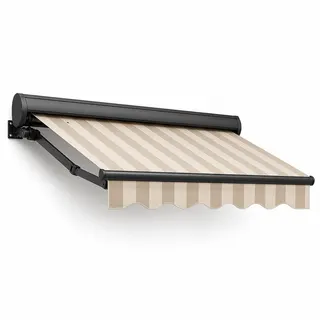
Manual Retractable Awning
For smaller or occasional-use patios where a crank is easy to reach.
- Lower control complexity
- No motor needed
Check:Crank access and user effort.
Search on AmazonMotorized
Motorized Retractable Awning
For wider or daily-use awnings when power and service access are solved.
- Convenient operation
- Adds electrical planning
Check:Outlet location and override option.
Search on Amazon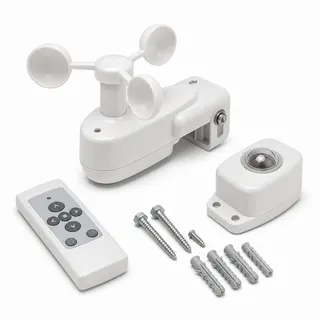
Controls
Awning Wind Sensor
For automation research after the basic awning is chosen.
- Weather automation
- Not a safety guarantee
Check:Manual instructions and sudden gust limits.
Search on AmazonManual override and power failure
Power failure is where a motorized awning can look better on paper than it feels in a storm. Some motorized awnings include manual override. SunSetter's FAQ says its motorized awning includes manual override for power outages, and its owner manual says a supplied crank wand can open or close the awning during an electrical failure. That does not prove every motorized awning has the same access, tool or procedure.
Before choosing motorized, ask where the override is reached when the awning is extended. A high access point, hidden bypass, missing crank, blocked furniture layout or tool-dependent procedure can turn convenience into a weak point. Carefree's Mirage manual gives a model-specific example using manual override and a 7 mm hex key procedure, which is exactly why the buyer should read the actual manual rather than assume a universal crank backup.
Practice matters. A manual override that has never been tested is not a weather routine. If a remote is lost, a GFCI trips, moisture gets into the motor housing, the motor overheats after repeated operation or the power fails while the awning is out, the owner needs to know whether closing the awning is realistic before rain or wind arrives.
- Verify that the exact model has manual override before buying.
- Check the override tool, access point, clearance and procedure.
- Practice the override before relying on the awning during storm season or travel.
Weather routine and maintenance
A retractable awning is not a storm roof, regardless of how it opens. Carefree warns that awnings are designed for sun protection and that wind and rain effects are unpredictable; if wind or extended rain is expected, the awning should be retracted and secured. SunSetter warns that rainwater pooling on fabric can collapse an awning and cause serious injury. Do not walk under pooled fabric, and do not treat waterproof or water-repellent fabric as structural cover.
Sensors help only if they are installed, powered and set correctly. Somfy's Eolis 3D wind sensor is battery powered and uses movement at the front bar to trigger retraction. Somfy's wind-sensor instructions also warn that incorrect motor direction can make the awning extend in windy conditions and cause serious damage. Carefree adds the broader warning: automatic retract systems are not a guarantee against severe or destructive weather.
Manual maintenance is mostly mechanical and visual: crank action, gear loop, arms, bolts, fabric tracking, pitch and annual inspection. Motorized maintenance adds motor limits, remote or wall switch behavior, sensor batteries, moisture-related GFCI trips, override access and occasional troubleshooting. SunSetter's troubleshooting notes include motor overtemperature after repeated operation and GFI trips linked to moisture in the motor housing. Carefree also says fabric should dry thoroughly before retraction after cleaning or wet conditions.
- Retract before strong or gusty wind, extended rain, snow or conditions the manual forbids.
- Treat wind and rain sensors as backup help, not as permission to leave fabric extended.
- Check bolts, arms, fabric alignment, controls, batteries and override access during routine maintenance.
Tie-breaker: when manual, motorized or neither wins
Choose manual when the awning is smaller, the crank loop is reachable, the awning will be used occasionally and the owner wants fewer powered parts. Manual also fits when the outdoor outlet is missing, lease rules are uncertain or the installation is a trial before a bigger patio upgrade. The trade-off is discipline: someone still has to crank the fabric closed before wind, extended rain or absence.
Choose motorized when the awning will be opened and closed often, the mount is high, the projection is deep, the crank point is blocked by furniture or several people need to operate it. Motorized is not a safety upgrade by itself, but it can make the right behavior easier. It earns its keep when the power route is weather planned, the override is reachable, sensor limits are understood and service access is realistic.
Choose neither when the wall or mounting substrate is weak, the outlet/GFI/GFCI path is unresolved, the awning would be left open in bad weather, rental or condo rules block attachment, or the real problem is low side glare. The Department of Energy notes that awnings can shade windows and outdoor living spaces, while YourHome's shading guidance points out that low east and west sun often needs adjustable or vertical shade. In those cases, a side screen, vertical shade, removable canopy, fixed door cover, pergola or planting may solve the problem better than changing the awning controls.
- Manual wins for reachable, occasional-use awnings where simplicity and lower first cost matter.
- Motorized wins for frequent, high, wide or shared-use awnings when power and override are solved.
- Neither wins when structure, exterior power, weather closure, rules or low side glare are the unsolved constraint.
Watch-outs
Before you buy or install
- Do not hardwire, add exterior outlets or troubleshoot repeated GFI/GFCI trips without a qualified electrician.
- Do not rely on wind or rain sensors as storm protection; retract according to the product manual.
- Do not walk under fabric with pooled water or treat a retractable awning as a permanent rain roof.
- Do not choose either version until the wall, rules and low-angle glare problem are checked.
Read Next
Related guides
Patio Awning Guide
Use this when patio awning is closer to the real constraint than the current page.
Retractable Awning Guide
Use this when retractable awning is closer to the real constraint than the current page.
Fixed vs Retractable Awning
Use this when fixed vs retractable awning is closer to the real constraint than the current page.
Awning Wind Rating
Use this when awning wind rating is closer to the real constraint than the current page.
Questions
FAQ
Is a motorized awning worth it over a manual awning?
It is worth it when the awning will be used often, mounted high, wide or deep, or operated by people with limited reach or strength. It is harder to justify for a smaller, occasional-use awning with an easy crank and no convenient outdoor power.
How much more does a motorized retractable awning cost after installation?
HomeGuide lists broad installed examples around $200-$3,000 for manual retractable awnings and $1,000-$6,000 for motorized retractable awnings. Your quote can shift with width, wall work, controls, sensors, outlet work, hoods, covers and local labor.
Can I use a motorized awning without an outdoor GFCI outlet nearby?
Do not treat an indoor extension cord as the plan. Check the model's power requirements, outlet location, cord route, weather cover and GFI/GFCI protection. If a new outlet, hardwire path or uncertain protection is involved, use a licensed or qualified electrician.
What happens to a motorized awning during a power failure?
Some motorized awnings include manual override, but it is model-specific. Before buying, verify the tool, access point, clearance and procedure. Practice it while the awning is extended so a power outage, lost remote or tripped circuit does not leave fabric open.
Are wind sensors enough to protect a motorized awning?
No. Wind sensors can help retract fabric when movement crosses the sensor setting, but manufacturer manuals still warn that automatic systems are not fail-safe. Retract the awning before strong gusts, storms or extended rain according to the product manual.
When is a manual crank awning better than electric?
Manual is better when the crank is reachable, the awning is modest, use is occasional, the budget is tighter or exterior power would add awkward work. It also avoids remote, sensor, switch and motor troubleshooting, though the arms, fabric, bolts and gearbox still need care.