
Quick Answer
Patio shade sail buying summary
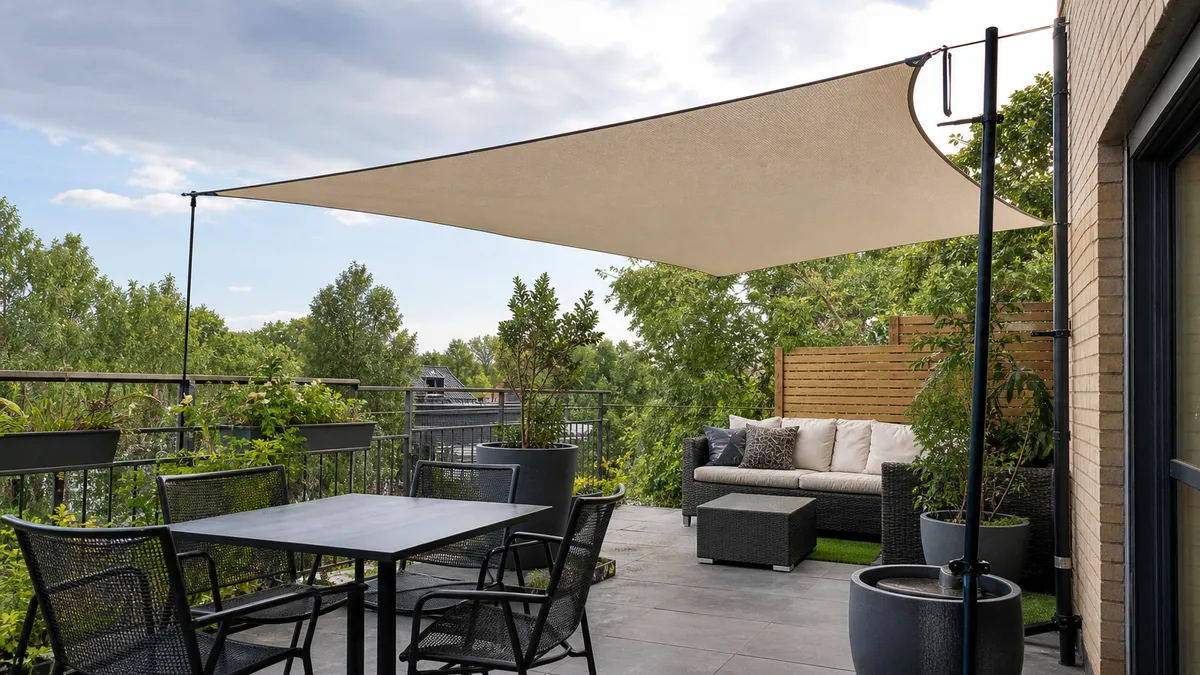
For most patios, the best shade sail is a breathable mesh sail sized to the real seating zone, with strong anchor points and room for turnbuckles. Choose waterproof fabric only when the corners can create clear slope and runoff. Do not buy fabric yet if the only anchors are fascia, weak fence posts, blocked doors or an area where fire or severe weather will be ignored.
Choose breathable mesh when sun is the problem and anchors are real; choose waterproof fabric only with slope and runoff, and pause the purchase when the structure is uncertain.
Buying Direction
What to buy for your patio setup
Use this table after the patio zone, anchors, hardware gap, drainage and wind routine are clear.
| Situation | Buy / use this | Why |
|---|---|---|
| Small corner lounge with three solid fixing points | Buy a triangle breathable mesh sail sized to the chairs, not the whole patio. | Three corners can be enough for a small reading or coffee area, but coverage drops quickly near curved edges. |
| Dining table with pulled-out chairs and four strong corners | Use a rectangle or square mesh sail with diagonal high and low corners. | A four-point sail can cover furniture better when each corner has a real anchor and height difference. |
| Narrow townhouse patio with one house wall | Buy a smaller standard or custom sail only if the opposite anchors are structural. | One strong wall does not solve the other corners, and long extensions can let the sail move harder in wind. |
| West-facing hour hits faces under otherwise useful shade | Use a smaller sail only if the shadow reaches the chair backs; otherwise compare side shade. | Low sun can pass under overhead fabric, so a bigger sail may miss the glare line. |
| Rain-first seating where dry furniture matters | Choose waterproof fabric only when one edge can sit clearly lower and runoff has a safe landing spot. | A flat coated sail can hold water, stretch corners and overload anchors. |
| Open or windy patio | Buy a smaller removable sail with quick-release or pulley hardware before considering a permanent install. | The useful purchase is the sail you will actually lower before severe weather. |
| Only fascia, siding, brick veneer or fence posts are available | Do not buy the sail fabric yet; verify the load path or use non-tension shade. | Decorative surfaces and light posts are not safe assumptions for a tensioned fabric corner. |
Start with the failed sun hour and anchor count
Start with the hour that makes the patio unusable. The EPA says shorter shadows mean higher UV exposure, so the chair, table edge or doorway that fails in late morning through mid-afternoon matters more than the full slab size.
Mississippi State University Extension recommends measuring the space before buying and laying the sail where it will go before installation. On a patio, that means marking the dining table with chairs pulled out, the lounge chair reclined, the door fully open and the walking path still clear.
Every sail corner needs an anchor point. A triangle shade sail needs three; a rectangle shade sail or square sail needs four. Before color, fabric weight or online price, count the posts, masonry points, wall plates or professionally checked supports that can actually take tension.
Read the broader shade sail guide if you are still deciding whether a sail is the right family of shade. This page assumes a sail is possible and narrows the purchase to shape, fabric, hardware and when to stop.
- Mark the failed sun hour on the patio floor before choosing shape.
- Count one real anchor point for every sail corner.
- Keep the grill, fire pit, patio heater and open flame outside the sail zone.
- Include turnbuckles, shackles, wall plates and removal hardware in the first budget.
Choose shape by the patio area, not the product photo
A triangle shade sail is not automatically the patio choice. It works when three strong corners already match a small lounge or one awkward corner of the patio. It usually leaves more uncovered edges than a four-corner sail.
A rectangle or square sail can be the better purchase for a dining table, outdoor sofa or larger seating area. The trade-off is simple: four corners need four real anchors, and the sail still needs high and low points so rain and tension do not fight each other.
Two smaller sails can solve an odd patio, but they add hardware, more tension checks and possible rubbing where fabric overlaps. Shade Sails LLC recommends separation between layered sails to reduce chafe, so overlapping is not a shortcut around weak anchors.
Use the triangle vs rectangle shade sail guide when the shape decision is still the main question. Here, shape is only one buying filter beside anchor strength, gap, fabric, wind and door clearance.
Shape check
Triangle, rectangle, custom or two smaller sails?
Pick the shape after the usable shade zone and real anchors are known.
| Shape or order type | Buy it when | Do not buy it when |
|---|---|---|
| Triangle sail | Three strong anchors frame a small corner lounge or narrow shaded patch. | A full dining table, wide sofa or chair pull-out zone needs broad coverage. |
| Rectangle or square sail | Four strong anchors can surround the table or seating with height variation. | One corner would land on fascia, siding, weak masonry veneer or a light fence post. |
| Two smaller sails | The patio has an awkward shape and each sail can keep its own tension and separation. | You are using two sails to avoid checking the missing structural corner. |
| Custom-measured sail | Secure anchors are known first and a standard size would force bad hardware angles. | The anchors are still guesses or may move after ordering. |
| Standard-size sail | The patio can adapt to the listed dimensions without blocking doors or using long leaders. | A cheap size would require chain extensions on several corners. |
Size, hardware gap and useful shade
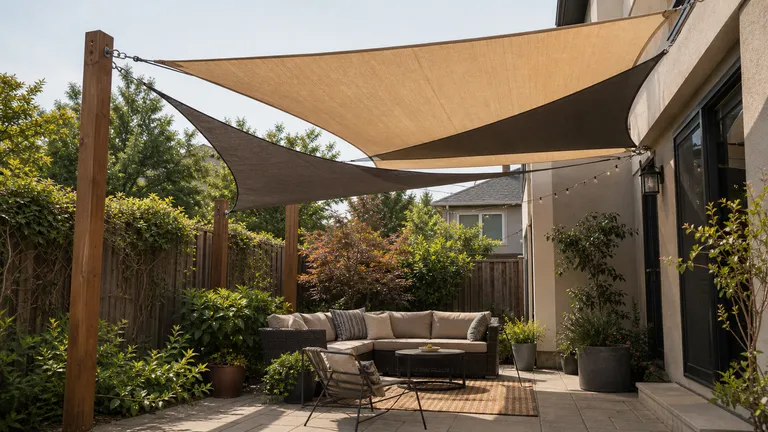
The sail should be smaller than the anchor spread. Shadow Comfort gives at least 25 cm between the sail corner and mounting point in its waterproof instructions, while Shade Sails LLC says ready-made supports often need about 18 in of extra room for rope, links, turnbuckles, shackles and site variation.
Do not measure only the patio slab. Measure the shadow you need, then subtract space for the hardware gap, curved edges, low-corner clearance and runoff path. Shade Sails LLC says curved sail edges can deflect about 10 percent over each edge length, so the useful shade is smaller than the corner-to-corner outline.
Door swing and chair movement can turn the right fabric size into the wrong buy. The low corner should not catch a tall guest, block a sliding door, hit a cabinet door or force people to duck when they pull out a chair.
Use the shade sail size guide once the anchor spread is known. Size guidance is useful only after the posts, wall plates or masonry points have a real location.
- Measure anchor-to-anchor spread, not only fabric width.
- Leave room for each turnbuckle, shackle, chain link or rope section.
- Check where the curved edge reduces shade over the table.
- Keep the low corner away from doors, chair backs and walking paths.
- Choose a smaller sail when runoff or removal access would otherwise be awkward.
Category research
Patio shade sail categories to compare
Use these category searches after anchor points, slope, hardware gap and wind exposure are known.
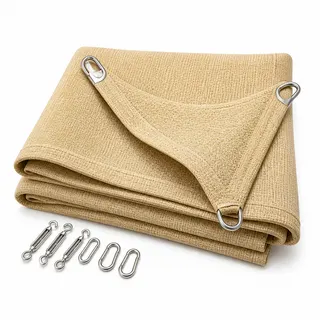
Rectangle
Rectangle Shade Sail
For broad patio coverage with four reliable anchor points.
- Best for dining zones
- More anchor planning
Check:Hardware gap, curved edges and runoff slope.
Search on Amazon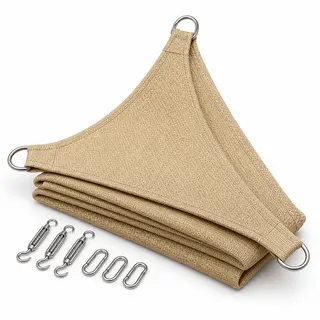
Triangle
Triangle Shade Sail
For smaller patios or three-corner layouts.
- Simpler anchor count
- Less full coverage
Check:Failed sun hour and usable shaded footprint.
Search on Amazon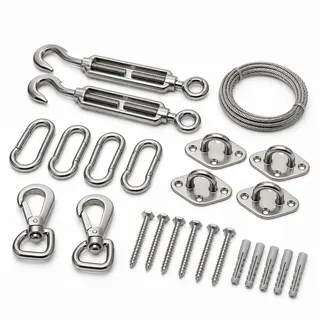
Hardware
Shade Sail Hardware Kit
For tensioning and fixing once the anchor points are real.
- Turnbuckles and pad eyes
- Not a weak-anchor fix
Check:Material grade, fastener type and corrosion exposure.
Search on AmazonBreathable mesh, waterproof fabric and drainage
Breathable mesh is the safer default for most sun-first patios. It reduces sun, lets air move and allows rain to pass through instead of turning the sail into a water pocket. It is not a dry-roof product.
Waterproof fabric is a narrower purchase. It makes sense only when the anchor heights can create a clear high side, a low side and a runoff landing that misses doors, steps, outlets, furniture cushions and the neighbor side.
Shadow Comfort states a 30% slope in its waterproof instructions, equal in that guide to 30 cm of height difference per 1 m of sail length. Treat that as a product-guide example, not a universal promise that every coated sail will work on a flat patio.
Waterproof shade sail fabric also raises the tension question. A sagging coated sail can hold water, and adding more tension is not safe if posts, wall plates or anchors move.
- Choose mesh when shade and airflow matter more than dry seating.
- Choose waterproof fabric only after slope and runoff are solved.
- Do not send runoff toward a threshold, outlet, slick step or neighbor property.
- Remove debris so leaves do not start a pooling problem.
Do not buy fabric before the anchors are real
A shade sail, posts, wall plates, turnbuckles and fabric behave as one tensioned setup. Buying a larger sail does not fix weak corners. It increases the load surface and makes wind, water and movement harder to control.
Coolaroo says fixing points must be structurally sound and recommends builder or engineer advice when the fixing is uncertain. It also calls out fascia support when attaching to fascia, because the load needs to reach rafters or trusses rather than decorative trim.
Do not assume brick veneer, siding, stucco, pergola trim, fence posts, trees or thin fascia can carry sail tension. Shade Sails Canada warns that an anchor must reach more than a facade, and Four Seasons gives similar caution for fascia and brick veneer.
Keep barbecues, fire pits, patio heaters and open flames away from the sail. Several manufacturer instructions warn against flame or heat below or near the fabric. If the dining area needs shade over a grill, shade the seats instead and leave the heat source open.
- Ask for professional help when the corner depends on fascia, veneer, siding, tall posts or a permanent large sail.
- Check local rules, landlord rules or HOA limits before drilling visible exterior anchors.
- Avoid exact load promises unless the product manual and installed structure are designed together.
- Do not tension fabric from a corner that moves during a hand check.
Hardware, tensioning and removal routine
Turnbuckles are not optional decoration. MSU Extension lists them as part of the installation materials, and they give you controlled adjustment after the sail is clipped to each corner.
Buy hardware that matches the substrate and instructions: wall plate, eye bolt, D-shackle, chain, turnbuckle, post bracket or pulley. The hardware should pull toward the sail center instead of sideways across a weak edge.
A taut sail should not mean an overtightened sail. Coolaroo tells installers to stop when the sail is rigid with little or no wrinkles and not to overtension. Shade Sails Canada warns that too much tension can stress fabric, hardware and anchors, while too little tension can let the sail flap.
Plan removal before the first storm warning. Coolaroo, Shade Sails LLC and ShelterLogic all recommend taking sails down for severe weather or strong winds unless the installation is designed for that exposure. A quick-release or pulley kit is worth comparing when one person must lower the sail quickly.
Re-tensioning and inspection belong in the purchase decision. Coolaroo notes that fabric can settle after weeks of rain, wind and sun. Check turnbuckles, shackles, fabric corners and mounting points before leaving the sail up for another season.
- Label corners if the sail comes down seasonally.
- Store fabric dry so mildew and hardware corrosion do not become the next repair.
- Inspect wall plates, posts and turnbuckles after storms.
- Do not use longer chain on multiple corners to rescue the wrong sail size.
Patio shade sail types to compare
Compare sail types only after the anchor, fabric and weather checks above are clear. The useful shortlist is the one that fits the patio geometry, hardware gap and removal routine.
A breathable HDPE patio sail is the first type to check for most sun problems. A waterproof or coated sail is the rain-focused buy, but only where slope, runoff and water-pooling checks already pass.
Shape comes next. Triangle sails fit small corner shade with three strong anchors. Rectangle and square sails fit dining and seating zones when four strong anchors and height variation are realistic.
Hardware may decide the purchase more than the fabric. Stainless kits, wall plates, fascia-support parts, quick-release sets, pulley kits, posts and custom measuring all add cost before the patio is usable.
A standard-size sail is a budget test only when the patio can adapt to it. A custom-measured sail is better when the secure anchors are fixed and a standard size would force bad angles, blocked doors or long leader cables.
Buying filters
Types to compare after the safety checks
Use these filters before comparing category pages, sizes or hardware bundles.
| Type | Best fit | Check before ordering |
|---|---|---|
| Breathable HDPE patio sail | Sun-first seating where airflow and drainage matter. | Anchor count, useful shadow and removal routine. |
| Waterproof or coated sail | Rain-first seating with high-low corners and runoff solved. | Slope, pooling risk and where water leaves the patio. |
| Triangle shade sail | Small lounge corner with three strong fixing points. | Coverage loss near edges and low-corner clearance. |
| Rectangle or square shade sail | Dining table, sofa zone or wider patio with four anchors. | Height variation, stronger hardware and chair pull-out. |
| Custom-measured sail | Known anchor locations that do not match standard sizes. | Final anchor placement before ordering fabric. |
| Quick-release or pulley kit | Open patios where lowering the sail must be fast. | Whether one person can loosen, label and store the sail. |
When not to buy a patio shade sail
Do not buy a sail when the only available corners are decorative fascia, light fence posts, siding or brick veneer. Use an umbrella, screen, freestanding shade or the patio shade ideas guide until a real support plan exists.
Do not buy waterproof fabric when no corner can be lower. The correct next step is the water-pooling guide or a different rain cover, not a tighter flat sail.
Do not buy a large permanent sail for a rental patio, HOA-controlled facade or visible townhouse wall until written rules allow the attachment. Removable shade is less exciting, but it avoids holes that must be repaired later.
Do not cover a grill, fire pit, patio heater or open flame. Move the shade to the seating zone or choose a shade product that keeps fabric and heat separate.
Do not buy a sail if the household will leave it up during severe weather because removal is too hard. Choose a smaller sail, quick-release hardware, an umbrella, an awning that retracts, or no tensioned fabric at all.
Watch-outs
Before you buy or install
- Do not attach a tensioned sail to fascia, siding, brick veneer, pergola trim or fence posts unless the load path has been checked.
- Keep barbecues, fire pits, patio heaters and open flame away from sail fabric.
- A flat waterproof sail can hold water and stretch corners.
- Take the sail down for severe weather unless the whole installation is specifically designed for permanent exposure.
Read Next
Related guides if your situation is different
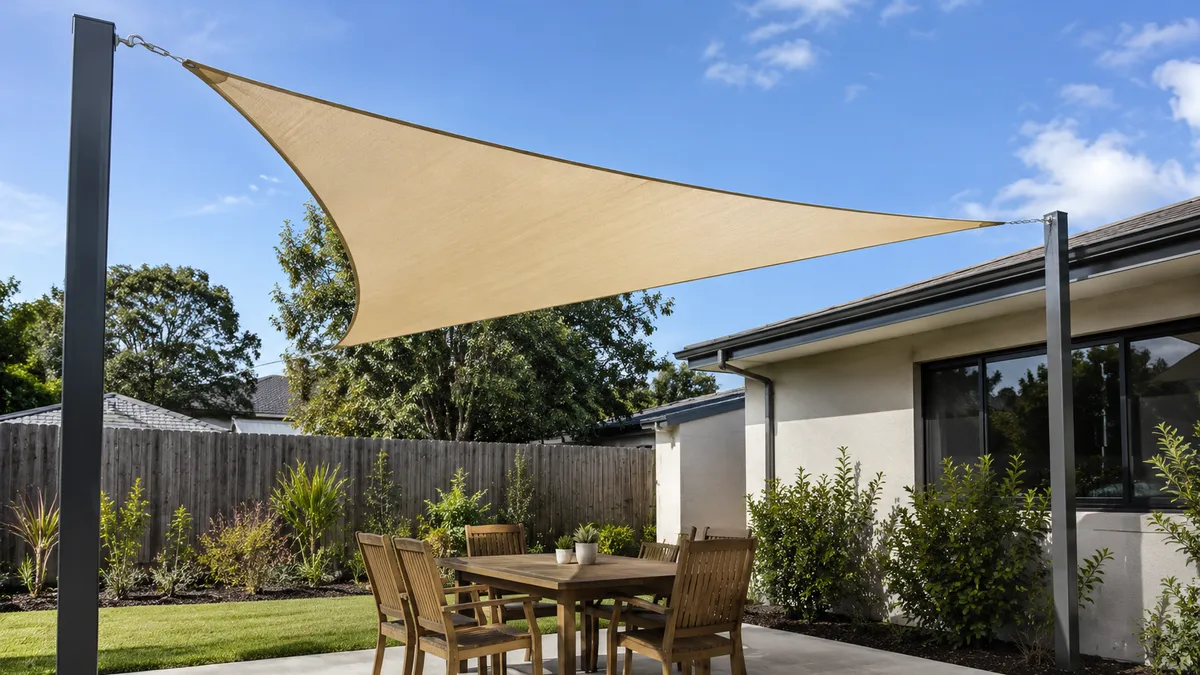
Shade Sail Guide
Use this when you still need the broader sail basics: shape, anchor spacing, slope, fabric, tension and wind removal before buying.
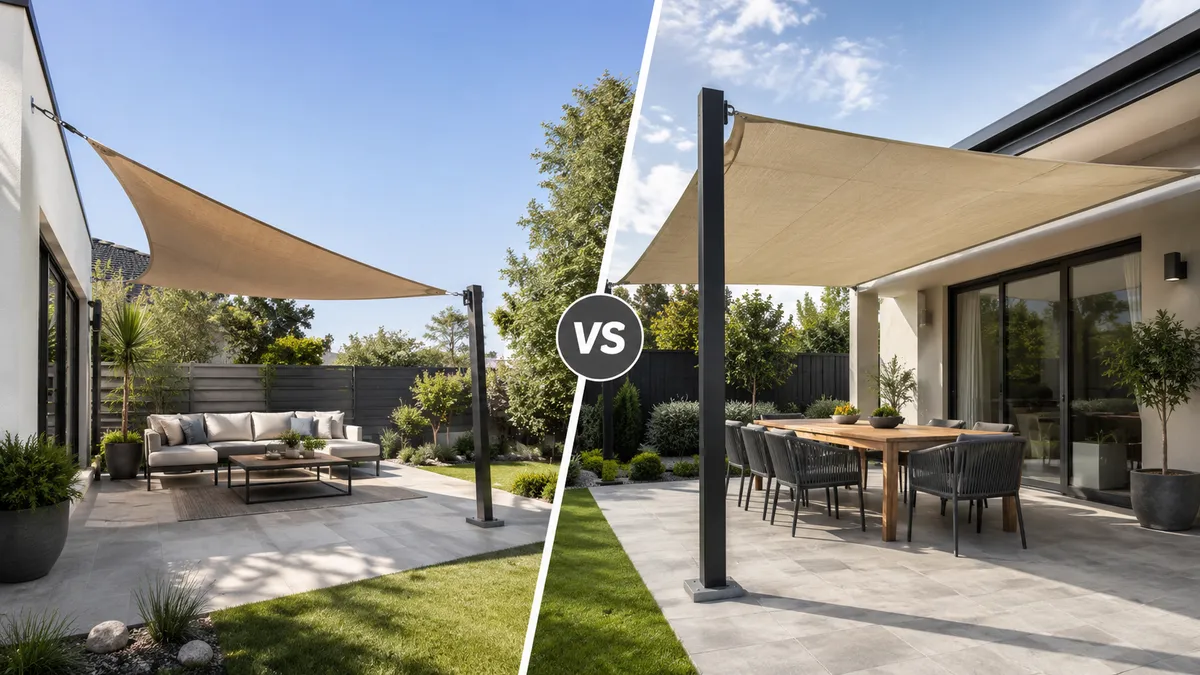
Triangle vs Rectangle Shade Sail
Use this when the patio decision is mainly about three anchors versus four anchors, useful coverage and where the shade will land.
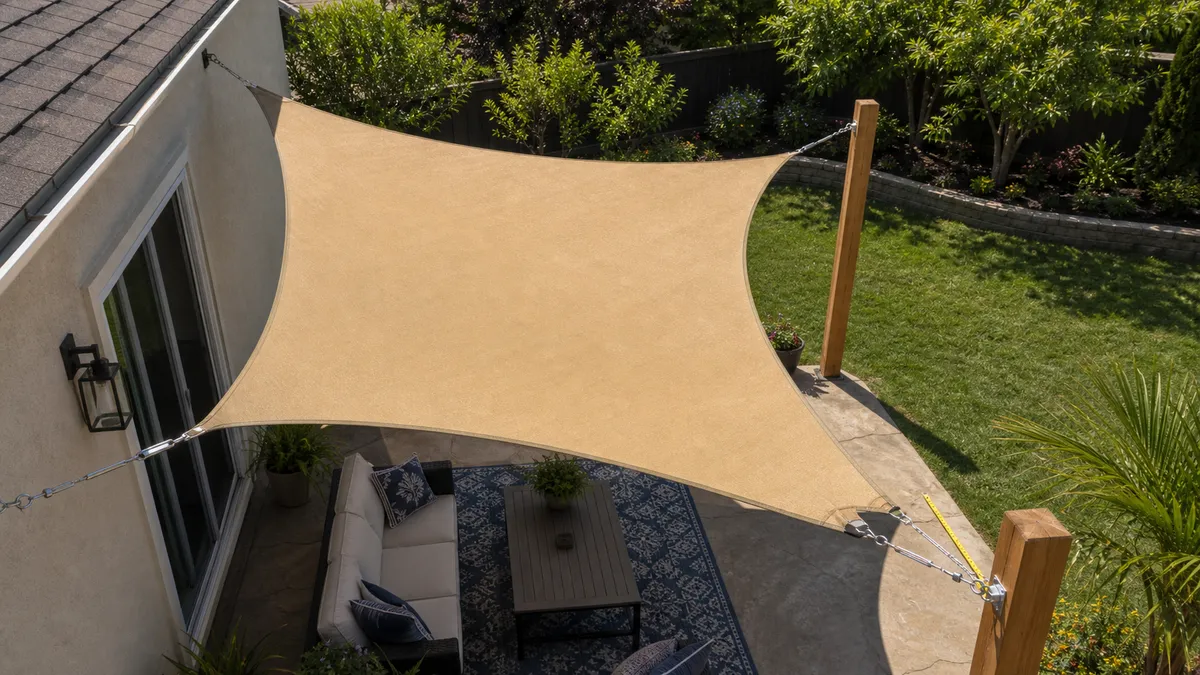
Shade Sail Size Guide
Use this when shade sail size guide is closer to the real constraint than the current page.
Questions
FAQ
Is a triangle or rectangle shade sail better for a patio?
A triangle works for a small corner lounge when three strong anchors already fit the space. A rectangle or square works better over dining tables and sofas when four strong anchors and height variation are realistic. Use the shape guide if coverage, anchor count and runoff are still the main debate.
Should I buy breathable or waterproof fabric for a patio?
Buy breathable mesh when the main goal is cooler seating, airflow and easy drainage. Buy waterproof fabric only when the corners can create clear slope and runoff. Mesh is not rainproof, and coated fabric should not be treated as a flat roof over furniture.
Can I attach a shade sail to fascia, brick, siding or a fence post?
Do not assume those surfaces are safe. Fascia may need support back to rafters or trusses, and veneer or siding is not the same as a structural anchor. If you cannot name the load path behind the surface, ask a builder or installer before buying the sail.
How much smaller should the sail be than the anchor points?
Leave room for each turnbuckle, shackle, chain section or rope, plus the sail's curved edge. Shadow Comfort gives at least 25 cm in one guide, while Shade Sails LLC often uses about 18 in for ready-made supports. Check the product instructions before ordering.
Should I take a patio shade sail down in wind?
Yes, take it down for severe weather or strong wind unless the installation has been designed and rated for permanent exposure. A quick-release or pulley setup can make removal realistic. If nobody will lower it before storms, buy a smaller removable sail or choose another shade type.
Is one large sail better than two smaller sails?
One four-point sail is often simpler over a dining area when all four anchors are solid. Two smaller sails can fit awkward patios, but they need more hardware, separation to reduce rubbing and more tension checks. Do not use two sails to hide an unverified anchor.