
Quick Answer
50 vs 70 shade cloth: the short version
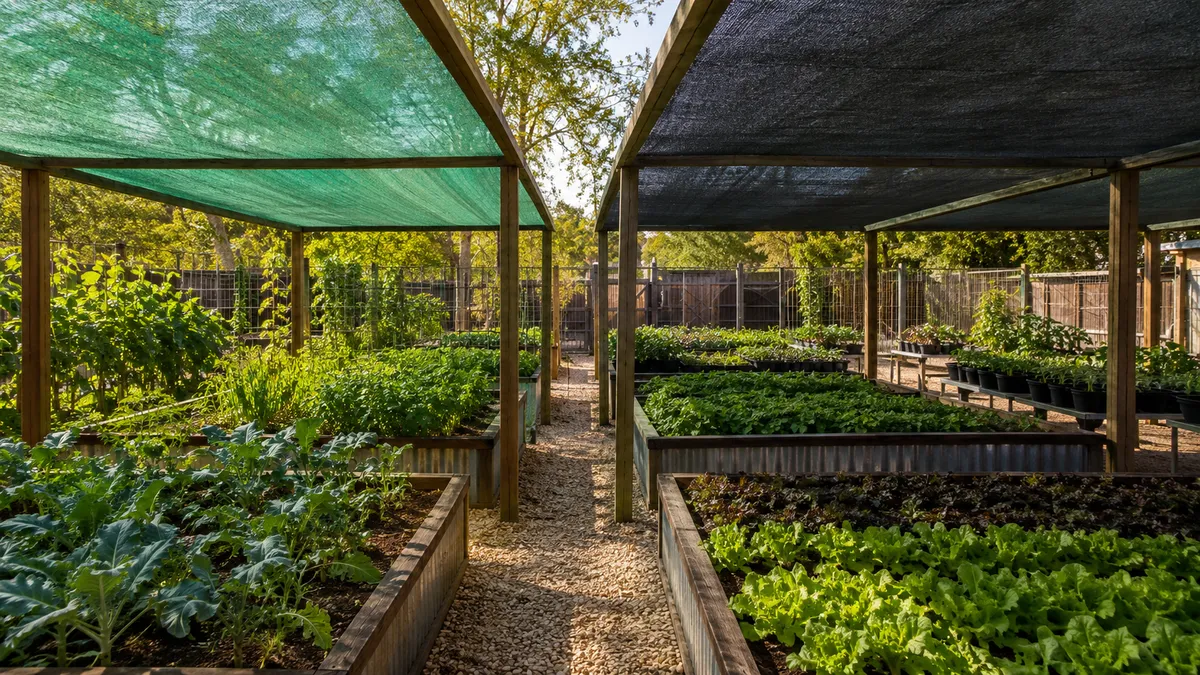
Use 50% shade cloth as the upper practical limit for most vegetables and mixed edible beds; use 70% shade cloth only for shade-loving orchids, ferns, nursery plants, tender recovery plants or short severe-heat coverage. Fruiting crops can lose flowering, pollination and ripening light under deeper cover. In a greenhouse or high tunnel, darker cloth helps only when airflow, clearance and removal timing are handled.
Choose 50% when vegetables, mixed beds or all-day cover are involved; choose 70% only for shade-loving plants or temporary severe heat with open airflow.
Compare
Where 50% or 70% fits
Match the plant group, heat window, airflow and removal plan before choosing 50% or 70% cloth.
| Situation | Recommendation | Why | Next guide |
|---|---|---|---|
| Lettuce, spinach or leafy greens wilt during a short severe-heat spell | Start with 50%; use removable 70% only for the hottest afternoon window. | University of Delaware allows 50%-70% for very heat-sensitive crops such as lettuce, while UC ANR keeps many cool-season plants closer to 50%-60%. | — |
| One bed mixes tomatoes, peppers, cucumbers and leafy greens | Use 50% or split the bed into separate shade zones. | Penn State keeps most vegetable shade in the 30%-50% range, so one large 70% panel can over-shade the fruiting side. | Shade Cloth Percentage Guide: 30%, 50%, 70% or 90%? |
| Tomatoes, peppers, cucumbers or squash are flowering and ripening | Stay at 50% or lighter; do not leave 70% over the crop. | A HortScience high-tunnel pepper study found 50% shade reduced marketable fruit number by 32% and weight by 29% versus no shade. | — |
| Lower-light orchids sit under intense summer greenhouse sun | Use 70% if the cloth sits above the roof or bench with moving air. | The American Orchid Society describes greenhouse shading near 60% with roof clearance and fresh air, and lower-light orchids can need deeper shade than vegetables. | Shade Cloth for Greenhouse: Best Percentage, Color and Placement |
| Mixed orchid collection includes higher-light types | Stay closer to 50%-60% and separate plants by bench or exposure. | The American Orchid Society separates lower-light terrestrial orchids from higher-light epiphytes, so one deep cover is too blunt. | — |
| Ferns, hostas, nursery stock or a tender recovery bench need deep shade | Use 70% when fruiting and flowering production are not the goal. | WSU Extension notes nurseries use shade cloth for shade-loving plants such as hostas and ferns. | — |
| A greenhouse or high tunnel is hot but vents are closed or air is still | Choose neither first; fix ventilation and clearance before buying darker cloth. | USU Extension starts high-tunnel heat control with doors, vents and roll-up sides, while Penn State warns cloth should not touch plants. | — |
| Tender plants or new transplants need a short rescue cover | Use a removable 50% or 70% panel and set a removal trigger before clipping it on. | UF/IFAS favors movable greenhouse shade because it can be removed during cloudy periods instead of darkening plants all season. | — |
50% vs 70% shade cloth at a glance
Before comparing 50% and 70% shade cloth, ask whether the plants can handle deep shade at all. If the crop is tomatoes, peppers, cucumbers, squash or a mixed edible bed, 50% shade cloth is already the strong side of the range. Penn State Extension recommends 30%-50% shade cloth for most vegetable gardens, which makes 70% a narrow tool rather than an upgrade.
70% shade cloth belongs where the plants actually want deeper shade. Lower-light orchids, ferns, hostas, nursery plants and tender plants recovering from heat or transplant shock can justify it, especially under intense afternoon sun. The American Orchid Society still stresses fresh air and circulation, so the darker cloth must not seal the growing area.
Use the table below before comparing rolls or finished panels. It separates light, crop fit, greenhouse behavior, airflow and installed parts so the darker percentage does not hide a ventilation or plant-selection mistake.
Comparison
50% vs 70% shade cloth side by side
Use this comparison after the scenario table, before ordering cloth, clips or edge hardware.
| Decision point | 50% shade cloth | 70% shade cloth | Before buying |
|---|---|---|---|
| Light reduction | Strong garden shade that still leaves more usable light for vegetables. | Deep shade with a higher over-shading risk for edible crops. | The percentage is light blocked, not a guaranteed cooling number. |
| Leafy greens and tender starts | Often enough for hot afternoons and seedling establishment. | Possible for severe heat if the panel can come off quickly. | Watch for stretching, damp foliage or pale growth. |
| Fruiting crops | Already a caution zone for tomatoes, peppers, cucumbers and squash. | Usually too dark for all-day or season-long fruiting use. | Watch flowering, pollination, fruit set, sizing and ripening. |
| Orchids and nursery plants | May fit mixed orchid benches or higher-light plants. | Better for lower-light orchids, ferns, hostas and recovery benches. | Separate higher-light plants instead of shading every bench deeply. |
| Greenhouse or high tunnel | Can help when vents, sides and fans are already working. | Fits shade-loving zones or temporary extreme heat, not default tomatoes. | Fix ventilation before moving darker. |
| Airflow and contact | Needs hoops, wire, roof clearance or a frame above leaves. | Needs even more care to avoid humid, still pockets under deep shade. | Do not drape either percentage directly on foliage. |
| Installed parts | Needs clips, edge support and a removal routine. | May need better edge control, storage access and zone separation. | Price the whole installed setup, not only the panel. |
Crop and plant fit: where 70% is a narrow answer
Leafy greens are the main edible-crop exception. Lettuce, spinach and tender salad greens can trade some light for cooler leaves during a hard heat window. University of Delaware says 50%-70% is sometimes used for very heat-sensitive crops such as lettuce. UC ANR Master Gardeners are more restrained, pointing delicate seedlings and cool-season plants toward about 50%-60%. That is why removable shade matters: the same dark panel can help at 3 p.m. and become too much after the heat breaks.
Orchids need narrower language than a chart usually gives. The American Orchid Society notes that orchid light needs vary, with lower-light terrestrial orchids differing from higher-light epiphytes. 70% can be reasonable for a lower-light orchid zone under intense roof sun, but a mixed collection often needs separate benches, side shade or a 50%-60% middle ground.
Nursery plants, ferns and hostas are stronger 70% candidates because the job is deep protection, not fruit production. WSU Extension describes shade cloth as open-weave fabric that lets reduced air, light and water through, and notes nursery use over shade-loving plants such as hostas and ferns. That is very different from covering a mixed vegetable bed with the same cloth.
- Use 50% first when the bed contains fruiting crops or mixed edible crops.
- Use 70% only for shade-loving plants, recovery benches or short severe-heat cover.
- Split plant groups before buying one large dark roll.
Fruiting crops: why more shade can backfire
Fruiting crops are the clearest reason not to treat 70% shade cloth as better than 50%. Tomatoes, peppers, cucumbers and squash need relief from sunscald and heat stress, but they also need light for flowers, pollination, fruit sizing and ripening. Too much shade can make the leaves look protected while the harvest slows down.
The strongest warning in the research report comes from the Iowa State and ASHS high-tunnel bell pepper study. In that setting, 50% shade reduced marketable fruit number by 32% and marketable fruit weight by 29% compared with no shade. The same study also found 50% shade reduced sunscald incidence, so the trade-off is real: protection can help fruit quality while lowering yield. If 50% can create that penalty in one fruiting-crop tunnel, 70% should not be the routine next step.
Pollination adds another caution. USU Extension notes that cucumber and squash pollination can already be poor under tunnels because bees do not readily fly into or under them. A darker cover that lowers light, slows flowers and makes access less inviting can compound the wrong problem. Use lighter cloth, partial afternoon shade or a shorter coverage window before darkening the whole crop.
Category research
50% and 70% shade cloth categories to compare
Compare stronger shade only after the crop can tolerate lower light.
50 percent
50 Percent Shade Cloth
For heat relief where light still matters.
- Balanced shade
- Often safer first
Check:Crop type and heat duration.
Search on Amazon
70 percent
70 Percent Shade Cloth
For shade-tolerant plants, nursery areas or temporary severe exposure.
- Deep shade
- Risk of too little light
Check:Stretching, flowering and growth rate.
Search on Amazon
Greenhouse
Greenhouse Shade Cloth
For roof or wall sections where ventilation still works.
- Structure coverage
- Works with airflow
Check:Vent access and exterior attachment.
Search on AmazonGreenhouse and high-tunnel heat: shade is only one control
In a greenhouse or high tunnel, the first question is not whether 70% blocks more light. The first question is whether hot air can leave. USU Extension describes high-tunnel heat management around ventilation, doors and roll-up sides, and recommends replacing warm-season tunnel plastic with 30% shade cloth in many vegetable settings. That is a strong clue that 70% is not the first fix for vegetable tunnels.
UMN Extension gives useful scale without promising a fixed result for every cloth. It reports shade cloth can lower high-tunnel temperatures by about 6-9 F and is often installed when tunnel air repeatedly reaches about 80-85 F. That supports summer shade, but UMN also notes 30% is often a good bet in Minnesota tunnels and that 50% may reduce yields. Moving to 70% needs a shade-loving crop zone, not just a hot thermometer.
Greenhouse tomatoes push the same point. UF/IFAS greenhouse tomato guidance describes shading ranges that can rise to about 50% in the hottest season, not a fixed 70% roof. For a greenhouse with orchids, ferns or nursery plants, 70% may work over a bench or roof zone when vents, fans and clearance are working. For tomatoes or peppers, read the greenhouse shade cloth guide before darkening the whole house.
Installed cost
Installed parts that change the real cost
The darker percentage may not cost much more per panel, but the installed setup can change.
| Cost piece | 50% shade cloth | 70% shade cloth |
|---|---|---|
| Cloth square footage | Usually priced by size, edge finish and fabric grade more than the label alone. | Similar size math, but a wrong dark panel can cost more through crop loss. |
| Edge finish, clips and grommets | Needs enough clips or reinforced edges to stop flapping and rubbing. | Needs the same hardware plus an easier rollback plan if plants over-shade. |
| Hoops, wire, cable or frame | Must hold the fabric above leaves and leave harvest access. | Must keep deeper shade from sagging onto plants or benches. |
| Greenhouse roof placement | Can work with vents, sides and fans if light-loving crops stay bright enough. | Usually belongs over shade-loving zones or temporary intense-sun periods. |
| Airflow clearance | Requires open sides or air gaps to avoid heat and disease pockets. | Has less margin because deep shade and still air can keep foliage damp. |
| Removal and storage | Needs a rollback trigger when heat breaks or fruiting slows. | Needs a clear seasonal or daily removal routine before installation. |
| Replacement risk | Wind rubbing, loose edges and fabric on leaves shorten cloth life. | Extra handling and edge stress can rise if the panel is moved often. |
UMN gives about $400-$600 as a scale benchmark for 30% or 50% cloth on a 30 ft by 96 ft high tunnel before labor and site-specific handling.
Airflow, cloth color and plant contact
Airflow is the part a percentage chart cannot solve. Penn State Extension warns that shade cloth should not touch plants because heat from the cloth and wind movement can damage foliage. That warning matters more with 70% shade cloth because a darker panel is often installed when plants are already stressed.
WSU Extension recommends raising fabric several feet above the leaf canopy and leaving one side open away from direct sun where practical. K-State Extension adds that poor airflow can increase humidity and disease pressure. If the only way to install the cloth is to drape it over cages or seal the bed tight, buy supports or fix the frame before buying a darker percentage.
Color can also change the feel of the space. WSU notes black cloth gives darker shade but absorbs more heat, while light-colored cloth can create a cooler, brighter environment. If the goal is heat relief rather than deep darkness, a lighter color, better roof clearance or an exterior movable panel may beat the jump from 50% to 70%.
Tie-breaker when both percentages look possible
Choose 50% when the shade will cover vegetables, mixed crops, fruiting crops, all-day exposure or a bed with uncertain airflow. It leaves more light and creates fewer removal surprises. It is also the better tie-breaker when one cover has to serve leafy greens and tomatoes at the same time.
Choose 70% only when the plants are truly shade-loving, the hottest exposure is temporary or extreme, the panel sits above the canopy and the cover can be removed, rolled back or limited to one zone. UF/IFAS favors movable greenhouse shade because it can be removed during cloudy periods; that logic is even more important for a darker panel.
When plant groups disagree, split the shade before buying one big roll. A smaller 70% panel over orchids or a nursery bench is easier to manage than a full roof of deep cloth over tomatoes, greens and transplants. Smaller zones also make it easier to test leaf stretch, flowering and humidity before committing.
When neither 50% nor 70% is right
Use neither when the crop needs lighter shade. Fruiting vegetables, high-tunnel tomatoes and mixed edible beds often need 30%, partial afternoon shade or a shorter coverage window instead of choosing between two dark options. The broader shade cloth percentage guide is the better next step if you have not narrowed the crop and heat window yet.
Use neither when the greenhouse problem is trapped air. Closed doors, sealed roll-up sides, undersized fans and cloth sitting too close to plants will not be fixed by a darker label. Improve ventilation, roof clearance and exterior placement first, then decide whether 50% or 70% still belongs there.
Use neither when the cloth would rub leaves, block harvest access, flap in wind, trap humidity or stay up after the heat breaks. In those cases, the better purchase may be clips, edge reinforcement, hoops, wire, cable, a smaller temporary panel or a crop-specific timing change rather than a darker roll.
Watch-outs
Before you buy or install
- Do not leave 70% shade cloth over fruiting crops through flowering, pollination and ripening.
- Do not expect a fixed temperature drop from either percentage; ventilation, color, placement and wind still matter.
- Do not drape cloth directly on plants, because heat and wind movement can damage foliage.
- Do not use darker cloth to hide a closed greenhouse, poor fan capacity or trapped humid air.
Read Next
Related guides
Shade Cloth Guide
Use this when shade cloth is closer to the real constraint than the current page.
Shade Cloth Percentage Guide
Use this when shade cloth percentage guide is closer to the real constraint than the current page.
Shade Cloth for Greenhouse
Use this when shade cloth for greenhouse is closer to the real constraint than the current page.
Shade Cloth for Orchids
Use this when shade cloth for orchids is closer to the real constraint than the current page.
Questions
FAQ
Is 70% shade cloth too much for vegetables?
Usually, yes for broad vegetable beds and fruiting crops. Penn State keeps most vegetable garden shade around 30%-50%. Use 70% only for a short severe-heat window, a leafy crop zone or a separate tender-plant area that can be uncovered quickly.
Is 70% shade cloth good for orchids?
It can be good for lower-light orchids or intense greenhouse sun, but not every orchid wants deep shade. The American Orchid Society stresses fresh air and varied orchid light needs. Mixed collections often work better with 50%-60% shade plus bench-by-bench placement.
Should leafy greens use 50% or 70% shade cloth?
Start with 50% for most leafy greens. Move toward removable 70% only if lettuce, spinach or tender greens still wilt or scorch during severe afternoon heat. Reduce shade when plants stretch, stay wet or the hot spell ends.
Will 70% shade cloth cool a greenhouse more than 50%?
It blocks more light, but it does not guarantee a fixed cooling gain. UMN reports shade cloth can lower high-tunnel temperatures by about 6-9 F, yet vents, fans, exterior placement, open sides and removal timing still decide plant response.
Which costs more after clips, frames and installation?
The percentage alone rarely decides the bill. Square footage, edge finish, clips, cable, roof placement, frame strength, storage and removal labor usually matter more. A 70% panel can cost more later if it forces plant relocation or replacement.
When should I choose neither 50% nor 70%?
Choose neither when fruiting crops need lighter shade, the greenhouse needs ventilation first, the cloth would touch leaves, or the heat problem is really water, mulch, airflow or timing. Use a lighter percentage, partial afternoon shade or a smaller removable panel.