
Quick Answer
Quick patio shade route
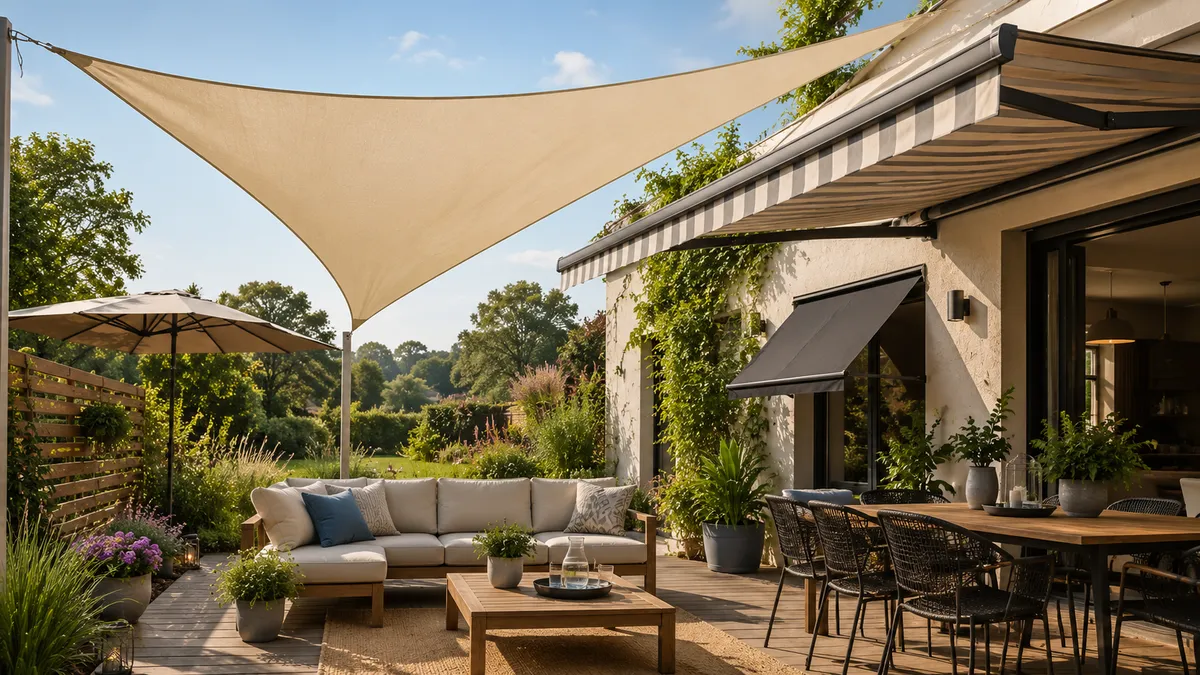
Choose patio shade ideas by the failed hour and sun angle, not by the photo that looks best. Use overhead shade for high midday sun, side shade for low afternoon sun, and freestanding shade when no drilling or weak anchors rule out fixed hardware. Check wall structure, ballast, wind routine, rain limits and written approval before buying.
Choose overhead shade for high midday sun within the furniture zone; choose side shade or freestanding shade when low glare, no-drill rules or weak anchors control the patio.
Guide Path
Choose your patio shade path
Start with the hour or rule that makes the patio fail. The right shade changes when the problem is overhead heat, low side glare, no drilling, wall structure, open coverage or floor space.
High midday heat over seating
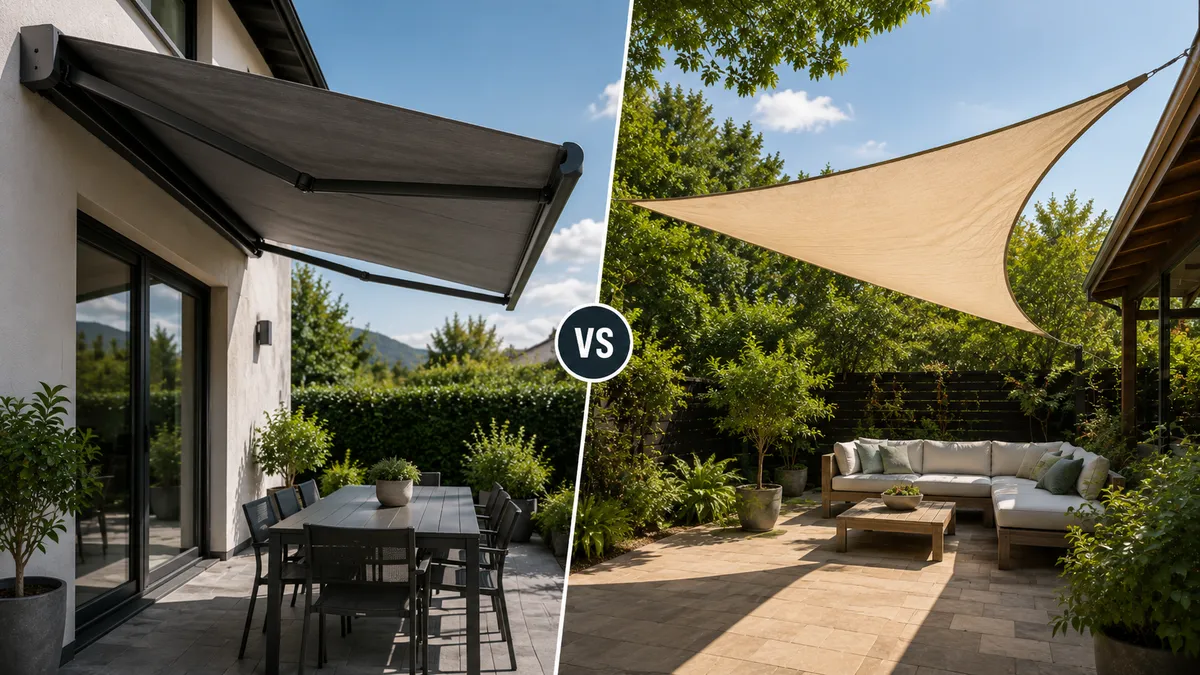
Use an awning, umbrella or sail that shades the table and chair pullback, not just the table center.
EPA UV guidance supports seeking shade during late morning through mid-afternoon when the UV Index is 3 to 7.
Best when:The hard hour is roughly late morning through early afternoon and the sun is high.
Check first:Furniture footprint, door swing, chair pullback and whether the shade can close or store before wind.
Watch out:A small roof patch can leave faces, knees or pulled-out chairs in full sun.
Compare sail and awning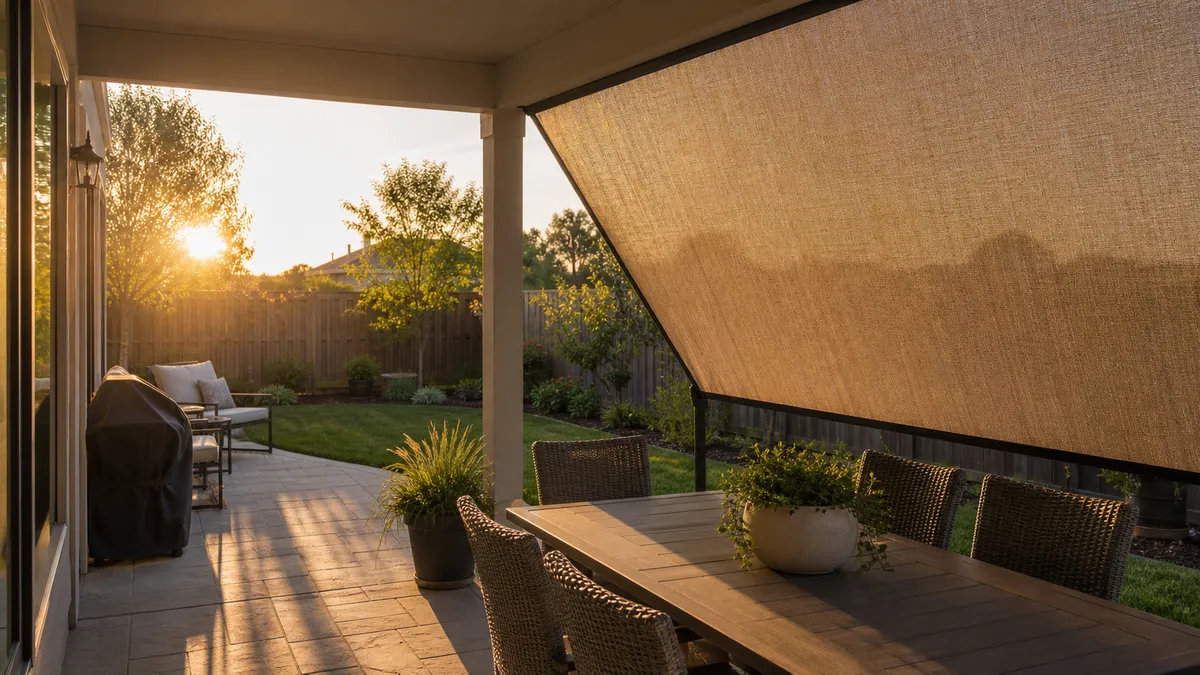
Low afternoon sun
Low glare usually needs vertical shade, not another overhead layer.
YourHome and Scottsdale both separate low east or west sun from midday overhead shade because the light arrives from the side.
Best when:The patio is tolerable at noon but harsh after the sun drops toward the horizon.
Check first:Glare line, screen height, west or southwest exposure and whether a valance can move with the sun.
Watch out:A deeper awning can still let evening light pass under the front bar.
Read the low-sun guide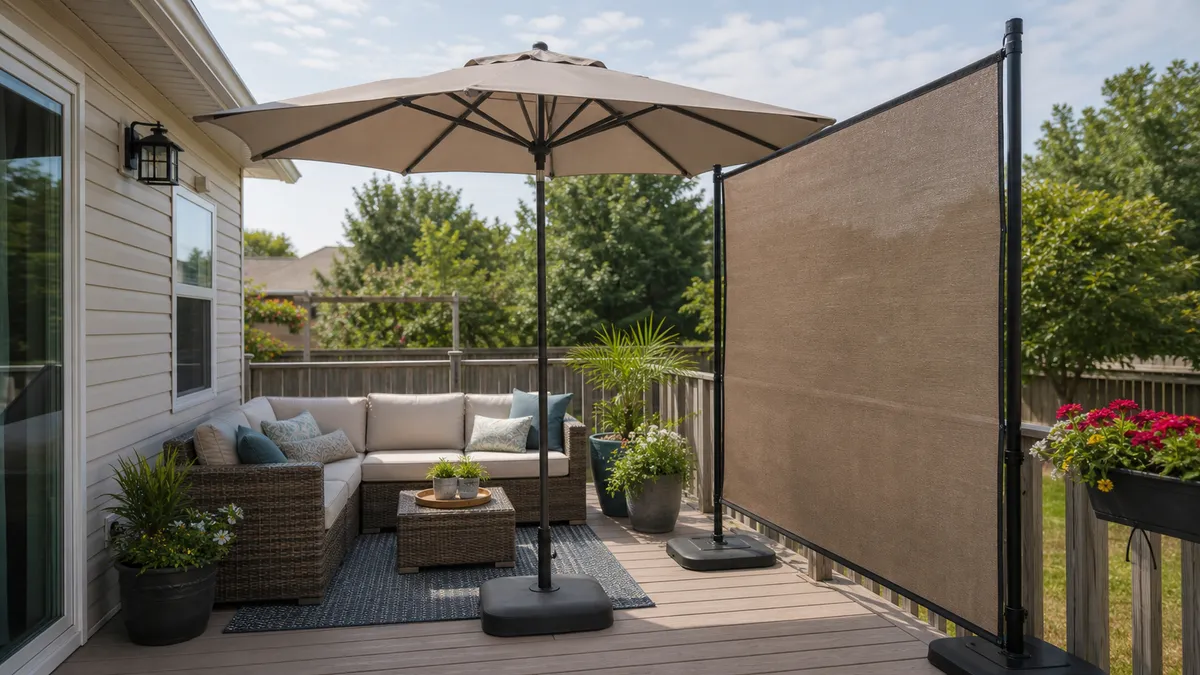
No drilling or weak anchors
Use weighted umbrellas, portable canopies, freestanding screens or other removable products before fixed hardware.
No-drill shade still needs ballast and a shutdown habit; weight is part of the support, not an accessory.
Best when:The patio is a slab, rental, shared surface or unknown wall where brackets are not allowed.
Check first:Ballast, trip points, storage, lease rules and whether the product manual allows the exposure.
Watch out:Furniture, light planters and decorative rails are not safe substitutes for designed supports.
Read the no-drill guide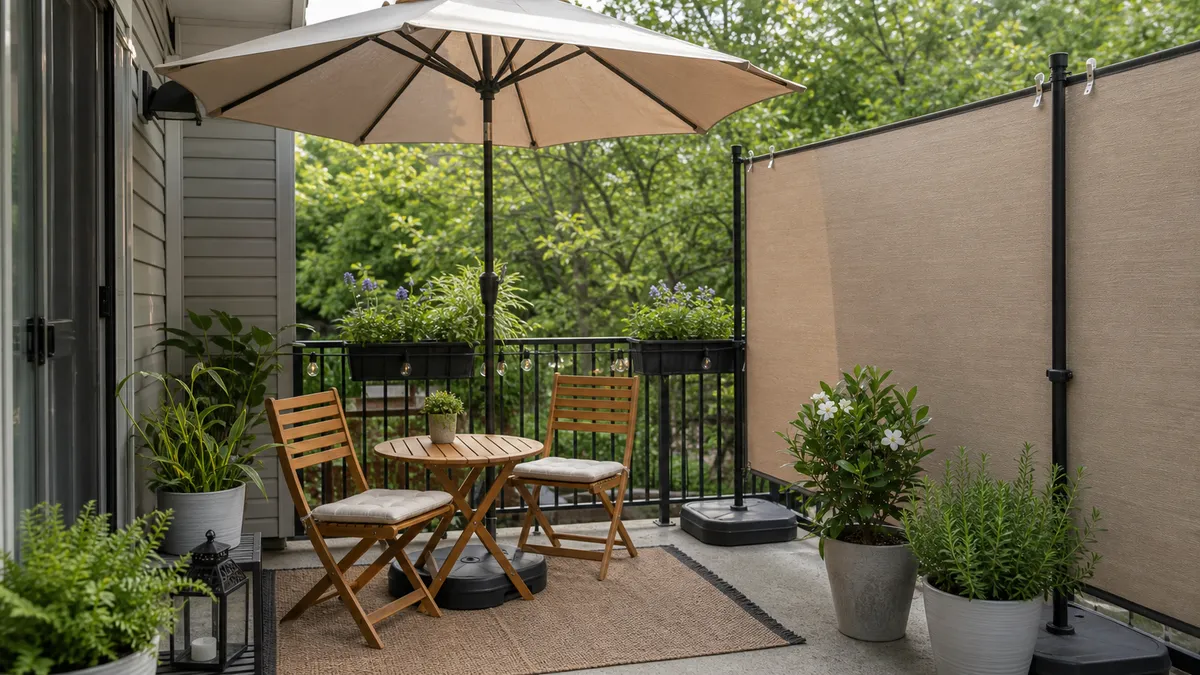
Renter or HOA limits
Use removable, reversible shade only after the written rules are checked.
A clamp, rail screen or tension pole can still violate a lease or building rule even when it leaves no hole.
Best when:Permission, inspections, shared railings or exterior appearance rules matter more than permanent coverage.
Check first:Lease wording, HOA documents, balcony handbook, rail limits and where stored shade will dry.
Watch out:Do not assume a product is allowed because it is advertised as renter friendly.
Read renter shade options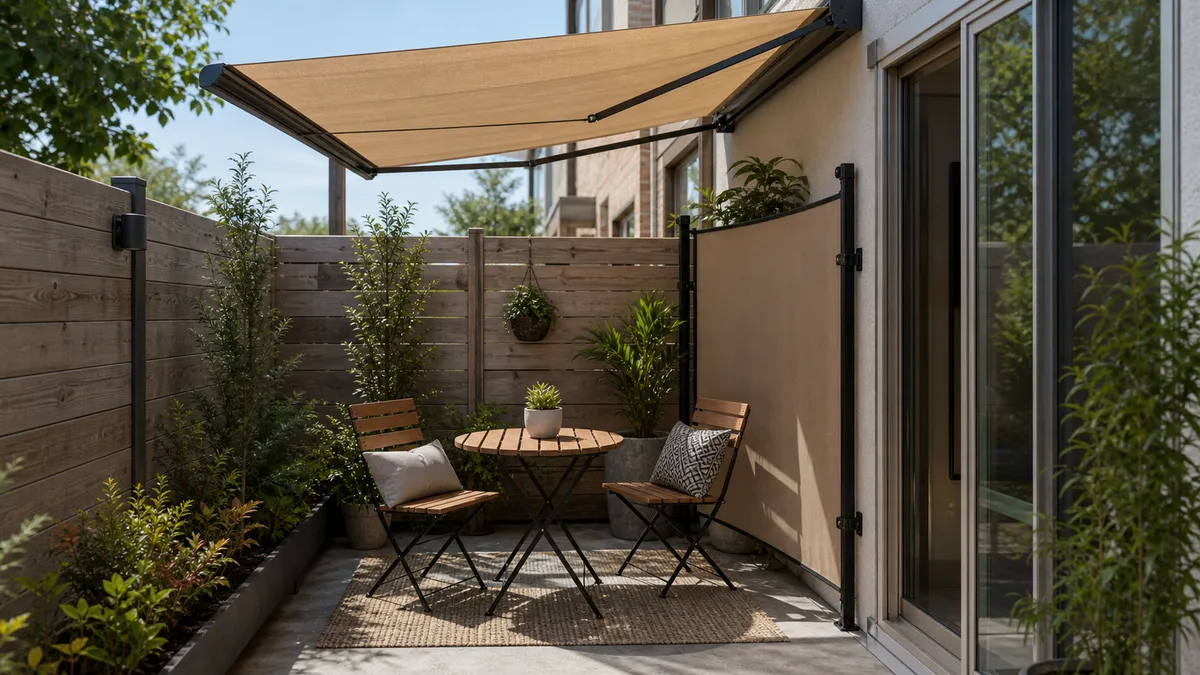
Small patio or balcony
Protect the exact seat, table or glare edge instead of trying to cover every square foot.
Half umbrellas, slim side screens, compact awnings and small sail corners can work when bases and legs stay clear.
Best when:The patio loses comfort because bases, canopy legs or low fabric edges steal the walking route.
Check first:Door swing, chair movement, rail rules, base footprint and head clearance at the lowest fabric edge.
Watch out:The largest shade product is often the least usable product on a tight patio.
Read small patio shade ideas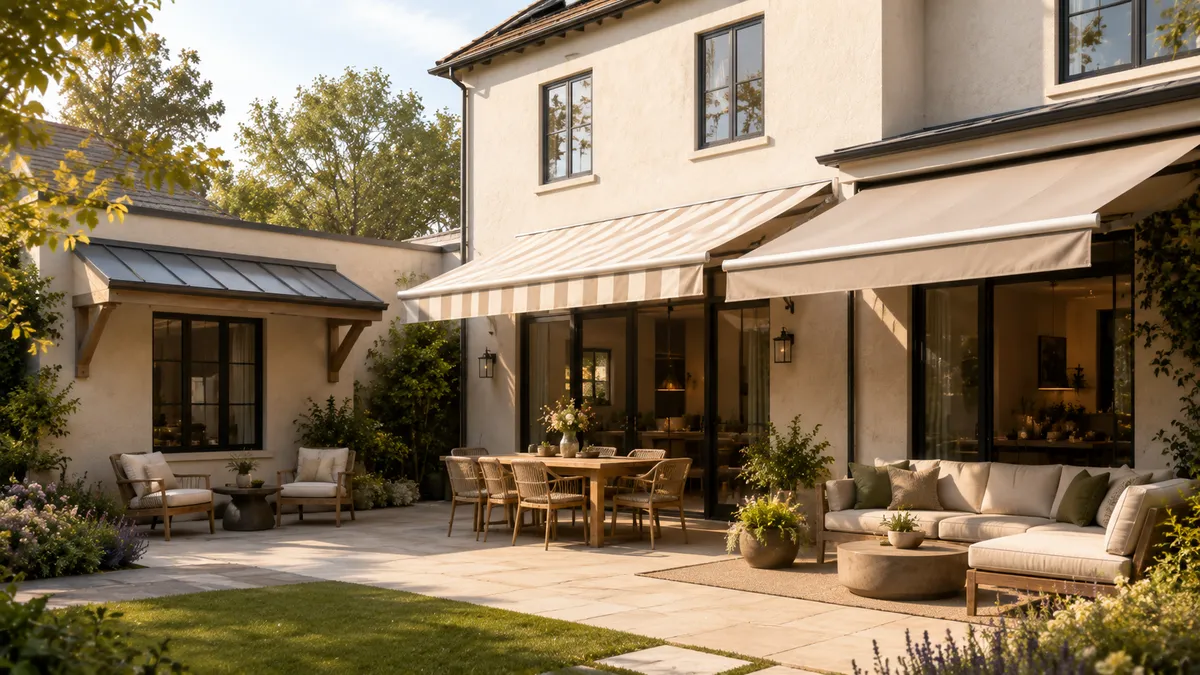
Wall-adjacent adjustable shade
A patio awning fits when the seating or glass doors sit close to a wall that can take brackets.
Energy.gov says exterior awnings can reduce summer solar heat gain through south- and west-facing windows, so this route can help the room behind patio doors too.
Best when:Shade needs to project from the house and retract for weather or winter sun.
Check first:Masonry, structural timber or framing, awning projection, front-bar height and grill clearance.
Watch out:Vinyl siding, fascia, trim and unknown cladding are not enough proof for awning brackets.
Read the patio awning guide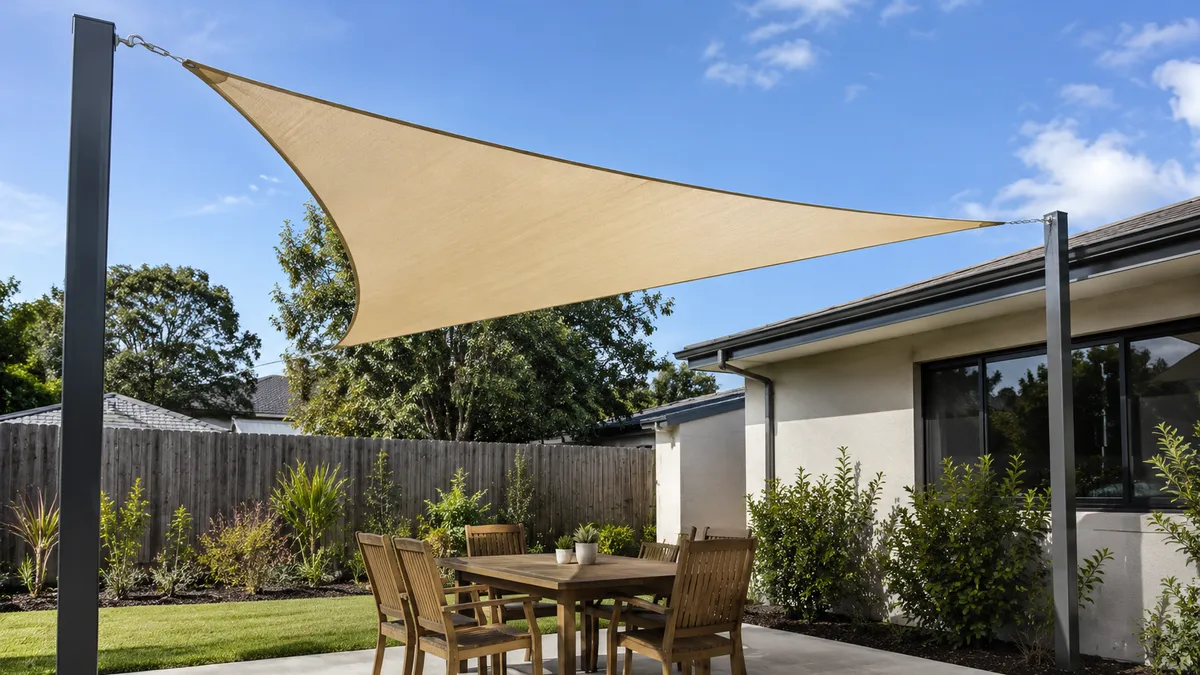
Open fixed coverage
A shade sail can cover a lounge zone when posts or structural anchors are realistic.
ShadeLogic instructions treat fixing points, hardware room, wind exposure, utilities and barbecue placement as planning checks, not afterthoughts.
Best when:The patio needs broad fixed shade away from the house and real posts or structural anchors are available.
Check first:Shade sail anchors, post footings, slope, hardware allowance, wind routine and where rain will run.
Watch out:A sail is not a workaround for weak walls, fences, furniture or decorative posts.
Read the shade sail guideMatch the shade to the failed sun hour
A patio shade hub should start with the failed hour. EPA tells people to seek shade during late morning through mid-afternoon when the UV Index reaches 3 to 7, and its shadow rule gives a quick field check: when your shadow is shorter than you are, sun exposure is stronger. That points many lunch patios toward overhead shade.
Low afternoon sun is a different problem. YourHome notes that east- and west-facing openings need a different shading approach because low-angle sun is harder to block, and Scottsdale shade guidance says horizontal shade works best around midday while vertical elements handle low morning or late-afternoon sun. If glare hits eyes from the side, buy side shade before adding another roof.
Reflected heat can make both routes feel incomplete. Pale paving, light walls and glass rails can bounce heat into the seating area even when the table has a shadow. In that case, move the seat, add a side screen, soften the reflected surface or use planting before assuming the overhead shade is too small.
Fit Map
What to use by failed patio hour
Use the situation that matches the bad hour before comparing fabric, color or price.
| Situation | Start with | Why it fits | Next route |
|---|---|---|---|
| High midday sun over a dining table | Awning, properly sized umbrella or shade sail over the full chair zone | The light is overhead, so horizontal coverage can land on seats and table. | /shade-sail-vs-awning/ |
| Low afternoon glare under a roof | Exterior screen, curtain, panel, plants or awning valance | The light enters from the side, so another overhead layer misses the glare line. | /how-to-block-low-afternoon-sun-on-patio/ |
| Concrete slab with no permission for anchors | Weighted umbrella, portable canopy or freestanding screen | The support has to come from ballast or legs instead of holes. | /patio-shade-without-drilling/ |
| Small balcony where the walkway is already tight | Half umbrella, approved rail screen, slim side panel or compact awning | The shade has to preserve door swing and foot room. | /small-patio-shade-ideas/ |
| Open lounge area away from the house | Shade sail only if posts, anchors, slope and wind routine are realistic | Fixed fabric needs a real load path, not just empty space above chairs. | /shade-sail-guide/ |
Coverage size, furniture clearance and base footprint
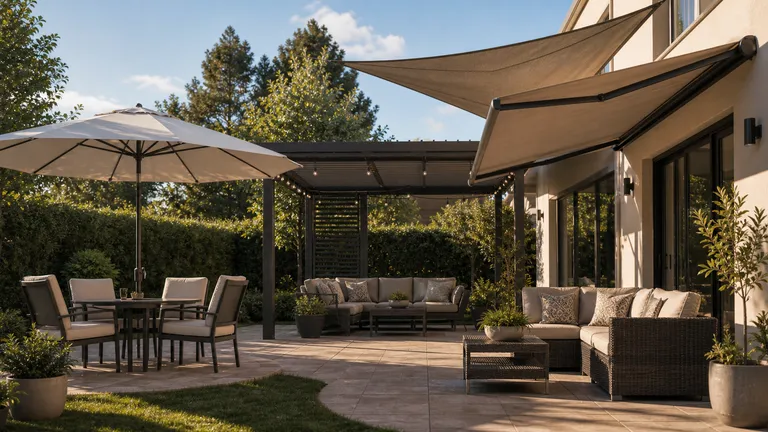
Measure the occupied patio, not the catalog scene. A two-chair coffee zone may work with 6 to 8 ft of shade, while a dining setup often needs 10 to 12 ft in one direction once chairs pull out. These are planning ranges, not guarantees, because shadows move and the bad hour may land at an angle.
Chair pullback is where many patio shade ideas fail. Mark the chair legs with the chairs in use, open the patio door, leave the serving path clear and then test where the shadow falls. If the base blocks a chair or a canopy leg sits in the main walkway, the shade will get pushed aside until it no longer fixes the bad hour.
Sails and awnings add their own clearance checks. ShadeLogic gives an 8 ft fixing-height example in its sail instructions, while awnings need front-bar height and projection clearance. On a small patio, low fabric edges, guy lines, long cranks and cantilever bases can matter more than square footage.
Budget tiers after bases, posts and labor
Compare the full setup, not fabric alone. A side screen can be a low-cost glare fix if it uses an approved support. A basic umbrella may look cheap until the base footprint, ballast and replacement canopy are included. A sail can become a post-and-footing job. An awning can need brackets, labor, electrical work or service access.
HomeGuide lists manual retractable awnings at $200 to $3,000 and motorized models at $1,000 to $6,000, with labor ranging from small manual installs to larger motorized work. Use those numbers only for awnings. For umbrellas, canopies, sails and screens, treat the table below as relative cost pressure unless a product manual or quote gives a real price.
Rework risk belongs in the budget. If the first idea cannot handle low sun, wind, wall structure or written approval, the second purchase becomes the real cost. The cheapest working route is usually the one that solves the exact failed hour with the least structure.
Cost Check
What the full setup usually adds
Exact prices vary by product and labor. Use this to catch missing parts before shopping.
| Shade family | Cost pressure | Often forgotten | Avoid when |
|---|---|---|---|
| Side screen or approved clamp screen | Low to medium | Permission, wind panel behavior, storage and rail rules | The building bans rail attachments or the screen cannot be secured safely. |
| Basic umbrella | Low to medium | Base, tilt reach, replacement canopy and closure routine | The base blocks chairs or the patio is too exposed for unattended use. |
| Offset or cantilever umbrella | Medium | Large base footprint, filled weight, cover and storm storage | The base consumes the only walkway or cannot be closed quickly. |
| Portable canopy | Low to medium | Leg positions, ballast, drying space and fabric replacement | It would stay open as a permanent roof in wind or rain. |
| Shade sail with posts or anchors | Medium to high | Posts, footings, hardware gaps, tensioning parts and possible qualified help | Only fascia, fence, trim, furniture or weak walls are available. |
| Wall awning | $200-$3,000 manual or $1,000-$6,000 motorized, per HomeGuide | Wall structure, brackets, pitch, motor, labor and service access | The seating is too far from the wall or the wall substrate is unknown. |
| Pergola or permanent cover | High | Permits, footings, drainage, wind exposure and long-term maintenance | The problem is only one low-glare hour or the patio rules do not allow a structure. |
Use exact quotes for final buying decisions. This hub compares cost drivers, not specific products.
Materials, airflow and rain limits by shade family
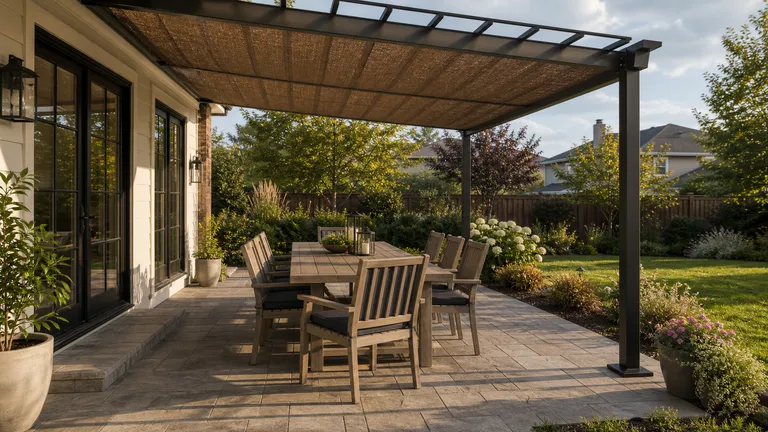
Materials decide comfort as much as shape. Energy.gov describes awning fabrics such as acrylic and polyvinyl laminates as water-repellent and treated to resist mildew and fading, and it recommends opaque, tightly woven awning fabric. That fits patio doors and wall-adjacent seating where blocking solar heat before it reaches glass matters.
Shade sails and screens trade differently. Breathable HDPE-style sail cloth can keep air moving, while coated or waterproof fabric needs more pitch and runoff planning. Screen mesh and outdoor curtains help low side glare but can behave like wind panels when they are fixed too rigidly.
Rain and cooking need conservative expectations. Rollac's awning manual describes retractable awnings as solar shade rather than all-weather protection and says they should retract during wind, rain, frost or snow risks. The same manual warns against grills or intense heat under awning fabric. Treat fabric shade as sun protection unless the product manual specifically supports rain, wind and heat exposure.
Mounting, permission and wind checks before buying
A patio shade idea is only as good as its support. Awnings need a wall that can take brackets, not just siding. Sails need shade sail anchors, tension hardware, posts or structural wall points. Freestanding umbrellas and canopies avoid wall holes, but they shift the problem to ballast, base footprint and closure habits.
ShadeLogic tells sail planners to check structurally sound fixing points and to get independent technician or engineer advice when uncertain. It also calls for extra room between the sail corner and fixing point for tensioning hardware. That is why a sail should be planned from anchors outward, not from a fabric size inward.
Freestanding shade is not permission-free. A 9 ft patio umbrella manual gives model-specific base examples and still says umbrellas are for sun, not wind. A cantilever base manual lists filled weights up to 200 lb with sand or 150 lb with water for that model and still says to close the umbrella in high winds or storms. Use those as proof that ballast and shutdown routines matter, not as universal base-weight rules.
Written approval matters on rentals, HOAs, balconies and shared patios. Do not attach to balcony rails, fences, exterior cladding, fascia, trim, glass panels or unknown surfaces without written permission and a support check. If utilities, buried services, post footings, wall substrate or wind exposure are uncertain, get qualified help before ordering fixed hardware.
Patio shade ideas that are the wrong route
Do not choose an awning when the shaded seats sit far from the wall or when the wall structure is unknown. Awnings work best near patio doors, windows and wall-adjacent tables. If the table is out in the yard, compare a sail, umbrella, canopy or pergola route before forcing an oversized projection from the house.
Do not choose a shade sail because the fabric looks clean in a photo. A sail is wrong when the only possible anchors are fascia, vinyl siding, a light fence, furniture or decorative posts. Use the shade sail guide if real posts, footings, slope and hardware room are possible; use no-drill shade if they are not.
Do not choose an umbrella or canopy when the base, legs or guy lines will make the patio harder to use. These can be the right freestanding shade for renters and slabs, but they need room to stand, close and store. For a narrow balcony, a half umbrella, slim vertical screen or approved rail product may be better.
Do not choose a side screen as a permanent wind wall. Side shade is often the correct answer for low afternoon sun, but a rigid screen in an exposed corner can collect wind. Use the low-sun guide for glare placement and the wind guide when gusts, open corners or high panels are the controlling issue.
Do not treat fabric shade as a rain roof unless the product manual supports that use. If rain protection is the main job, route to a rain-specific patio shade guide or a permanent cover discussion. Mesh may stay cooler and handle sun better, while waterproof fabric can trap heat or collect water without pitch and support.
Watch-outs
Before you buy or install
- Do not mount awnings or sails to fascia, trim, vinyl siding, light fences, furniture or unknown cladding.
- No-drill shade still needs ballast, floor clearance and a wind routine.
- Side screens and curtains can become wind panels when fixed too rigidly.
- Fabric shade near grills, heaters or intense cooking heat needs manual-supported clearance and conservative placement.
- Rental, HOA and balcony attachments need written approval before clamps, rails, brackets or visible exterior changes.
Read Next
Related hub
Small Patio Shade Ideas
Use this when small patio shade ideas is closer to the real constraint than the current page.
Patio Shade Without Drilling
Use this when patio shade without drilling is closer to the real constraint than the current page.
How to Block Low Afternoon Sun on a Patio
Use this when how to block low afternoon sun on patio is closer to the real constraint than the current page.
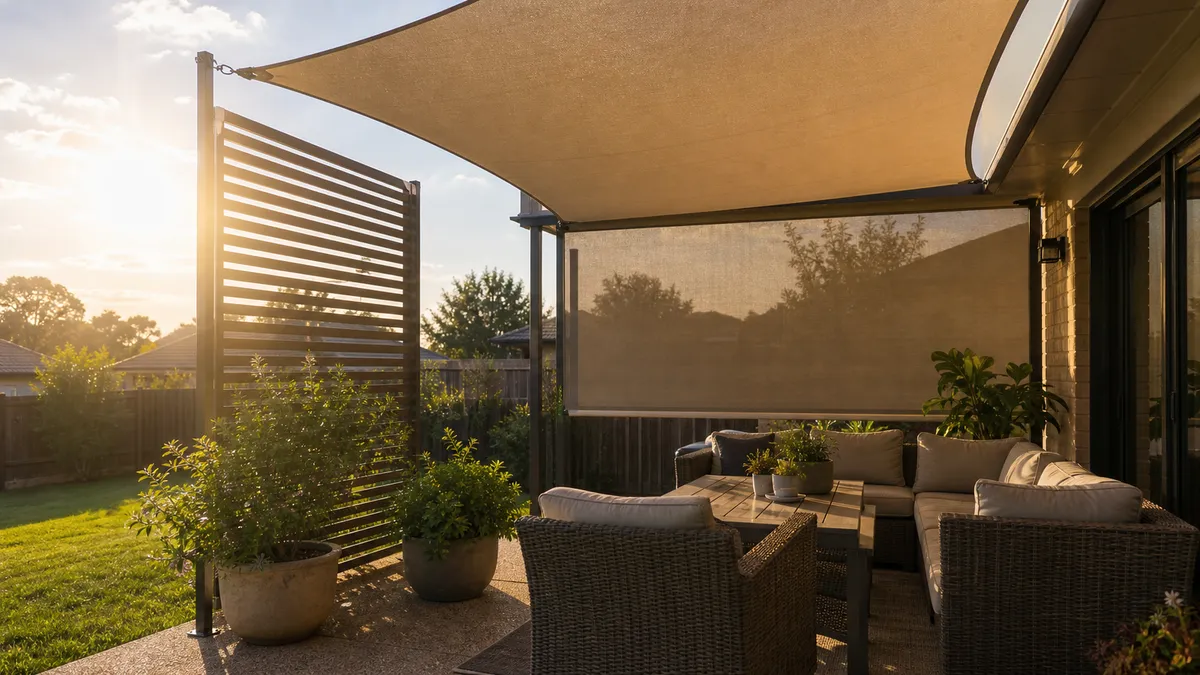
West-Facing Patio Shade
Use this when west facing patio shade is closer to the real constraint than the current page.
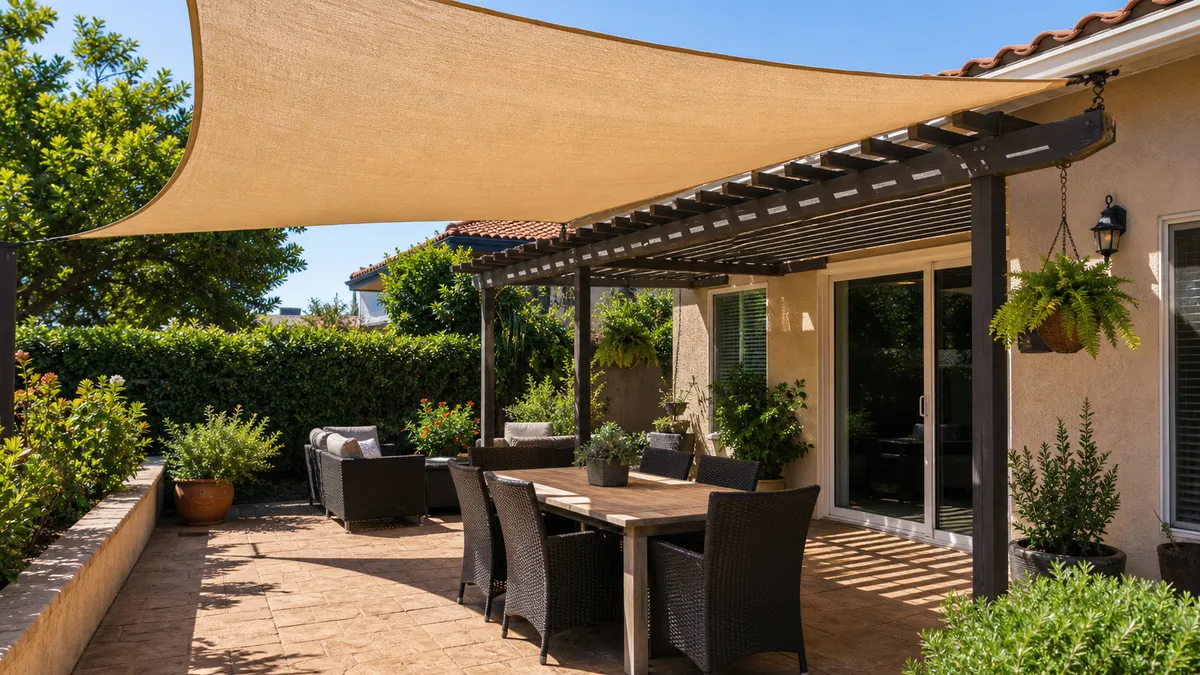
South-Facing Patio Shade
Use this when south facing patio shade is closer to the real constraint than the current page.
Patio Awning Guide
Use this when patio awning is closer to the real constraint than the current page.
Shade Sail Guide
Use this when shade sail is closer to the real constraint than the current page.
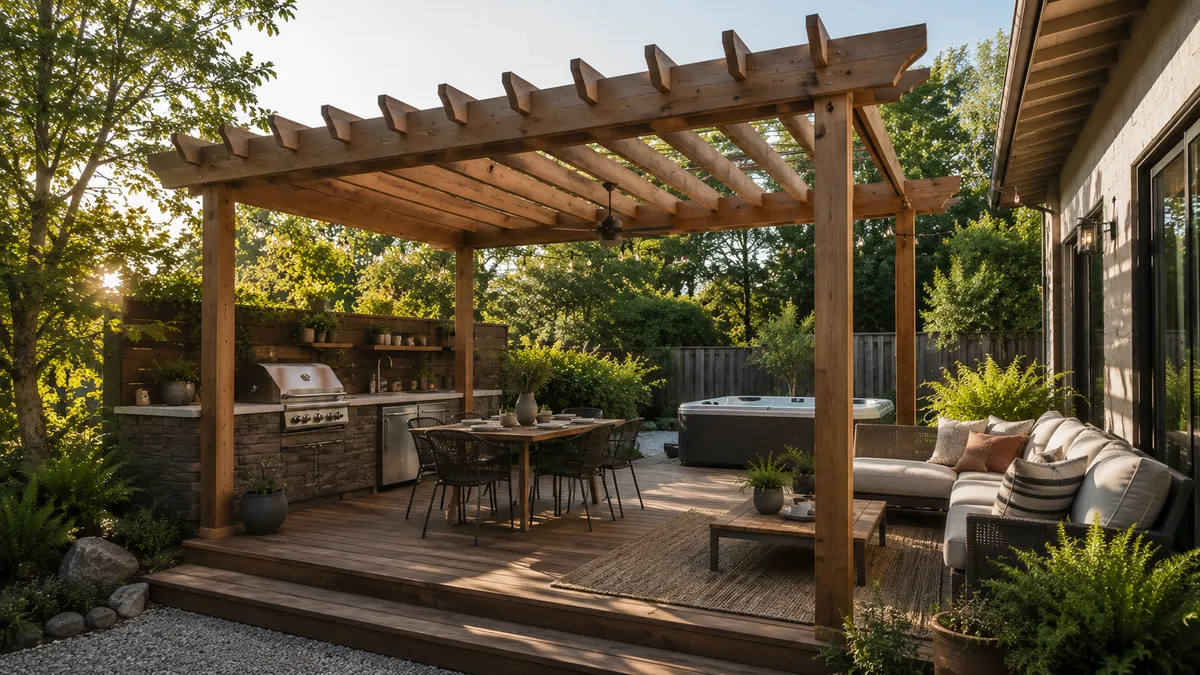
Pergola Guide
Use this when pergola is closer to the real constraint than the current page.
Shade Sail vs Awning
Use this when shade sail vs awning is closer to the real constraint than the current page.
Renter-Friendly Patio Shade
Use this when renter friendly patio shade is closer to the real constraint than the current page.
Questions
FAQ
What is the best way to shade a patio?
Start with the failed hour. Use overhead shade for high midday sun over seats and tables, side shade for low glare, and freestanding shade when no drilling is allowed. Then check wind, wall structure, ballast and whether the shade can close or store before weather changes.
Is a shade sail or awning better for a patio?
An awning is usually better when the shaded area sits close to a verified structural wall and retraction matters. A shade sail is better for open fixed coverage when posts or structural anchors are realistic. If both seem possible, use the shade sail vs awning guide before buying.
How do you shade a patio when the sun comes in from the side?
Use vertical or side shade: an exterior screen, outdoor curtain, side panel, planting line or awning drop valance. Low sun can pass under an overhead roof or awning, so first map the glare line from the seated position instead of adding more top cover.
What patio shade works without drilling?
Weighted umbrellas, portable canopies, freestanding screens and approved clamp or tension products are the usual no-drill routes. They still need ballast, floor clearance, storage and written permission where rules apply. No-drill does not mean no load or no wind risk.
What is the cheapest patio shade idea that still works?
The cheapest working idea is the smallest product that solves the exact failed hour. A side screen may beat a big umbrella for low glare. A basic umbrella may work for a bistro set. Count the base, storage, replacement fabric and wind routine before calling it cheap.
Can patio shade also block rain or wind?
Sometimes, but many fabric products are solar shade first. Rain or wind use depends on the manual, pitch, runoff, ballast, brackets and closure rules. Retractable awnings, umbrellas, sails and canopies should not be treated as storm shelters unless the product is rated for that exposure.