
Quick Answer
Quick answer for patio awnings
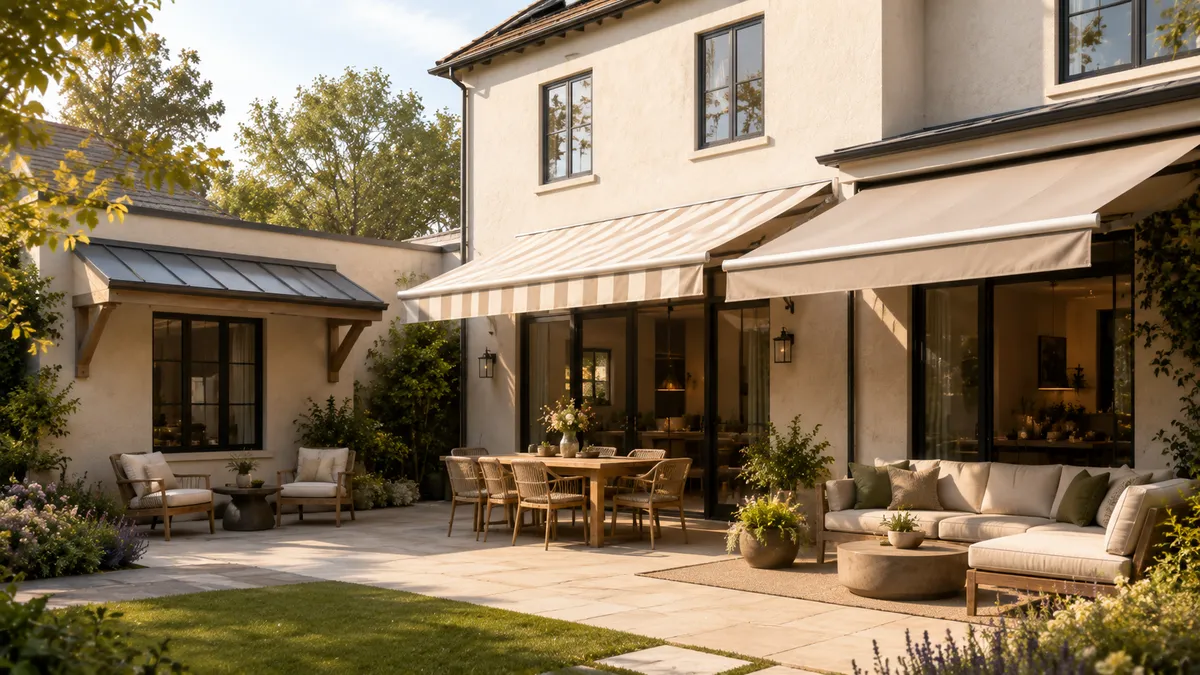
Choose a patio awning when the shade has to come from the house wall and the seating, dining or door zone sits within normal projection reach. Check structural backing, front-bar clearance, pitch, fabric width and the closing routine before choosing fixed, manual, motorized or cassette hardware. Use a sail, freestanding shade, no-drill shade or side screen when those checks fail.
Choose a wall-mounted patio awning when the hot zone is beside a verified structural wall; choose a sail, freestanding shade or side screen when the area is detached, the wall is uncertain or low sun is the real problem.
Guide Path
Choose the patio awning route first
Start with the awning family that matches the wall, sun angle and daily closing routine. The hardware choice comes after those checks, not before.
Fixed awning
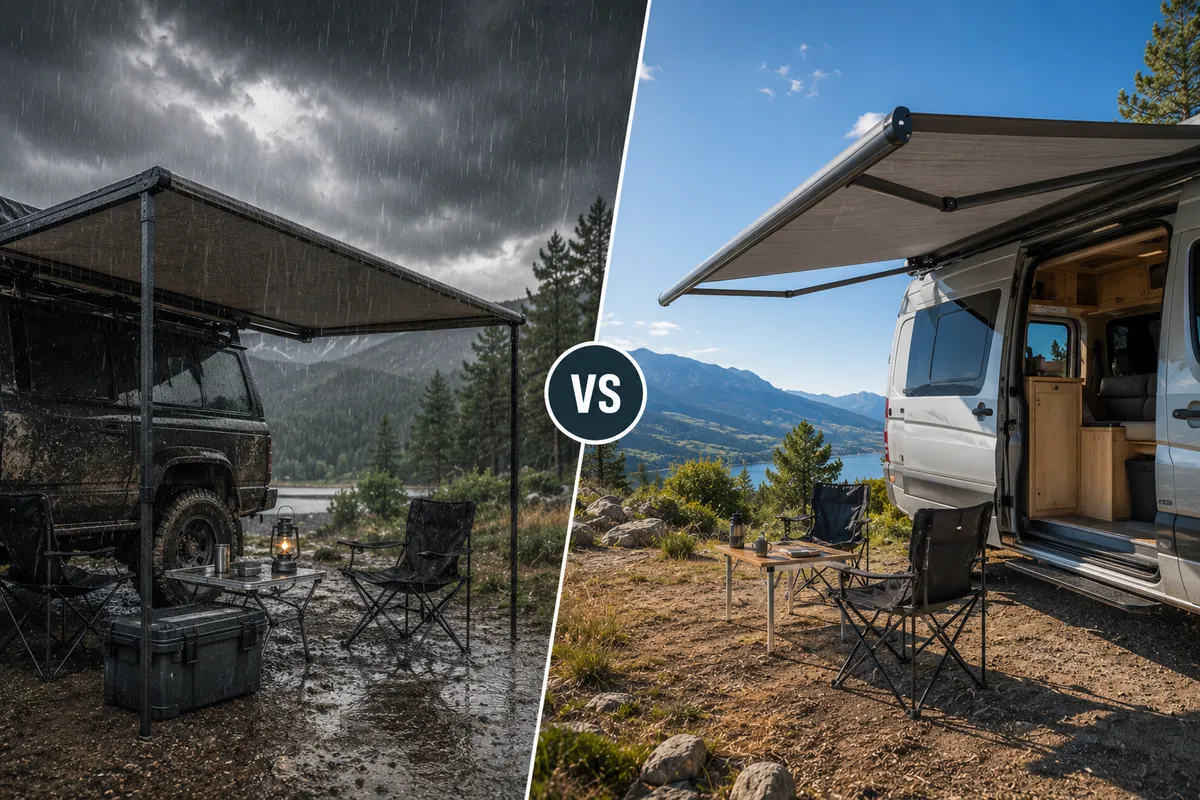
Use a fixed awning for a small door, window or narrow threshold where steady cover matters more than winter sun.
Do not use it as broad patio cover if the dining area needs adjustable shade or the wall takes heavy wind.
Best when:A small opening needs permanent shade or light rain deflection.
Check first:Wall attachment, runoff line and whether winter sunlight should still reach the glass.
Watch out:A fixed frame stays exposed during wind, snow and shoulder-season low sun.
Compare fixed and retractable awnings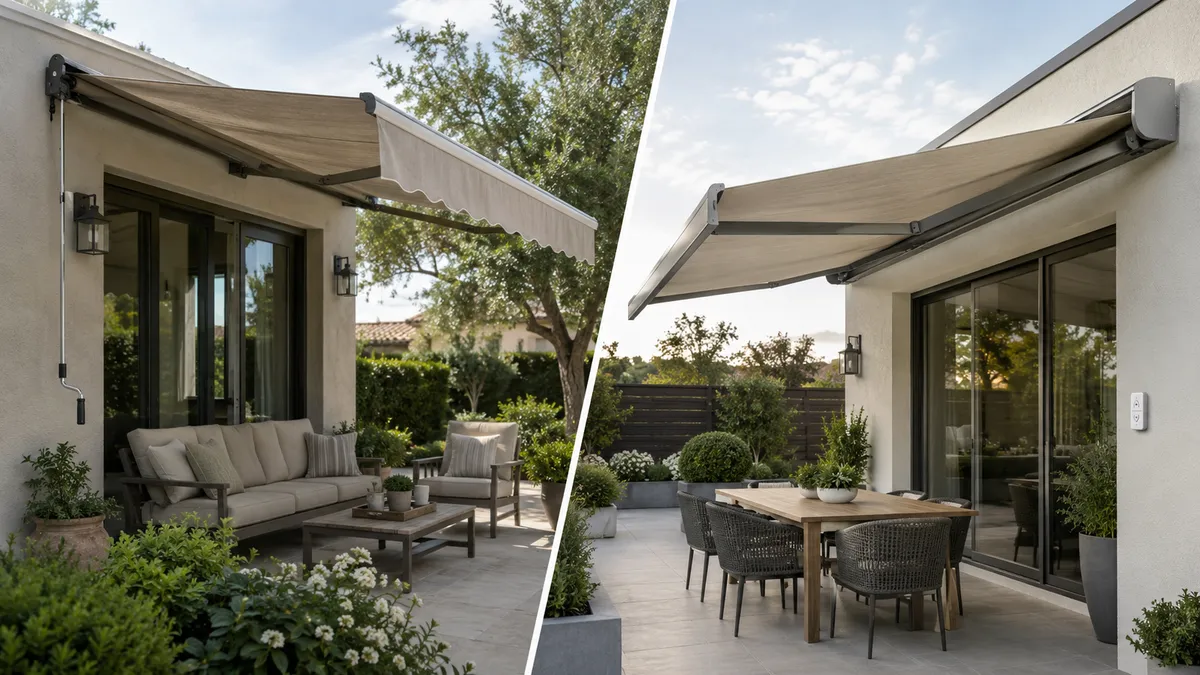
Manual retractable awning
Use a manual retractable awning when the crank is reachable and shade is needed for predictable lunches, weekends or summer afternoons.
It keeps wiring simple, but it only helps if someone will close it before wind, storms or long absences.
Best when:The awning is modest in width and the crank can be used without a ladder.
Check first:Crank reach, projection, front-bar clearance and the wall bracket line.
Watch out:A hard-to-reach crank turns a simple awning into fabric that may be left open too long.
Compare manual and motorized awningsMotorized retractable awning
Use a motorized retractable awning when the unit is high, wide, deep or opened most days.
Plan the outlet, switch, manual override and sensor testing before treating the motor as a convenience upgrade.
Best when:Daily shade needs fast opening and closing from a wall switch or remote.
Check first:Outdoor power, cord side, override access, wind routine and service access.
Watch out:A motor and wind sensor do not make open fabric safe in gusty weather.
Compare controls and wiring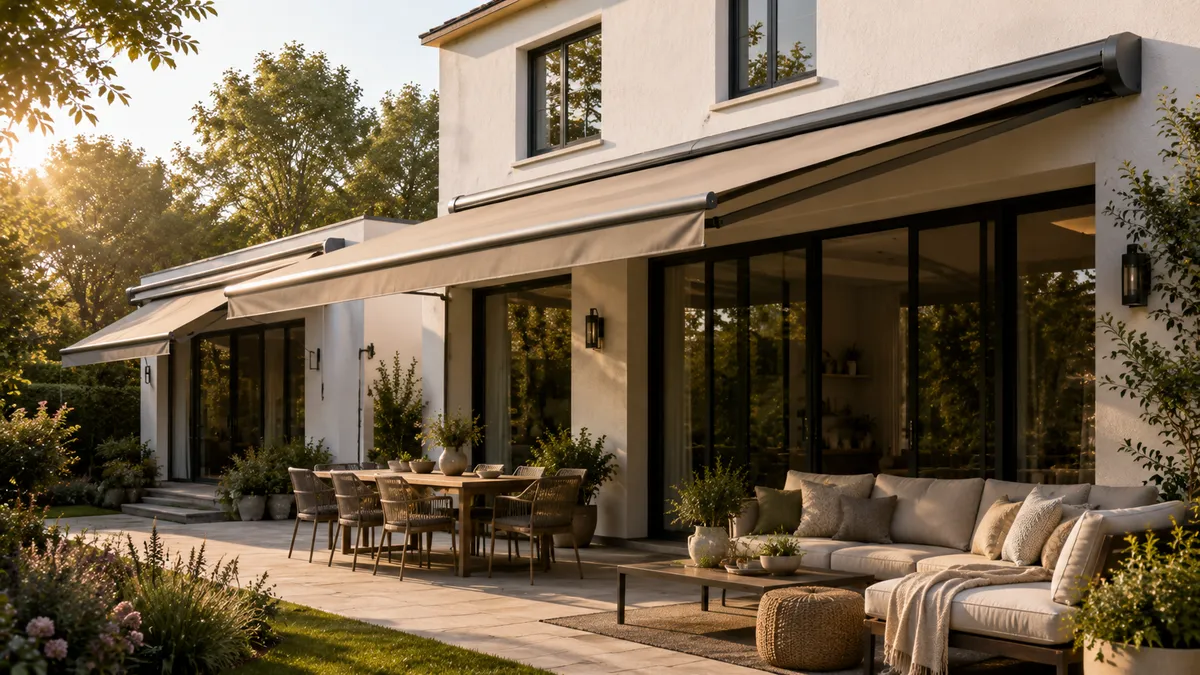
Open, semi-cassette or full cassette
Choose open frame, semi-cassette or full cassette by exposure after the bracket load is already settled.
A full cassette protects stored fabric and arms better on an exposed wall, but it adds cost, weight and service planning.
Best when:The awning will sit in sun, rain splash, tree litter or visible front-of-house locations.
Check first:Wall strength, cassette weight, fabric access and how repairs will be handled.
Watch out:Cassette housing protects storage; it is not permission to leave the awning open in storms.
Read the retractable awning guide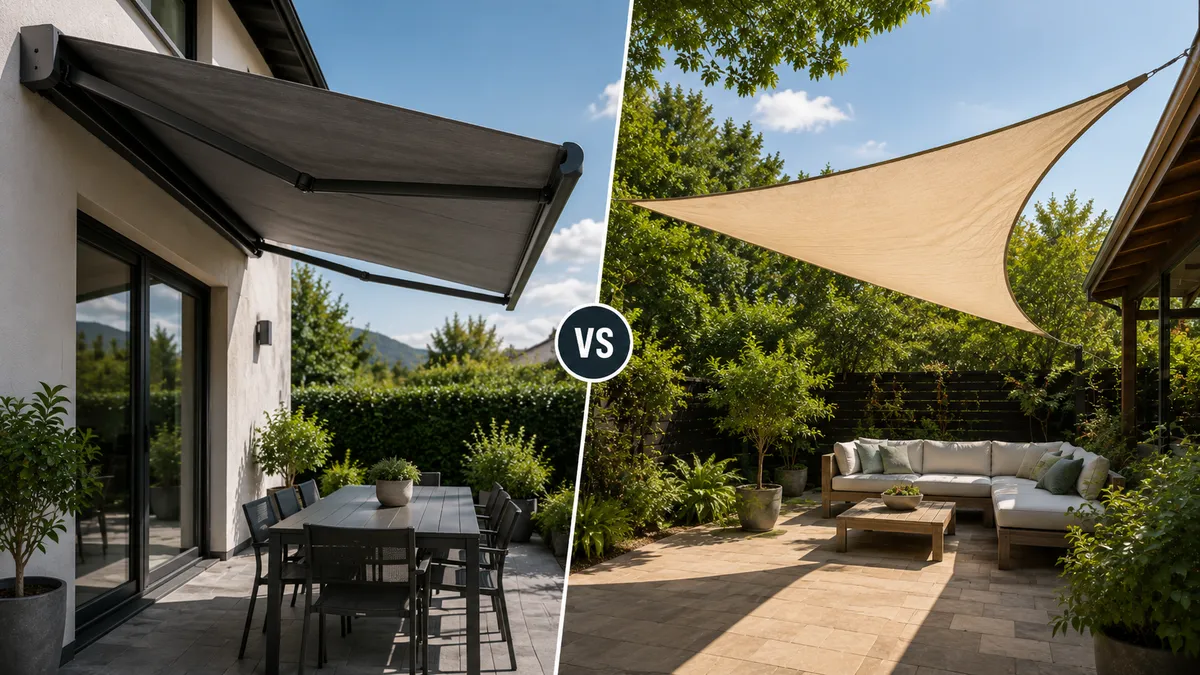
Use another shade type
Use a shade sail, umbrella, canopy, no-drill shade, drop valance or side screen when the awning cannot solve the actual site.
Detached seating, low west glare, rental rules and unknown cladding often need a different answer.
Best when:The failed hour is away from the wall, under the front bar, or blocked by permission and structure.
Check first:Distance from wall, low-angle sun, lease or HOA rules, and whether posts or freestanding bases are realistic.
Watch out:A deeper awning will not fix low side glare or a wall that cannot carry brackets.
Compare sail and awningSize, projection and front-bar clearance
Size the shade zone first. A patio awning title may advertise width, but the useful shade depends on outside frame width, fabric width, listed projection, horizontal shade depth, pitch and the front-bar low point. Rolltec lists retractable projection examples from 5 ft 4 in to 13 ft, while Roche describes patio-awning projections commonly sold in 50 cm steps and often below 400 cm. Treat those as manufacturer examples, not universal limits.
Treat projection as a sloped-fabric number, not a promise that the patio floor gets the same flat shaded depth. Rolltec's measuring guidance shows why pitch reduces usable reach, so send exact sizing questions to the awning size guide before ordering a deep arm.
Frame width, fabric width and shade width also differ. SunSetter says some fabrics can be 4.5, 7.5 or 10 in narrower than the awning width by model, and Rolltec says fabric is usually 5 to 6 in narrower than the outside frame. Before ordering, mark the bracket line, outside frame width, fabric edge and planned shadow separately.
Mounting height can stop the purchase even when the patio is the right size. SunSetter gives model-specific minimum height examples around 7 ft to 7 ft 6 in, while Solair says its awning cannot mount lower than 8.5 ft and needs 8 to 12 in of clear wall space. Check lights, vents, gutters, trim, downspouts and the motor cord side before choosing the projection.
Low east or west sun can still slide under overhead fabric. YourHome notes that low-angle sun is harder to shade and often needs vertical shading. If evening glare is the main complaint, a drop valance, side screen, exterior roller shade or planting may solve more hours than a deeper arm projection.
Measure
Measurement checks before choosing a size
Use the exact awning manual for final numbers. These checks prevent the common width and projection mistakes.
| Check | What to measure | Why it matters |
|---|---|---|
| Outside frame width | The full case or frame width on the wall | Brackets, trim, vents and gutters need uninterrupted space. |
| Fabric width | The actual cloth width between the arms | Fabric can be several inches narrower than the named awning width. |
| Projection | The sloped fabric length and the horizontal shade reach | A listed projection can overstate the flat shaded depth on the patio. |
| Front-bar clearance | The low front edge after pitch is set | A steeper rain pitch can lower the bar into the walking or dining area. |
| Clear bracket line | Wall height, obstructions and outlet side | Lights, downspouts, trim and cord routing can rule out a model early. |
Wall structure and bracket requirements
A wall-mounted awning loads the wall through brackets, arms and leverage. Advaning names wood framing, studs or headers, exterior siding only when real structural backing and spacers are used, and solid masonry such as brick, concrete or stone at adequate thickness as suitable examples. The safe question is not whether the wall looks strong; it is which structural backing carries the brackets.
Stop before buying if the proposed mount is vinyl siding alone, fascia alone, unknown cladding, deteriorated masonry, hollow brick, hollow block, cinder block, compressed wood or metal studs without a manufacturer-approved detail. Advaning warns that missed installation requirements can lead to awning damage, property damage, severe injury or death. That belongs in the quote conversation, not in fine print after delivery.
A wide or deep awning can need more brackets, better wall build-out or a different model. The arms multiply the load as the fabric extends, and wind can turn a clean-looking wall rail into a high-stress point. If an installer cannot explain the load path from bracket to framing or solid masonry, use freestanding shade until the wall is inspected.
Wall space is also practical, not just structural. SunSetter says wall brackets commonly need 8 in of clear horizontal space along the awning width, and Solair cites 8 to 12 in for its awnings. A light fixture, gutter drop, uneven stone band or outlet on the wrong side can make a chosen awning awkward even when the wall can carry it.
Fixed, manual, motorized and cassette specs
A fixed awning is the simplest patio-awning family: small frame, permanent cover, fewer moving parts. It can work for a door or window that needs steady shade or light rain deflection. It is a poor broad-patio answer when winter solar gain matters, low sun comes from the side, or weather exposure is too high for a permanent open frame.
A manual retractable awning is the low-complexity adjustable route. It makes sense when the crank is easy to reach, the projection is modest and the patio is used on predictable days. If closing the awning requires a ladder, awkward reach or too much effort, manual hardware can fail in daily life even though it looks reasonable in a catalog.
A motorized retractable awning is mainly about making closing easy enough to happen. It fits wide, high or daily-use patio shade when an outdoor power route, cord side, switch, remote, manual override and service access are planned. YourHome's point about adjustable shading needing active operation applies here: automation helps only when the controls are maintained and people still respect weather limits.
Open frame, semi-cassette and full cassette describe storage protection, not storm strength. Lippert/Solera separates open awnings that leave fabric and arms exposed, semi-cassette housing that protects stored fabric while arms remain partly exposed, and full-cassette housing that encloses the fabric and arms. A full cassette can be worthwhile on an exposed wall, but it adds weight and cost before the brackets ever see wind.
Fabric specifications matter after the route is right. The U.S. Department of Energy notes that modern awning fabrics are often synthetic acrylic or polyvinyl laminates, water-repellent and treated against mildew and fading. It also recommends opaque, tightly woven fabric and notes that lighter colors reflect more sunlight. None of that turns the awning into a storm roof.
Installed cost and what changes the quote
Compare installed cost, not fabric price. HomeGuide lists deck, porch and patio retractable awnings around $600-$3,000 installed for manual models and $1,000-$6,000 for motorized models. It also lists labor around $100-$400 for small manual awnings and $400-$1,000 for larger or motorized units. Those are planning ranges, not quotes for a specific wall.
The price changes when width, projection, cassette housing, motor, controls, wind sensor, rain sensor, power route, bracket count, access and wall correction change. Angi also flags width, projection, manual versus motorized controls and semi-cassette style as cost drivers. A cheaper awning can become expensive if the wall needs blocking, spacers, masonry work or an electrician.
Ask each quote to separate the awning, brackets, labor, power, sensors, wall correction and service access. That makes a manual crank, motorized awning and full cassette easier to compare without unsupported rankings. If two quotes differ sharply, the missing line is often wall preparation, electrical routing or who handles later fabric and motor service.
Do not let accessories hide the main check. A wind sensor, hood, lights or a cleaner cassette profile should come after projection, structural backing and weather routine. Somfy's Eolis material says the wind sensor does not protect awnings from strong gusts, so a sensor should be treated as backup help, not as permission to leave the fabric open.
Cost
What to ask for in an installed awning quote
Use these ranges as planning context, then ask local installers to break out the real line items.
| Line item | Planning range or driver | Ask this before approving |
|---|---|---|
| Manual patio awning | $600-$3,000 installed for many deck, porch and patio cases in HomeGuide | Does the price include brackets, wall checks and final pitch setup? |
| Motorized patio awning | $1,000-$6,000 installed in HomeGuide's patio/deck/porch range | Where will power, switching, override access and service happen? |
| Labor | $100-$400 small manual; $400-$1,000 larger or motorized in HomeGuide | What wall condition or access problem changes that labor line? |
| Cassette, hood, sensors and controls | Cost rises with protection, automation and sensor hardware | What added weight, wiring or service access comes with the upgrade? |
| Wall correction | Varies by substrate, blocking, spacers, masonry and exterior finish | Who verifies structural backing before the awning is ordered? |
Ranges are planning context from cited cost guides. Local quotes can move outside them.
Wind, rain and when an awning is the wrong shade
Follow the product manual for weather limits. SunSetter's 900XT/1000XT manual warns that awning fabric and structure are not designed to support pooled water or excessive wind, and it calls for complete retraction in stormy unattended conditions. Water-repellent fabric, a cassette case and a wind sensor do not change that basic rule.
Rain claims need pitch, runoff and supervision. Roche recommends at least 14 degrees of pitch for rain runoff on patio awnings, but that commercial guidance is not a universal guarantee. If water pools after tilt or drainage adjustments, the safe action is retraction, not adding weight to the front bar or assuming the fabric will drain later.
Use another shade when the patio problem sits outside awning strengths. A shade sail or freestanding canopy fits detached seating away from the house. A weighted umbrella or no-drill screen fits rental, HOA or unknown-wall situations. A drop valance, side screen, exterior roller shade or planting fits low-angle sun that slips below the front bar.
Choose a fixed door or window awning when the problem is a small drip line over one opening. Choose a pergola, roofed structure or rated permanent cover when the job is unattended weather shelter. A retractable patio awning is comfort shade beside the house; it should not be treated as a snow, storm or all-weather roof.
Alternatives
When a patio awning is not the right answer
Use these alternatives when the site fails the wall, weather or sun-angle checks.
| Situation | Use instead | Reason |
|---|---|---|
| Dining area sits well away from the wall | Shade sail with proper posts, freestanding canopy or umbrella | A wall awning cannot project far enough without excessive arm load. |
| Low west or east glare enters below the front bar | Drop valance, side screen, exterior roller shade or planting | Low-angle sun is a side-shade problem. |
| Wall structure, lease or HOA approval is uncertain | No-drill shade, weighted umbrella or removable screen | Do not add brackets until the wall and permission are verified. |
| Small doorway mainly needs rain deflection | Fixed door or window awning | A broad retractable patio unit may be more hardware than the problem needs. |
| Cover must stay out during storms, snow or unattended rain | Pergola, roofed structure or rated permanent cover | Retractable fabric should be closed before unsafe weather. |
Where to go next
If adjustable wall shade is still the right route, read the retractable awning guide next for manual, motorized, cassette, fabric and maintenance detail. If the remaining choice is crank versus motor, use the manual versus motorized awning comparison before paying for wiring or sensors.
If the measurements are unclear, use the awning size guide before ordering fabric. If the patio is detached, windy, post-friendly or close to the edge of normal projection reach, compare shade sail versus awning before forcing the house wall to solve the job.
Keep the page order simple: prove the wall, measure the shade zone, choose the awning family, price the installed work, then decide whether weather and low-angle sun still point to an awning. If one of those checks fails, change shade type before changing fabric color.
- Use /retractable-awning-guide/ for manual, motorized, cassette and fabric depth.
- Use /manual-vs-motorized-awning/ for power, override, sensor and daily-use tradeoffs.
- Use /awning-size-guide/ for width, projection and clearance detail.
- Use /shade-sail-vs-awning/ when posts, distance from the wall or fixed shade may fit better.
Watch-outs
Before you buy or install
- Do not attach a patio awning to vinyl siding, fascia, hollow block or unknown cladding unless the manufacturer-approved structural backing is reached.
- Water-repellent acrylic or laminated fabric is not a storm roof; retract before pooling water, strong gusts, snow or uncertain unattended weather.
- A wind sensor is backup help only. Test it and still follow the awning manual.
- Use a drop valance or side shade when low-angle sun comes under the front bar.
Read Next
Related hub
Retractable Awning Guide
Use this when retractable awning is closer to the real constraint than the current page.
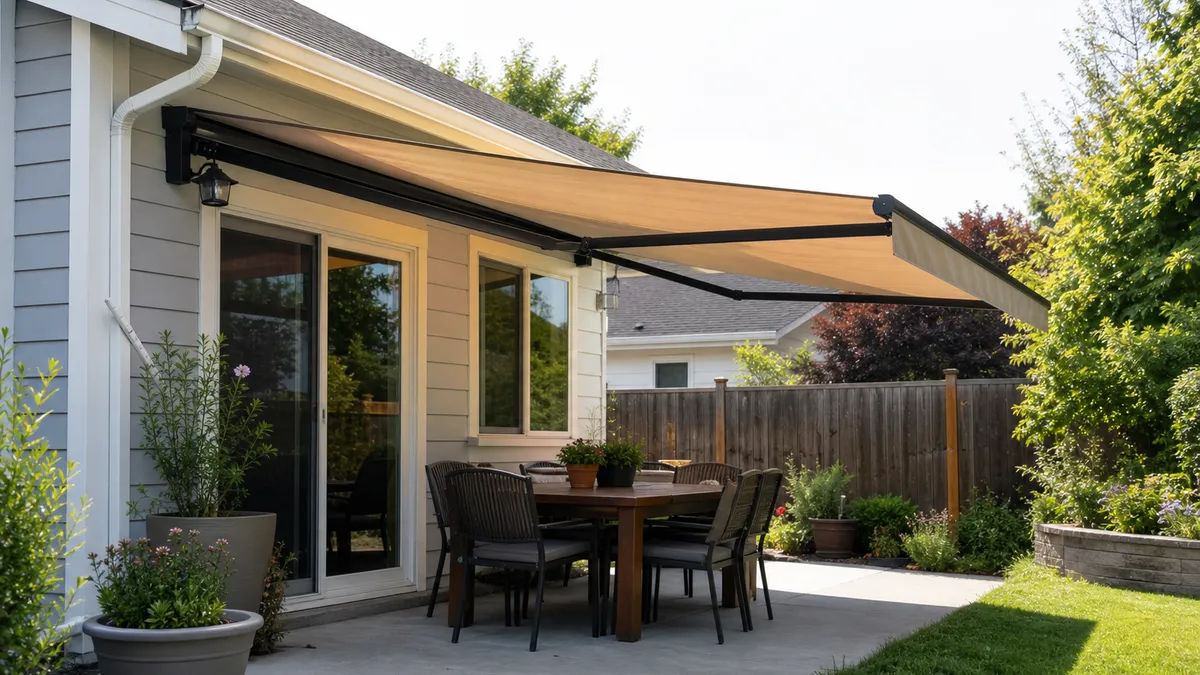
Best Retractable Awning for Patio
Use this when best retractable awning for patio is closer to the real constraint than the current page.
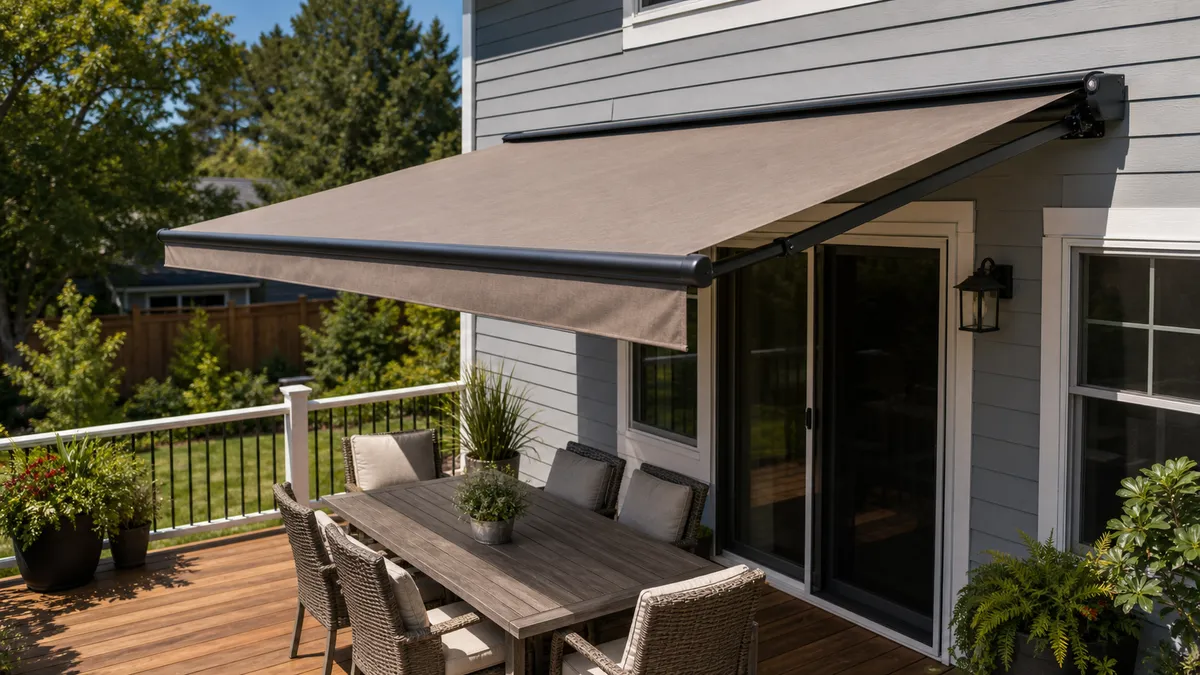
Awning Size Guide
Use this when awning size guide is closer to the real constraint than the current page.
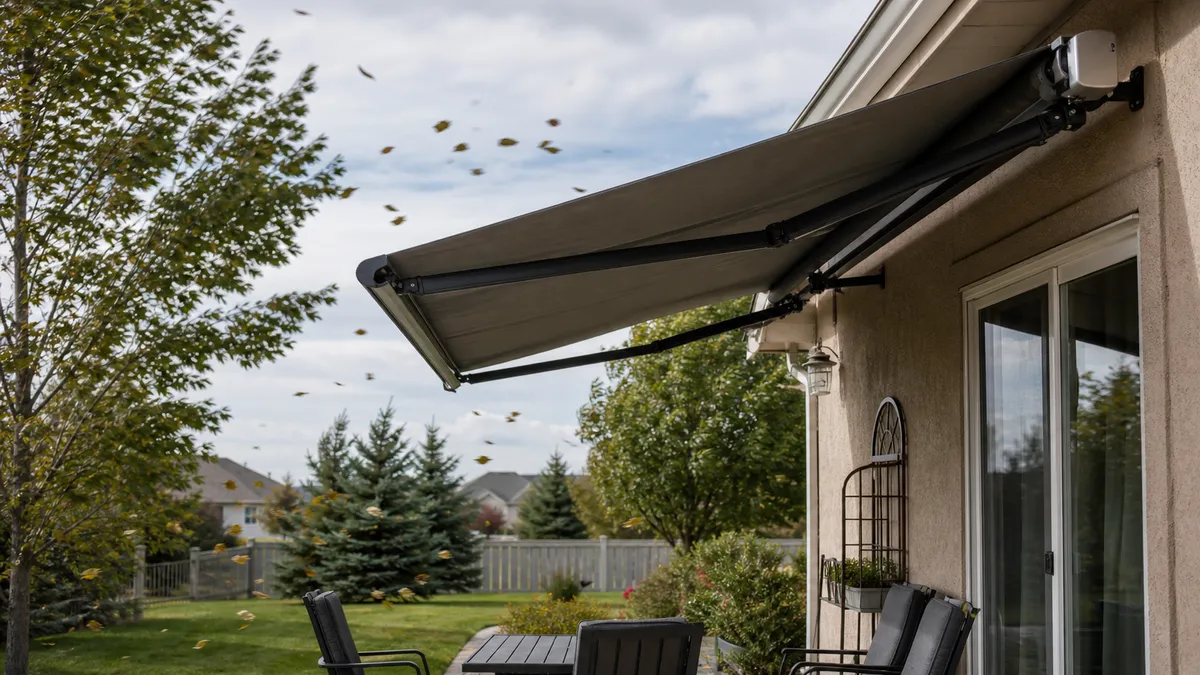
Awning Wind Rating
Use this when awning wind rating is closer to the real constraint than the current page.
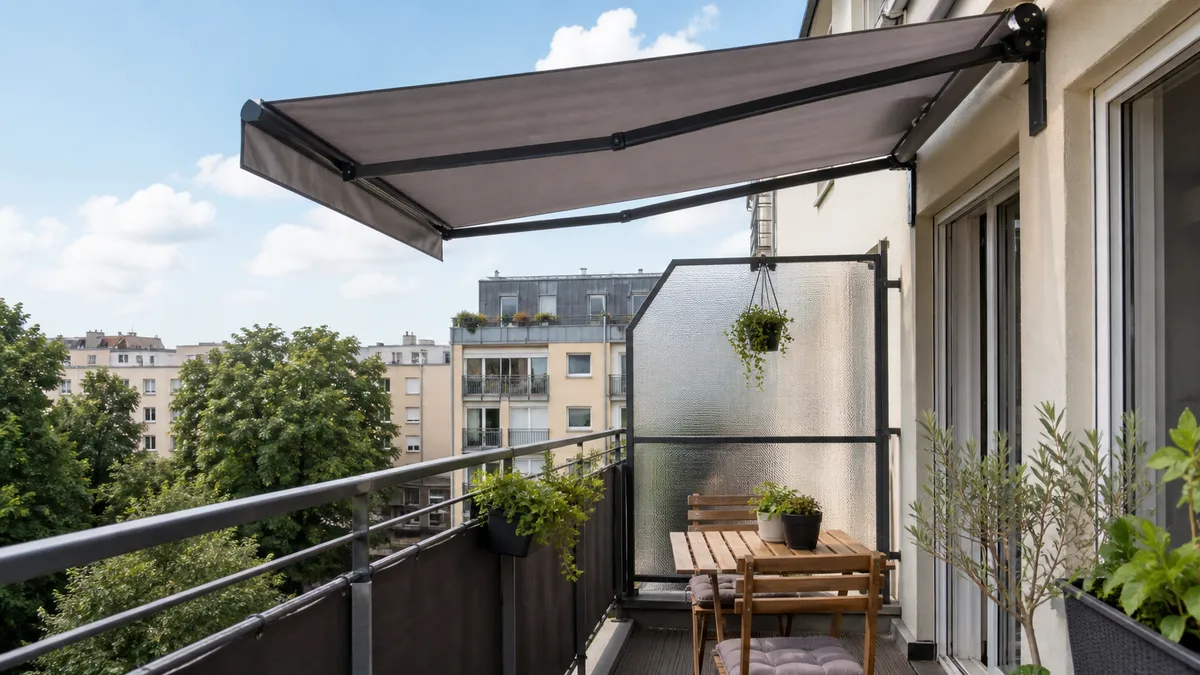
Awning for Balcony
Use this when awning for balcony is closer to the real constraint than the current page.
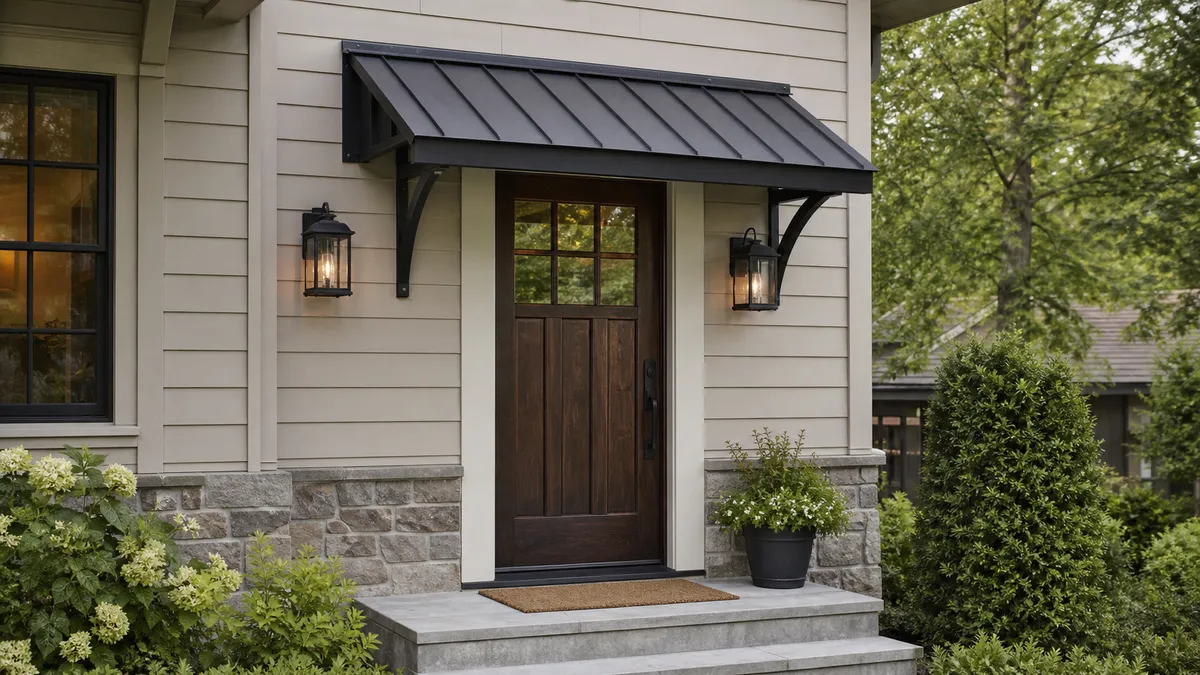
Awning for Front Door
Use this when awning for front door is closer to the real constraint than the current page.
Manual vs Motorized Awning
Use this when manual vs motorized awning is closer to the real constraint than the current page.
Fixed vs Retractable Awning
Use this when fixed vs retractable awning is closer to the real constraint than the current page.
Shade Sail vs Awning
Use this when shade sail vs awning is closer to the real constraint than the current page.
Questions
FAQ
How far can a patio awning project?
Many patio awnings sit in the rough 2 to 4 m planning range, but manufacturer limits vary. Check the listed projection, the horizontal shade depth, pitch and front-bar clearance together. A 10 ft sloped projection can give slightly less flat patio coverage.
How wide should a patio awning be compared with the door or seating area?
Measure the shade zone, not only the door. The outside frame width, fabric width and shadow width can differ by several inches. Leave clear wall space for brackets, lights, gutters and trim, then confirm that the fabric covers the table or chairs during the failed hour.
Can a patio awning be mounted on siding, brick, fascia or a soffit?
Only if the product instructions allow the exact substrate and the brackets reach structural backing or suitable solid masonry. Vinyl siding, fascia, hollow brick, hollow block, metal studs or unknown cladding should stop the purchase until a qualified installer verifies the load path.
Is manual or motorized better for a patio awning?
Manual works when the crank is easy to reach and the awning is used occasionally. Motorized makes more sense for wide, high or daily-use shade, but power, override access, service and weather closing still need planning before the motor matters.
Is a full cassette patio awning worth it?
A full cassette can be worth it on an exposed wall because stored fabric and arms get more protection from sun, rain splash and debris. It also adds cost and weight. It does not make the awning safe to leave open during wind, storms or pooling rain.
Can a patio awning stay out in rain or wind?
Follow the exact manual. Light rain claims depend on pitch, runoff and model limits. Pooled water, strong or gusty wind, snow, storms or uncertain unattended weather should trigger retraction, even when the fabric is described as water-repellent.