
Quick Answer
Driveway shade sails: the short version
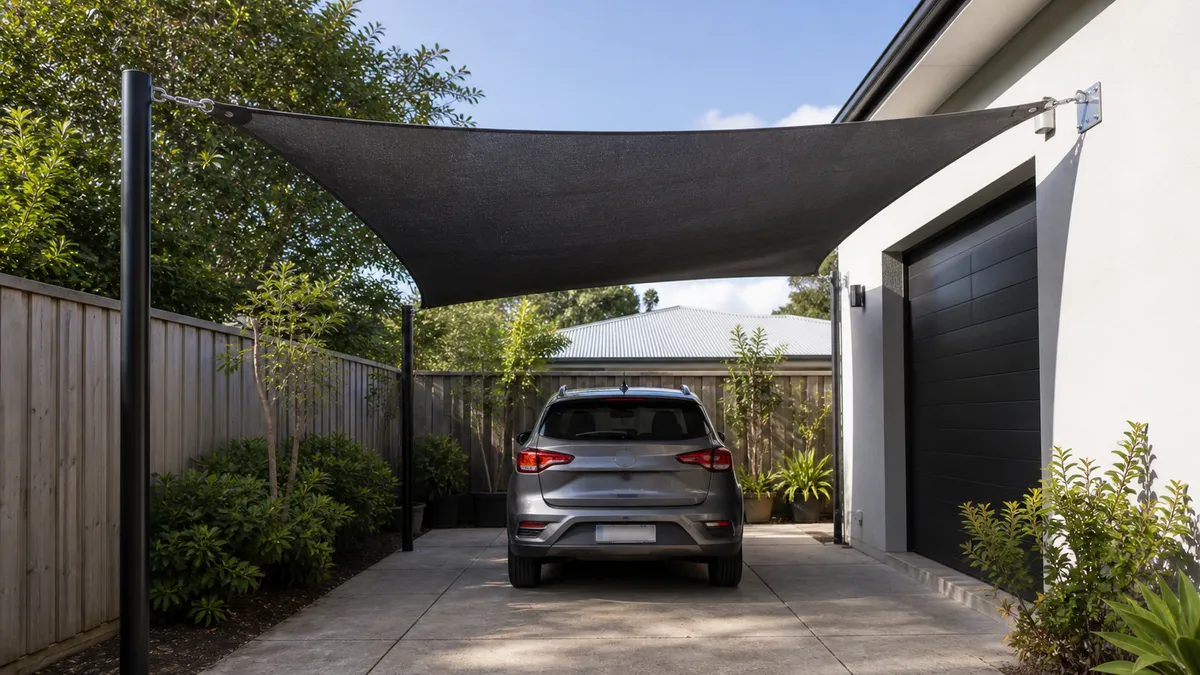
A shade sail for driveway parking is worth buying for seasonal sun reduction only when anchors, vehicle clearance, runoff, wind removal and local rules all work. Choose mesh for simpler drainage. Do not buy one as a cheap substitute for hail, snow, security, guaranteed rain protection or a code-compliant carport.
Choose a rectangle mesh driveway sail when verified anchors clear the parked car and one person can remove it before strong wind; choose a carport or canopy when roof-like protection is required.
Buying Direction
What to buy for driveway shade
Use this table after anchor, clearance, wind, runoff and approval checks pass.
| Situation | Buy / use this | Why |
|---|---|---|
| One-car driveway needs seasonal roof, hood and windshield shade, with four verified fixing points available | Use a rectangle mesh sail with corrosion-resistant hardware and room for turnbuckles. | A four-point mesh sail gives broader parked-car shade and easier drainage than a triangle or flat coated fabric. |
| Only one side of the car gets harsh low morning or afternoon sun | Use a small side-focused triangle or angled rectangle instead of oversizing the whole sail. | Low-angle sun can miss an overhead shade plan, so the sail must answer the failed hour. |
| No usable wall anchors exist, but posts can sit outside doors, gates, bins and turning paths | Set the post plan first, then size the fabric from the final fixing points. | Posts control tension, clearance and cost; fabric size comes after the corners are real. |
| Rain shedding is part of the reason for buying | Buy waterproof fabric only when the manual's slope, low corner and runoff route all work. | Flat coated fabric can pool water above the vehicle and add load to anchors. |
| Only gutters, trim, weak fence posts, hollow masonry or unchecked fascia are available | Do not buy the sail first; get the structure checked or use a freestanding shade. | The fixing point is the safety problem, not the fabric size. |
| The car needs hail, snow, falling-branch, security or year-round rain protection | Choose a carport, garage, metal canopy or engineered driveway cover. | A fabric sail is sun shade over a parked car, not a roofed parking structure. |
What to buy for a driveway shade sail
Start with a rectangle mesh sail when the driveway needs seasonal sun reduction over a parked vehicle and has four verified fixing points. Compare colors later; first make sure the sail clears the car, tensions cleanly and can come down before rough weather.
Use a triangle sail for a narrower problem. It can block one harsh morning or afternoon sun angle when the rest of the driveway is already usable. Do not expect a triangle to shade the roof, hood, windshield and side panels of a full-size vehicle at the same time.
Treat posts as part of the install, not an add-on. Mississippi State University Extension says each sail corner needs an anchor, posts should be secured with concrete, and posts must be sturdy enough for wind. On a driveway, those posts also have to avoid doors, liftgates, garage access, trash bins, trailer paths and turning radius.
Waterproof fabric asks more from the driveway than mesh. It can shed rain only when the chosen product allows the required slope, the low corner has somewhere safe to drain, and tension is maintained. If the slope would dump water onto the car, the garage threshold, a sidewalk or a neighbor's side, use mesh or a roofed structure instead.
- Buy mesh first for sun reduction and airflow over a parked vehicle.
- Use a side-focused triangle only for a narrow glare problem, not whole-car coverage.
- Plan posts before fabric when no existing wall or masonry anchor is proven.
- Move to a carport or canopy when the vehicle needs weather protection.
Driveway layouts that actually work
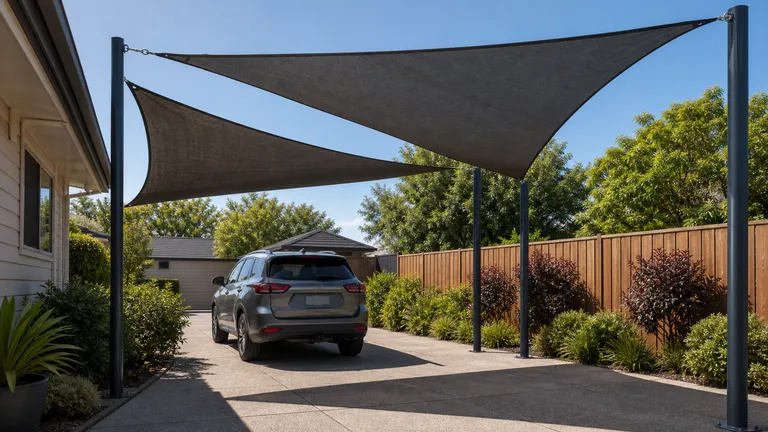
The best layout is the one that shades the parked car at the failed hour without putting posts or low corners into the vehicle path. Park the vehicle where it normally sits, then check the roof, windshield, dashboard, hood and exposed side panels when the heat problem happens.
A wall-to-post layout can work beside a garage when the wall fixing points are structural and the posts sit outside the backing path. Skip it when the wall side is only trim, gutter, thin fascia or unverified masonry. Auckland Council flags wind loading and weathertightness issues when shade sails attach to buildings, so wall attachment deserves more than a quick screw-in bracket.
A post-to-post or four-post layout gives cleaner control over the corners, but it can make the driveway harder to use. A post that sits neatly on paper can block a driver-side door, a wide liftgate, a trailer swing, a snow-clearing route, a trash-bin path or the turn into the garage.
A two-car driveway needs an extra check: shade for one bay can steal clearance from the other. If the sail has to stretch over both cars, the post plan, anchor strength and wind exposure matter more. In that case, compare the setup with the dedicated shade sail for carport guide before assuming fabric will save money.
Low morning or afternoon sun can defeat an overhead plan. EPA's UV guidance uses shadow length to show how sun angle changes exposure through the day, and Mighty Covers notes that a shade sail's shadow moves as the sun moves. Check noon shade, then check the side-sun hour that actually heats the vehicle.
- Wall-to-post: useful only when the wall fixing points and moisture details are verified.
- Post-to-post: cleaner for tension, but dangerous if posts intrude into vehicle movement.
- Four-post: better control for a single bay, with more concrete, permit and access questions.
- Side-sun layout: smaller and angled, built for one glare direction rather than broad coverage.
Clearance check
What can make the right sail size wrong
Run these checks with the vehicle parked in its normal spot.
| Clearance item | Why it matters | No-buy signal |
|---|---|---|
| Doors and liftgate | A low corner or post can block normal loading even if the roof is shaded. | You cannot open the driver door or hatch without touching fabric, post or hardware. |
| Garage door and gate travel | Moving parts need clear travel below and beside the sail. | The door, gate or opener path passes through the proposed fabric or tension line. |
| Roof rack, antenna or cargo box | Accessories raise the vehicle and can catch a low edge. | The tallest carried item has not been checked under the lowest corner. |
| Trash bins, trailer and snow clearing | Driveways are working spaces, not only parking pads. | Permanent posts would block regular access after installation. |
Category research
Driveway shade sail categories to compare
These are category directions, not ranked product picks. Compare them only after the driveway anchors, vehicle clearance, runoff and rules pass.
Broad shade
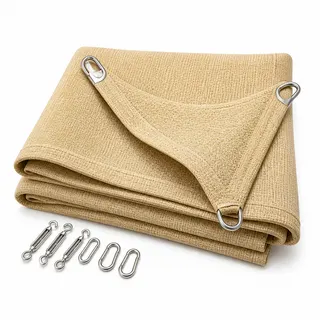
Rectangle mesh shade sail
For one-car seasonal shade when four fixing points are verified.
- Better whole-car coverage than most triangles
- Simpler drainage than coated fabric
- Still needs a wind routine
Check:Fixing points, hardware gap, curved-edge coverage and parked-car clearance.
Research category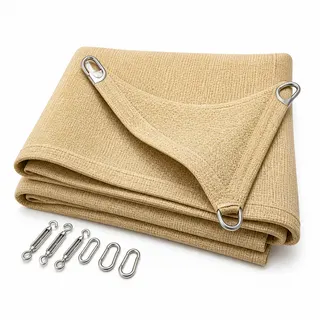
Rain caveat
Waterproof shade sail
For rain shedding only when slope and runoff are solved.
- Needs high and low corners
- Can pool when flat or loose
- Runoff must miss the vehicle
Check:Manual slope, low corner, drainage destination and tension maintenance.
Research category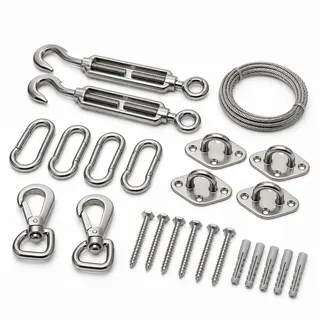
Hardware
Shade sail fixing kit
For matching turnbuckles, pad eyes and shackles to the anchors.
- Tensioning space affects fabric size
- Fasteners must match the substrate
- Hardware cannot rescue weak anchors
Check:Material grade, fastener compatibility, wall or post structure and corrosion exposure.
Research categoryPosts vs wall anchors
Posts are often cleaner on a driveway because they can be placed where tension, height and shade all line up. They are not automatically cheaper. Posts can require footings, concrete, digging, utility checks, boundary checks, hardware and labor before fabric is even ordered.
Wall anchors can save space, but only when the wall can carry the load. Coolaroo installation guidance says fixing points must be structurally sound and recommends builder or engineer advice when strength is uncertain. Mighty Covers gives the same warning for uncertain fixing points.
Fascia attachment is a special case. Coolaroo recommends fascia support to transfer load to the roof structure, and Auckland Council warns that building attachments can raise wind-loading and weathertightness issues. Do not treat garage fascia as a casual driveway anchor.
Existing fence posts are usually a bad assumption over a car. They may be sized for fencing, not sail tension, wind uplift or water load. If the post can move by hand, is rotten, is set shallowly or sits in a weak fence line, it is a stop signal.
- Better anchors: purpose-built posts, suitable masonry, verified framing or engineered steel.
- Risky anchors: gutters, decorative trim, weak fence posts, rotten timber and hollow masonry.
- Fascia needs proper support and moisture detailing before it carries sail tension.
- Ask for qualified advice when the wall, post or fixing point is not clearly structural.
Anchor check
Which fixing points deserve a driveway sail
A good sail over a car starts with the anchors, not the fabric shape.
| Fixing point | When it can work | When to stop |
|---|---|---|
| Purpose-built posts | They sit outside vehicle movement and are designed for tension and wind. | They block doors, turning, bins, snow clearing or property-line setbacks. |
| Structural wall or masonry | The load path, fasteners and moisture details are verified. | The surface is trim, hollow masonry, cladding or unknown framing. |
| Garage fascia | A support detail transfers load to the structure behind it. | It is treated as a simple board for an eye bolt. |
| Existing fence posts | Rarely, only after the post depth, condition and load capacity are confirmed. | The post moves, leans, is rotten or was built only for fence panels. |
Wind, waterproof fabric and water pooling
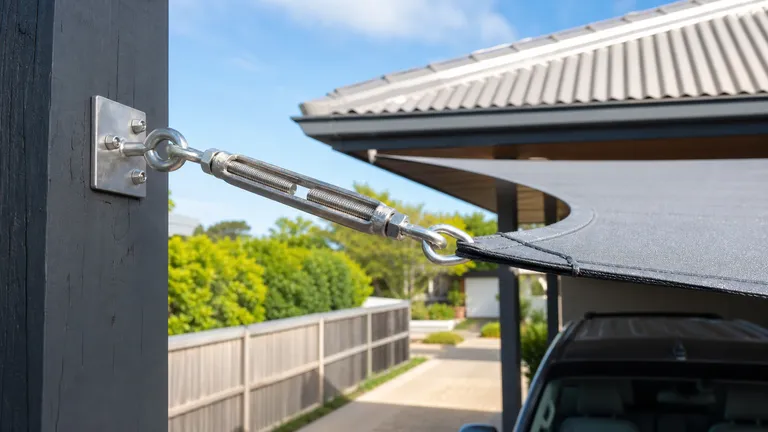
Wind is not a footnote for an open driveway. A patio may be partly sheltered by walls, but a driveway can be exposed to street wind, side-yard gusts and storm fronts. Coolaroo planning guidance says not to leave shade sails installed during strong wind and to remove them if windy conditions are expected.
Avoid universal wind-speed promises unless the exact sail manual gives them. Ask a simpler question: can one person loosen, lower or remove the sail before bad weather? If the answer is no, buy smaller, choose a more sheltered layout, or move to a structure designed for unattended exposure.
Mesh is usually the simpler driveway fabric because it breathes and drains. It reduces direct sun on the parts of the vehicle that sit under the shadow, but it will not keep the car dry. Wind-driven rain can still reach the sides, and reflected heat from pavement still matters.
Waterproof fabric demands more discipline. Mighty Covers warns that flat sails are harder to tension and can catch rain and wind. Shade Sails LLC warns that waterproof sails can stretch if water pools. Use the product manual's slope guidance, keep a low corner clear, and send runoff away from the car, garage threshold, public sidewalk and neighboring property.
- Use mesh when the goal is sun reduction with simpler drainage.
- Use waterproof fabric only with manual-approved fall and a safe runoff path.
- Remove or loosen the sail before strong wind when the product manual requires it.
- Do not route water onto the vehicle, into the garage or across a walking route.
Driveway shade sail cost drivers
Do not compare a fabric kit with a carport by the sail price alone. Fabric may be the lowest-cost line item; posts, footings, wall plates, turnbuckles, shackles, fasteners, concrete, labor, approval work and replacement hardware can drive the total.
The biggest cost jump usually appears when the driveway has no usable anchors. A sail between two verified walls and two existing structural posts is a different project from four new posts in concrete. If the posts need to avoid property lines, utilities, drainage, doors and turning paths, labor can matter more than fabric size.
Custom sizing can be worth it when the driveway is tight, but it depends on final fixing-eye measurements. Shade Sails LLC recommends measuring sides and diagonals after fixing points are installed for four-sided custom sails. That makes the project slower, but it can prevent a sail that looks close and still misses the windshield or door line.
Permits, HOA rules and lease restrictions can also change cost. Tucson's permit guidance shows that shade structures used as carports or occupiable space may need review regardless of size. Karratha and Auckland both show that some authorities ask for dimensions, location, post heights, boundary context and structural details for shade sails.
- Budget for fabric, posts, concrete, wall plates, turnbuckles, shackles and compatible fasteners.
- Add labor or structural advice when wall, fascia or masonry strength is uncertain.
- Add approval time when posts, front-driveway location or building attachment may trigger rules.
- Compare with a carport when posts and approval work erase the cheap-fabric advantage.
Installed total
Cost items to include before buying
Use this as a cost-driver list, not as a universal installed-price estimate.
| Cost item | Why it changes the total | Do not skip when |
|---|---|---|
| Sail fabric | Shape, fabric type and size decide basic coverage. | The car needs broad roof, hood and windshield shade. |
| Turnbuckles, shackles, pad eyes and fasteners | Hardware sets tension and consumes space at each corner. | The kit hardware does not match the real wall, post or masonry. |
| Posts, footings and concrete | New corners need support before the sail can be safely tensioned. | There are no verified existing fixing points. |
| Wall plates or fascia support | Building attachments can need load transfer and moisture details. | The sail attaches to a garage or house. |
| Labor or structural advice | Uncertain anchors over a vehicle carry property-damage risk. | The load path is unclear or the wall material is unknown. |
| Permit, HOA or lease work | Permanent posts and carport-like driveway shade can trigger local rules. | The install sits in a front drive, near a boundary or on rented/HOA property. |
| Removal and replacement hardware | Seasonal takedown is easier when the hardware is chosen for it. | The sail must come down before storms or winter storage. |
No exact dollar range is shown because the approved research supports cost drivers, not a universal installed price for every driveway.
What a driveway sail will not protect
A shade sail reduces direct sun where its shadow lands, but it does not make a parked vehicle safe for people or animals. National Weather Service heat safety guidance warns that parked vehicles can heat rapidly and are not safe for children, pets, disabled adults or vulnerable people. CDC heat guidance gives the same practical warning for pets.
Paint, dashboard and upholstery claims also need restraint. Shade can reduce direct sunlight on covered panels, and a National Highway Traffic Safety Administration hosted Hyundai service bulletin shows UV exposure can matter for some paint problems. That does not prove a driveway sail will prevent fading, peeling or interior wear on every vehicle.
A fabric sail is not hail protection, snow-load protection, security protection, falling-branch protection or a locked parking structure. If those are the buying reasons, the better comparison is shade sail versus carport, not a larger shade sail kit.
Fire is another firm limit. Keep grills, heaters and open flame away from shade fabric. Manufacturer instructions commonly warn against flame near sails, and a driveway install should not become a covered workshop for hot tools or fuel work.
- Never leave children, pets or vulnerable adults in a parked car because it is shaded.
- Do not promise exact cabin-temperature, paint-life or upholstery-protection gains.
- Do not use fabric as hail, snow, security or falling-branch protection.
- Keep open flame, grills and heaters away from the sail.
Permits, HOA rules and leases before drilling or digging
Rules vary by city, county, HOA and lease, so this page cannot give a universal permit answer. A driveway shade sail can become more than removable fabric once it uses permanent posts, building attachments, concrete footings or a front-yard carport-like position.
Tucson's permit guidance is a warning sign because shade structures used as a carport or occupiable space may require a permit regardless of size. Karratha's shade-sail guidance asks for items such as dimensions, location, boundary context and post heights. Auckland Council flags wind loading and building-attachment issues.
Check before digging, drilling or ordering custom fabric. Ask about setbacks, easements, property lines, public right-of-way drainage, HOA covenants, lease terms and historic or neighborhood overlays. A removable freestanding car shade may be safer when approval is uncertain.
If the approval process looks similar to a carport process, pause and compare the two projects directly. A more expensive engineered cover may be easier to justify than a fabric sail that still cannot meet the weather, security or year-round protection goal.
- Check local rules before setting permanent posts or drilling into a house or garage.
- Ask the HOA or landlord before changing the front driveway appearance.
- Keep runoff away from public sidewalks, neighbors and property boundaries.
- Use a removable shade when the approval answer is unclear.
Watch-outs
Before you buy or install
- Do not tension a driveway sail from gutters, decorative trim, weak fence posts, rotten timber, hollow masonry or unchecked fascia.
- Do not let waterproof fabric drain onto the car, garage threshold, sidewalk, neighbor property or public right-of-way.
- Do not leave the sail up in strong wind when the product manual calls for removal or loosening.
- Do not place posts where they block doors, liftgates, turning radius, bins, snow clearing, gates or trailer movement.
- Do not treat a shaded parked vehicle as safe for children, pets, disabled adults or vulnerable people.
- Do not drill, dig or attach near property lines, easements, HOA property or rented walls before checking the rules.
Read Next
Related guides if your situation is different
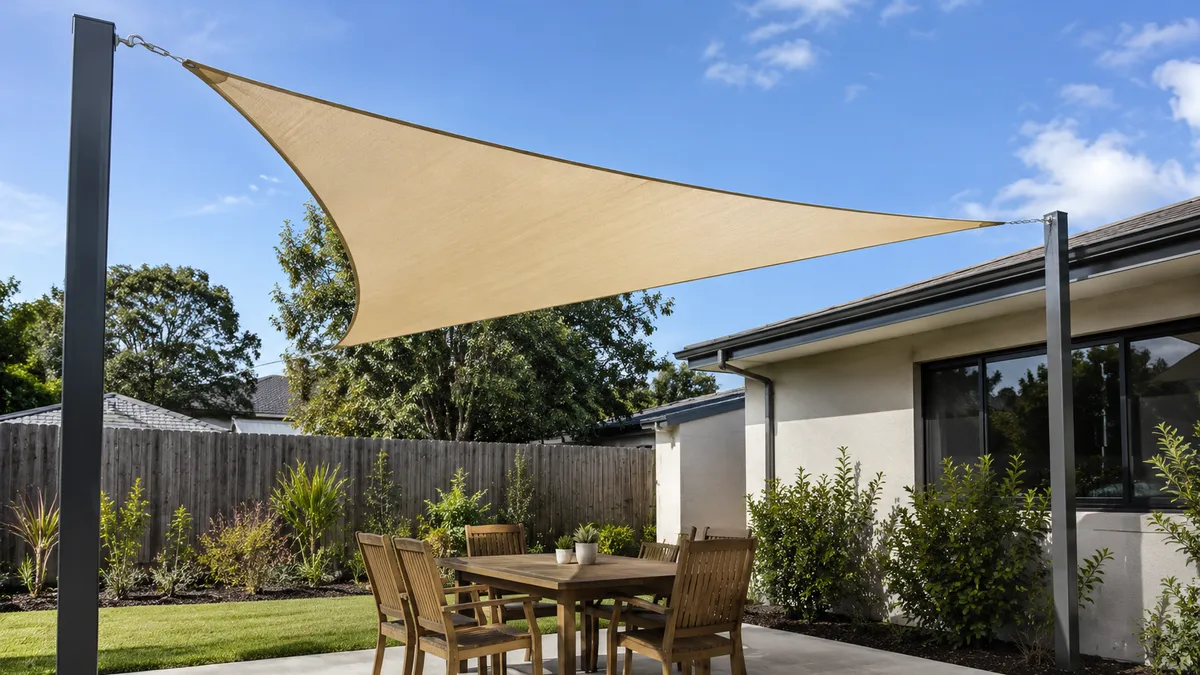
Shade Sail Guide
Use this for sail shape, anchor spacing, slope and hardware basics before adapting the plan to a driveway.
Shade Sail for Carport
Use this when the parking bay needs carport-style coverage and the driveway sail plan is starting to look permanent.
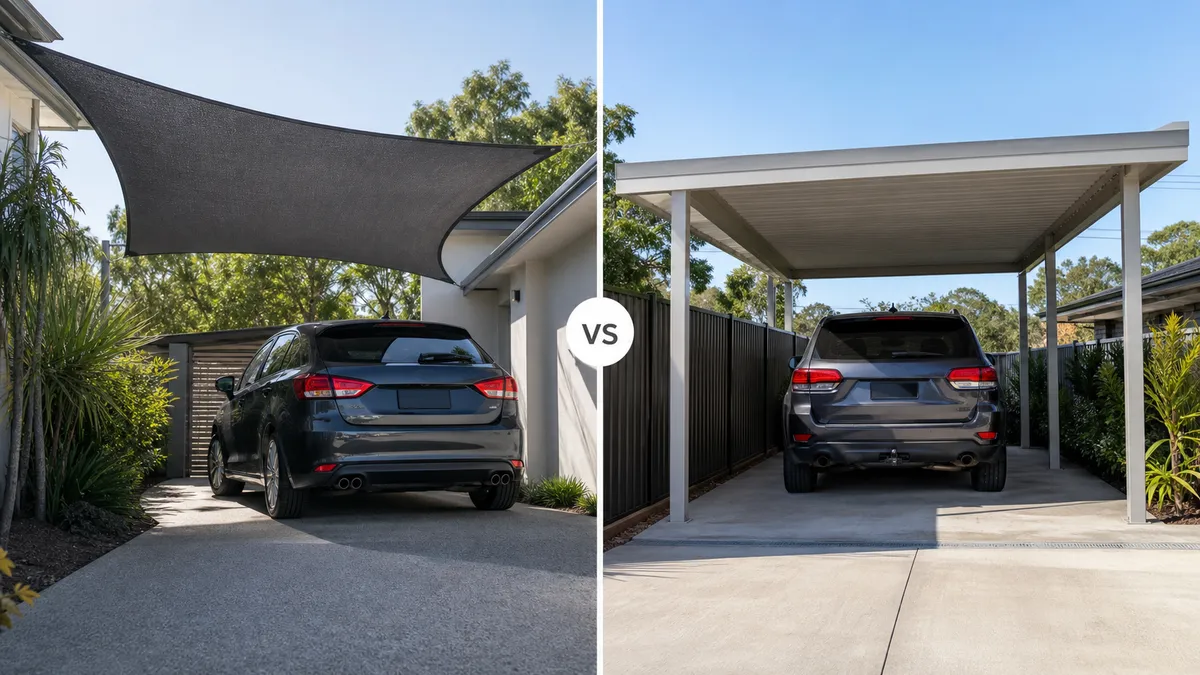
Shade Sail vs Carport
Use this when hail, snow, year-round rain, security or approval work may make a roofed structure the better buy.
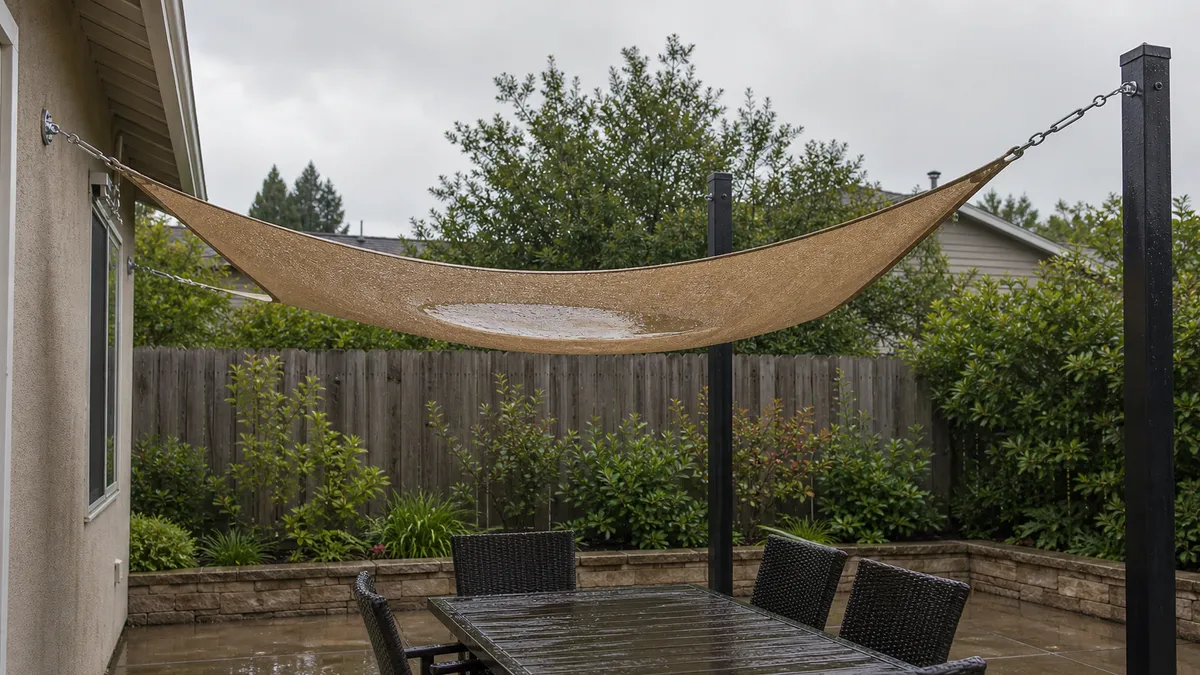
Shade Sail Water Pooling
Use this when coated fabric, low corners or rain runoff are the main risk over the parked vehicle.
Questions
FAQ
Can I put a shade sail over my driveway?
Yes, if the driveway has verified anchors, enough car clearance, a wind takedown routine, safe runoff and no local-rule problem. If posts would block parking or the only anchors are weak trim, gutters or fence posts, use a different car shade or get the structure checked first.
Is mesh or waterproof fabric better for a driveway shade sail?
Mesh is usually simpler for driveway sun shade because it breathes and drains. Waterproof fabric only makes sense when the product manual's slope, low corner and tension requirements can be met, and the runoff will not land on the car, garage threshold, sidewalk or neighboring property.
Can I attach a driveway shade sail to my garage or house wall?
Only use verified structural fixing points. Coolaroo and Mighty Covers both warn that uncertain fixing points need qualified advice, and fascia attachment may need support that transfers load to the structure behind it. Do not attach to gutters, decorative trim or unknown framing.
Will a shade sail protect my car from heat, UV and paint damage?
It reduces direct sun where the shadow lands, which can help exposed panels, but it cannot promise exact cabin-temperature, paint or interior results. It also does not make a parked vehicle safe for children, pets or vulnerable adults, even when the car is shaded.
Do I need a permit or HOA approval for a driveway shade sail?
Maybe. Rules vary, but permanent posts, building attachments, front-driveway location, setbacks, carport-like use, property lines, easements, HOA covenants and lease terms can all matter. Check the local building department, HOA or landlord before drilling, digging or ordering custom fabric.
When is a carport better than a driveway sail?
Choose a carport, garage, metal canopy or engineered cover when the vehicle needs hail, snow, falling-branch, security or year-round rain protection. A sail is a seasonal sun-shade purchase; once posts, approvals and structural advice become major costs, compare the roofed option directly.