
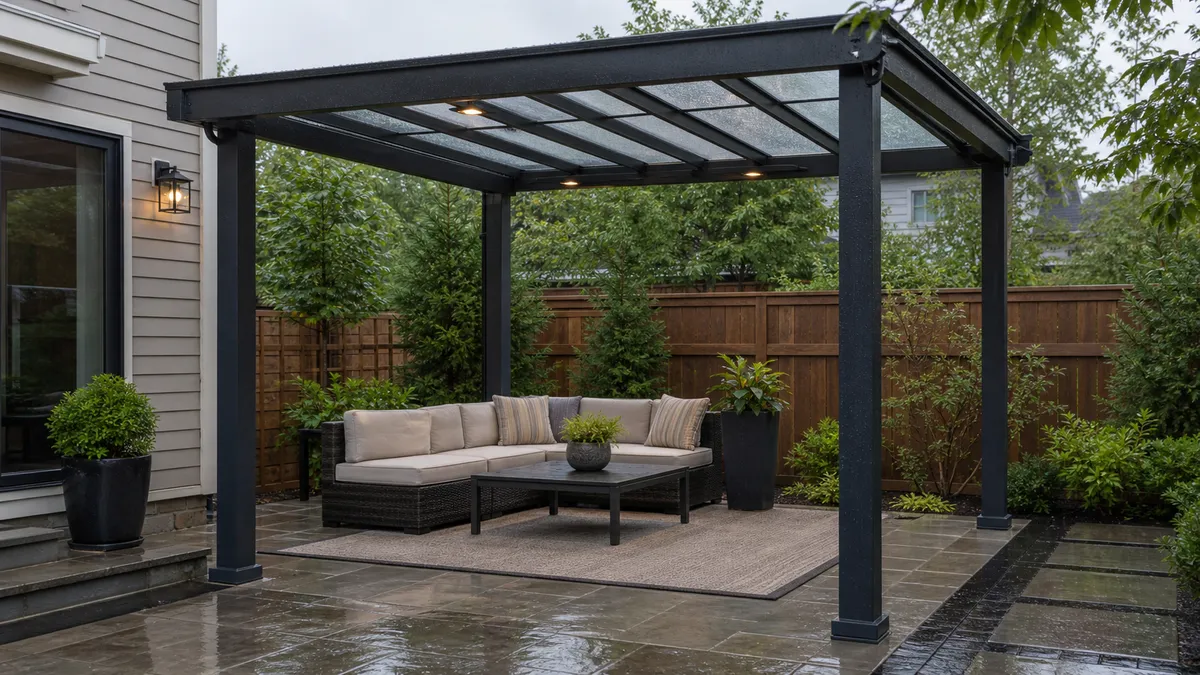
Quick Answer
Quick answer for rain cover
A pergola handles rain only when the roof material, slope, drainage path and structure are designed for water. Open rafters and breathable fabric are shade-first; fixed roof panels and some louvered roofs can manage rain when gutters, flashing and load checks are correct. Wind-driven rain, standing water, snow load and wet-location electrical work still need caution.
Choose fixed sloped roofing for the simplest dry seating, louvered roofing when open-close control is worth the cost and upkeep, and shade-only pergolas only when dry use is not the goal.
Buying Direction
Which rain-cover path fits?
Use this table for the first choice, then check the roof, drainage and safety details below.
| Situation | Buy / use this | Why |
|---|---|---|
| You need dry dining, door protection or an appliance-adjacent patio zone | Start with a fixed sloped roof or a louvered roof with a documented gutter and downspout route | Rain protection requires more than overhead material; water has to leave the roof without crossing doors, outlets, steps or work areas. |
| You mainly want airflow, filtered light and a patio that can get damp | Use an open frame, decorative slats or breathable shade fabric | Those choices can improve comfort, but Coolaroo and Tenshon both describe shade fabrics as weather-resistant or water-permeable rather than waterproof. |
| You want lower-complexity rain cover and can accept permanent shade | Compare fixed polycarbonate, metal or solid patio-cover roofing with the correct pitch, fasteners and flashing | A fixed roof has fewer moving parts than louvers, but panels add load and need manufacturer-specific slope and edge details. |
| You want sun when open and rain management when closed | Compare louvered roofs with integrated troughs, gutters, post drains and accessible cleaning points | Azenco and StruXure describe rain-managed louvered designs, but edge drips, wind-driven rain and clogged drains still matter. |
| The existing pergola is decorative, rotted, deck-mounted or attached to the house | Do not add panels, louvers or gutters until posts, beams, connectors, footings, deck support, ledger and flashing are checked | Roof panels, water, snow and wind surface change the load path and can also concentrate water against the building. |
| Rainwater would discharge toward steps, smooth tile, a foundation, outlets or an outdoor kitchen | Fix the drainage plan before buying the roof | HSE notes rainwater on smooth indoor or outdoor surfaces can create slip risk, and BASC warns that water should be directed away from foundations. |
Rain criteria before choosing a pergola roof
A pergola for rain starts with the dry-use target. Damp-tolerant lounge seating can live with edge drips and light mist. Dry dining, a door threshold, a serving counter, fans, lights or an appliance-adjacent patio cannot. Name that area before choosing louvers, panels, fabric or a gutter kit.
The roof type comes next. Open rafters and fixed decorative slats are shade and airflow choices. Breathable shade cloth may shed some water when it is steep and tight, but Coolaroo says its knitted shade fabric is weather-resistant rather than waterproof, and Tenshon says HDPE shade sail fabric is water-permeable. Fixed panels, metal roofing and solid patio covers can shed water when the pitch, overlaps, fasteners and flashing match the manual. Louvered roofs add open-close control, but they should be treated as rain-managed outdoor covers, not indoor ceilings.
Drainage decides whether the roof works. Trace the path from roof surface to slope, gutter or trough, downspout or post drain, and final discharge. Do not accept a roof plan that sends water across patio tile, down steps, against a door, toward the foundation, over outlets or through an outdoor kitchen work zone. If the plan cannot name where water exits, the roof is not ready.
- Dry dining and doors need more certainty than damp lounge seating.
- Choose roof material and drainage before color, post trim or screen accessories.
- Runoff must have a safe exit point before the roof is treated as rain cover.
Rain Criteria
Seven checks before you buy
Use these checks before comparing kit sizes, photos, motor options or accessories.
| Check | What it must prove | Do not buy yet if |
|---|---|---|
| Dry use target | The plan separates damp seating from dry dining, doors, outlets and appliance zones. | Every area is being promised the same dryness. |
| Roof type | The material is honest: shade-only, water-resistant, waterproof membrane or rain-managed louvered roof. | Open rafters or breathable fabric are being sold as a dry patio roof. |
| Drainage path | Water moves to a gutter, trough, downspout, post drain or clear edge discharge. | Runoff lands on steps, smooth tile, outlets, doors, counters or foundation walls. |
| Slope | Pitch matches the material manual, such as Palram SUNTUF at 5 degrees or Polygal multiwall at 10 degrees. | Flat fabric or panels are expected to drain without sagging, ponding or leaking. |
| Load and support | Posts, beams, connectors, footings, slab, deck and local snow or wind loads are checked. | A decorative or aging pergola is being converted into a roof without structural review. |
| Wall and flashing | Attached ledgers, penetrations, back channels and apron flashing protect the drainage plane. | The roof touches the house but nobody has planned flashing or wall drainage. |
| Maintenance and weather limits | Gutters, troughs, leaves, algae, closure rules and storm routines are realistic. | The design depends on never cleaning drains or never seeing wind-driven rain. |
Roof type vs rain behavior
The common mistake is buying a shade product for a rain problem. Open pergolas and slatted roofs can make a patio feel finished, but Azenco separates fixed slatted roofs from rain-protective louvered or solid roofs. They may slow some drops, but they do not create a dry room.
Fabric needs sharper wording. Breathable shade cloth improves heat and glare; it is not the same as a waterproof membrane. A retractable or tensioned waterproof canopy can help with occasional rain when it is pitched and kept tight, but flat fabric collects water, stretches, leaks at seams and can pull harder on anchors. Tenshon warns that pooling makes water pass through permeable fabric and that snow can stretch shade fabric beyond recovery.
Fixed panels and louvered roofs are the stronger rain-cover choices. Fixed polycarbonate, metal or solid roofing is usually the simpler dry-cover route if the structure, pitch, fasteners, purlins, flashing and cleaning access are right. Louvered roofs suit patios where open sky and ventilation matter, but the rain claim lives in the louver seal, trough, gutter, downspout and maintenance details.
- Open rafters are a shade choice, not a rain roof.
- Breathable shade fabric should be described as water-resistant or water-permeable unless a specific manual says otherwise.
- Fixed and louvered roofs both need a named water path.
Roof Types
What each pergola roof does in rain
Use this table before choosing a kit, installer or accessory package.
| Roof type | What stays dry | Water path | Best fit | Do not buy if |
|---|---|---|---|---|
| Open frame or decorative slats | Nothing reliably dry; expect wet furniture in real rain. | Rain falls through or drips off slats. | Shade, vines, airflow and a patio that can get wet. | Dry seating, door protection or appliance cover is the goal. |
| Breathable shade cloth or shade fabric | Glare and heat improve; light rain may deflect if the cloth is steep. | Water can mist through, run to low edges or pool in sagging fabric. | Summer shade where the furniture can tolerate dampness. | The product is being treated as a waterproof roof. |
| Waterproof fabric canopy or retractable cover | Occasional rain over seating if the fabric is pitched, tensioned and closed correctly. | Water sheds to the low edge or intended side, with seams and edges as weak points. | Seasonal patios where the cover can close, dry and be cleaned. | The fabric will stay flat, hold snow, or remain deployed through storms. |
| Fixed polycarbonate, metal or solid roof panels | The area under the roof can stay much drier when pitch, overlaps, fasteners and flashing are correct. | Roof surface to gutter or edge discharge, then away from the house and walking paths. | Lower-complexity dry dining or door protection with permanent cover. | The existing frame, wall connection or deck support has not been checked for roof load. |
| Louvered roof with integrated drainage | The area below can stay dry in ordinary rain when louvers are closed and drains are clear. | Louvers to troughs, perimeter gutters and downspouts or post drains. | High-budget patios where open sky, shade and rain management all matter. | Wind-driven rain, leaf debris, snow, power failure or maintenance access would be ignored. |
| Gutter or downspout accessory package | Only the runoff route improves; the roof still has to shed water first. | Gutter to downspout, post drain, splash block or approved drain point. | Existing roofed pergolas that spill water in the wrong place. | There is no safe discharge point or no way to clean the gutter. |
Waterproof, water-resistant and rain-managed are not the same
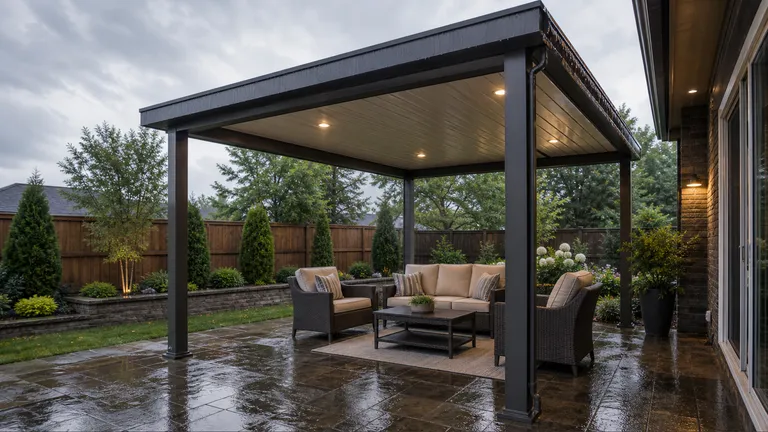
Use the word waterproof only when the specific roof material and installation details support it. A solid roof panel, metal roof or membrane may be sold for water shedding, but the final result still depends on slope, overlaps, screw washers, sealants, flashing, edge trim and where the runoff lands.
Water-resistant is more honest for many fabrics. Coolaroo says its knitted shade fabric is weather-resistant, not waterproof, and that water can mist through because the fabric breathes. Tenshon uses similar caution for HDPE shade fabric: it can resist water for a time, but pooling on top pushes water through. A steep, tight fabric surface may deflect a shower; it should not be sold as a dry patio ceiling.
Rain-managed is often the clearest phrase for louvered roofs. Azenco says louvered pergolas are not fully waterproof and have limits in severe storms. StruXure describes a managed path from closed louvers into troughs, perimeter gutters and concealed downspouts. That is useful outdoor rain control, but it is still exposed to wind-driven rain, edge drips, blocked drains and weather exclusions.
- Ask what the claim means at seams, fasteners, edges and side openings.
- Read weather exclusions before treating a louvered roof as storm cover.
- Do not let a waterproof label hide missing gutters, slope or flashing.
Category research
Rain-cover pergola categories to compare
Compare rain-cover categories only after slope, drainage, wind exposure and structure are clear.
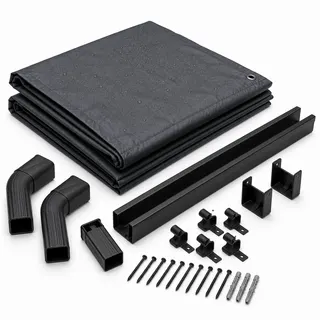
Waterproof cover
Waterproof Pergola Cover
For adding rain shedding to a pergola frame.
- Rain-focused cover
- Needs slope
Check:Drainage path, attachment method and wind routine.
Search on AmazonCanopy top
Pergola Shade Canopy Waterproof
For seasonal cover where fabric can be removed or tightened.
- Seasonal rain shade
- Lower permanence
Check:Sag, pooling and tie-down points.
Search on AmazonDrainage
Pergola Gutter Kit
For roofed pergolas where runoff needs a controlled edge.
- Controls runoff
- Needs roof compatibility
Check:Low side, downspout path and splash zone.
Search on AmazonFixed roof panels vs louvered roof
Choose a fixed roof when the main goal is simple dry cover and permanent shade is acceptable. Polycarbonate, metal or solid panels can shed water well when the manual details are followed. Palram's SUNTUF guide, for example, calls for at least 5 degrees of roof pitch, which it also expresses as 88 mm rise per meter, and names accessories such as apron flashing, back channel, capping, infill strips and approved washers or sealants.
Choose a louvered roof when control is worth the extra cost and upkeep. Louvers can open for light and airflow, then close during rain. Some high-end designs move water into troughs, gutters and post drains. They also bring motors, sensors, moving blades, gasket or overlap details, electrical controls and cleaning duties that fixed panels do not have.
Neither choice is automatically safer. A fixed roof can overload a weak pergola, leak at a wall, darken the patio and turn a simple frame into a building-envelope project. A louvered roof is a poor fit when leaves block gutters, snow is expected, wind pushes rain through the sides, power is unreliable or the budget leaves no room for professional installation and service access.
- Fixed roof: simpler water shedding, permanent shade, stronger flashing responsibility.
- Louvered roof: better light control, higher cost, moving parts and drain maintenance.
- Both need structure, pitch, runoff and local requirements checked before ordering.
Fixed vs Louvered
Fixed roof panels or louvered roof?
Use this table after deciding that shade-only is not enough.
| Decision point | Fixed panels or solid roof | Louvered roof |
|---|---|---|
| Dry performance | Strong when slope, overlaps, fasteners and flashing are correct. | Strong in ordinary rain when louvers close tightly and drains stay clear. |
| Wind-driven rain | Edges and open sides can still get wet. | Side wind can push water past edges or between components. |
| Light and heat | Permanent shade; clear panels add light but can add heat. | Adjustable light and airflow, with closed-roof heat changes. |
| Maintenance | Clean panels, gutters and sealant areas; inspect fasteners. | Clean troughs, gutters, louvers and downspouts; maintain motors or controls. |
| Installation complexity | Framing, pitch, panel spans, fasteners, flashing and load path. | Engineered frame, power/control work, drainage, service access and local permits. |
| Budget framing | Often lower than motorized louvered systems, but labor, flashing and gutters still matter. | HomeGuide's 2026 guide frames installed louvered roofs as high-ticket, especially motorized or smart versions. |
Drainage path, slope and pooling checks
Write the water path in one line before buying: roof surface to slope, gutter or trough, downspout or post drain, then discharge away from walls, doors, steps, outlets, foundation edges and outdoor kitchen work zones. If that line breaks at any point, the roof may keep the table dry while creating a worse problem somewhere else.
Slope numbers are material-specific. Palram's SUNTUF guide calls for at least 5 degrees roof pitch, or 88 mm per meter, for adequate runoff. Polygal's multiwall guide says ribs should run parallel to rainwater flow and calls for at least 10 degrees slope. Coolaroo says its weather-resistant shade cloth should be installed at a minimum 20-degree angle for runoff. Do not average those numbers into one universal pergola pitch.
Standing water is a failure sign. Flat fabric sags, stretches and leaks. Flat panels collect debris, push water toward fasteners and add weight. Clogged gutters make louvered and fixed roofs spill over edges. HSE's slip guidance supports a practical patio warning: do not send roof runoff across smooth tile, steps, thresholds or common walking paths.
- Keep roof runoff away from outlets, doors, cooking counters and foundations.
- Clean troughs, gutters and downspouts before leaf debris becomes a rain test.
- Use low-pressure cleaning and manufacturer-approved products around panels, louvers and coated fabric.
Load, attachment and flashing checks before you add a roof
Do not add roof panels to an existing pergola by assumption. Panels, louvers, gutters, screens, standing water and snow all add dead load, live load or wind surface. ICC patio-cover language is useful as a safety baseline because it names dead load, vertical live load, snow load where snow governs, and required wind or seismic resistance. It is not a universal DIY permission slip.
Check the complete support path: roof panel or louver, purlin or rail, beam, connector, post, base, footing, slab or deck framing. A decorative frame, aging wood post, undersized fastener, loose base, thin slab or unverified deck ledger can be the weak point. Polygal's technical manual is blunt about professional confirmation: load charts do not replace project-specific approval by an architect, engineer or other consultant.
Attached pergolas add a water path problem to the load problem. Building Science Corporation explains that ledgers can interrupt the water-resistive barrier and direct water toward fastener penetrations. BASC warns that missing flashing can lead to hidden water damage and rot. Any attached rain roof needs flashing, back channel or wall details that move water down and out, not behind siding or trim.
New posts or footings also need site checks. NFPA's outdoor electrical guidance includes the practical reminder to call 811 before digging. In snow country, high-wind areas, coastal exposure, deck-mounted installations, attached roofs, visible rot or any uncertain footing, bring in a qualified installer, engineer or local building authority before the roof purchase becomes a structural repair.
- Confirm posts, beams, connectors, fasteners, footings and deck or slab support.
- Use flashing and drainage-plane details for wall-attached roofs.
- Treat snow load, wind surface and water collection as structural checks, not product extras.
Cost, accessories and maintenance that decide the real buy
The roof price is not the project price. Budget for roof type, manual or motorized louvers, smart controls, gutter kits, downspouts, flashing, sealants, panel fasteners, purlins, permit help, labor, disposal, electrical work and cleaning access. A cheaper roof kit can become expensive when it arrives without the parts that make water leave safely.
Use cost ranges as planning numbers, not quotes. HomeGuide's 2026 louvered pergola guide places installed louvered pergolas roughly around $45-$125 per sq ft, with motorized and smart versions higher in many examples. That is useful for scale, but local labor, permits, site access, structure, drainage and current material pricing can move the real number.
Maintenance has to fit the household routine. StruXure warns that clogged gutters or downspouts can stop a drainage design from performing and cause spillover. Fixed panels need debris removal, fastener and sealant checks, algae or mildew monitoring and safe cleaning access. Fabric can need drying, retensioning, seasonal removal or replacement. If the roof needs cleaning that no one can reach, do not treat it as a low-maintenance buy.
- Price gutters, downspouts, flashing, sealants, fasteners, purlins and labor with the roof.
- Leave budget for electrical or outdoor-kitchen work if lights, fans, outlets, heaters or appliances are involved.
- Do not buy a motorized louvered roof without a storm, snow and cleaning routine.
Budget Checks
Cost and accessory checks
Use these as scope checks, not price quotes.
| Item | Why it changes cost | Check before buying |
|---|---|---|
| Louvered roof | Motors, controls, engineered frame, integrated gutters and service access add cost. | Drainage route, power/control location, snow limits and installer support. |
| Fixed panels or solid cover | Panels may need purlins, approved fasteners, flashing, gutters and labor. | Pitch, span, expansion allowance, wall detail and panel-cleaning access. |
| Waterproof canopy | Fabric quality, tracks, tension, seasonal storage and replacement matter. | Pitch, sag resistance, seam detail and storm takedown instructions. |
| Gutter and downspout kit | The kit may need post drains, splash control or connection to an approved drain point. | Discharge away from foundation, steps, outlets and smooth walking surfaces. |
| Wall flashing or ledger work | Attached rain roofs can require envelope repair, back channel or trim work. | Water-resistive barrier, fastener penetrations and hidden rot risk. |
| Electrical or outdoor kitchen upgrades | Lights, fans, outlets, heaters and appliances may need outdoor-rated parts and qualified work. | Wet-location covers, WR devices where required, GFCI/code work and appliance manuals. |
| Professional install or permit help | Load checks, snow/wind exposure, deck attachment and local rules can require trade help. | Engineer, installer or building department review before the roof is ordered. |
Costs are rough budget framing only. Confirm current local pricing, product manuals and installation requirements before purchase.
Rain-roof options to compare
Compare roof options only after the dry-use target, drainage path, support and maintenance access are clear. Use the list to decide which roof type is worth pricing or discussing with an installer.
A louvered pergola with integrated drainage makes sense when open-close control, electrical controls, gutters, post drains and cleaning access all fit the site. A fixed polycarbonate, metal or solid patio cover is a better fit when permanent shade is acceptable and the pitch, flashing, fasteners and gutter route can be designed before purchase.
Fabric and drainage accessories are narrower buys. A weather-resistant fabric or waterproof canopy can suit seasonal rain and shade when it is pitched, tensioned, dried and removed for storms or snow. Gutter and downspout accessories make sense only when the roof already sheds water and the remaining problem is where that water lands.
- Louvered roof: compare drainage design, weather limits, power, service access and snow routine.
- Fixed roof: compare pitch, panel span, flashing, fasteners, gutters and structure.
- Fabric or canopy: compare waterproof versus water-resistant claims, takedown needs and sag risk.
- Drainage accessory: compare final discharge point, gutter cleaning and walking-surface safety.
Category Filter
Which option is worth pricing?
Use this after the main rain and load checks, not as a product ranking.
| Option | Worth pricing when | Skip when |
|---|---|---|
| Louvered pergola with integrated drainage | Open-close control is worth the higher cost and drains can be cleaned. | Snow, wind-driven rain, leaf debris or service access would be ignored. |
| Fixed polycarbonate, metal or solid patio cover | Permanent shade is acceptable and the frame can support a pitched roof. | The existing pergola is decorative, weak, rotted or missing flashing details. |
| Weather-resistant fabric or waterproof canopy | Seasonal shade and occasional rain matter more than permanent dry cover. | Flat fabric would hold water or the patio needs reliable dry dining. |
| Gutter, downspout and discharge accessories | A roof already sheds water but spills it toward a door, step, outlet or foundation. | There is no safe discharge point or no way to clean the drainage run. |
When not to buy a rain pergola
Do not buy a roofed pergola when the structure is weak, rotted, decorative or unknown. Adding fixed panels to a light shade frame can turn a cosmetic patio feature into a load problem. Snow load, water load, wind uplift, deck support, slab thickness and footing depth are not details to solve after the kit arrives.
Do not buy when the water has nowhere safe to go. A dry table is not success if the downspout dumps onto steps, smooth tile, a door threshold, an outlet, a grill station or the foundation. If the broader question is still awning, canopy, pergola or sail for patio rain, use the patio rain shade guide first instead of forcing the pergola to solve every condition.
Do not buy a louvered or motorized system if maintenance and storm routines are unrealistic. Leaves, needles, roof grit, algae, snow and power issues can all change performance. Do not buy a roof for an outdoor kitchen, lights, fans, heaters or appliances until outdoor-rated equipment, wet-location electrical protection, appliance clearances and qualified trade work are settled. Use the outdoor-kitchen pergola guide when cooking or appliance layout drives the decision.
- Skip roof panels on weak, rotted or decorative frames.
- Skip the roof if runoff would cross steps, smooth tile, outlets, doors, counters or foundation edges.
- Skip motorized louvers when cleaning access, snow handling or storm closure will not happen.
Watch-outs
Before you buy or install
- Open rafters, decorative slats and breathable shade fabric should not be sold as dry rain cover.
- Standing water on fabric or panels can cause sagging, leaks and extra load.
- A dry-looking pergola roof does not make cords, outlets, fans, heaters or outdoor kitchen equipment indoor-safe.
- Runoff across smooth patio tile, steps, thresholds or work zones can create a slip hazard.
- Attached roofs need both a load path and a water path; missing flashing can hide damage behind the wall finish.
Read Next
Related guides if your situation is different
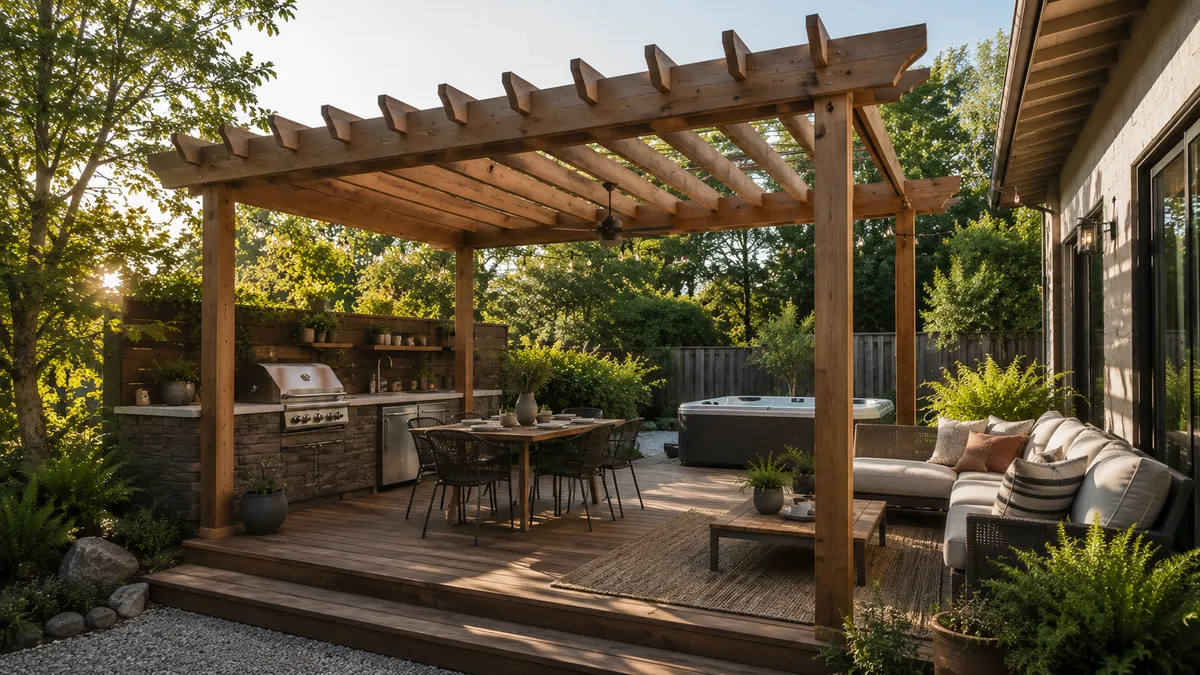
Pergola Guide
Use this when pergola is closer to the real constraint than the current page.
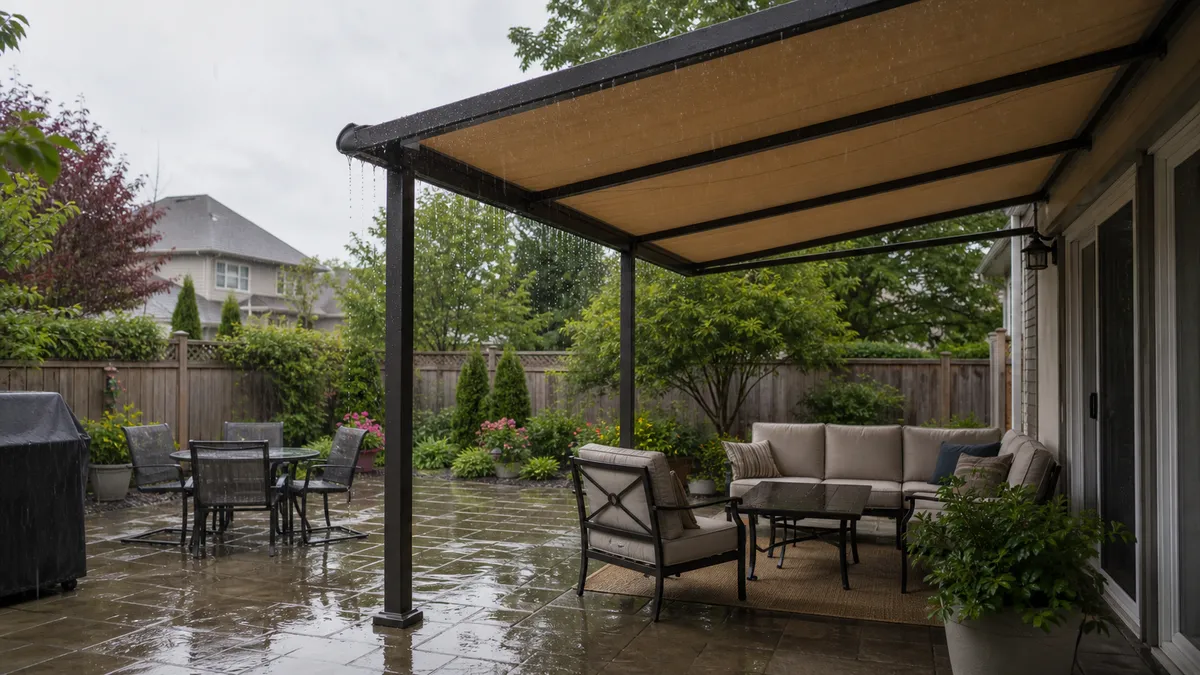
Patio Shade for Rain
Use this when patio shade for rain is closer to the real constraint than the current page.
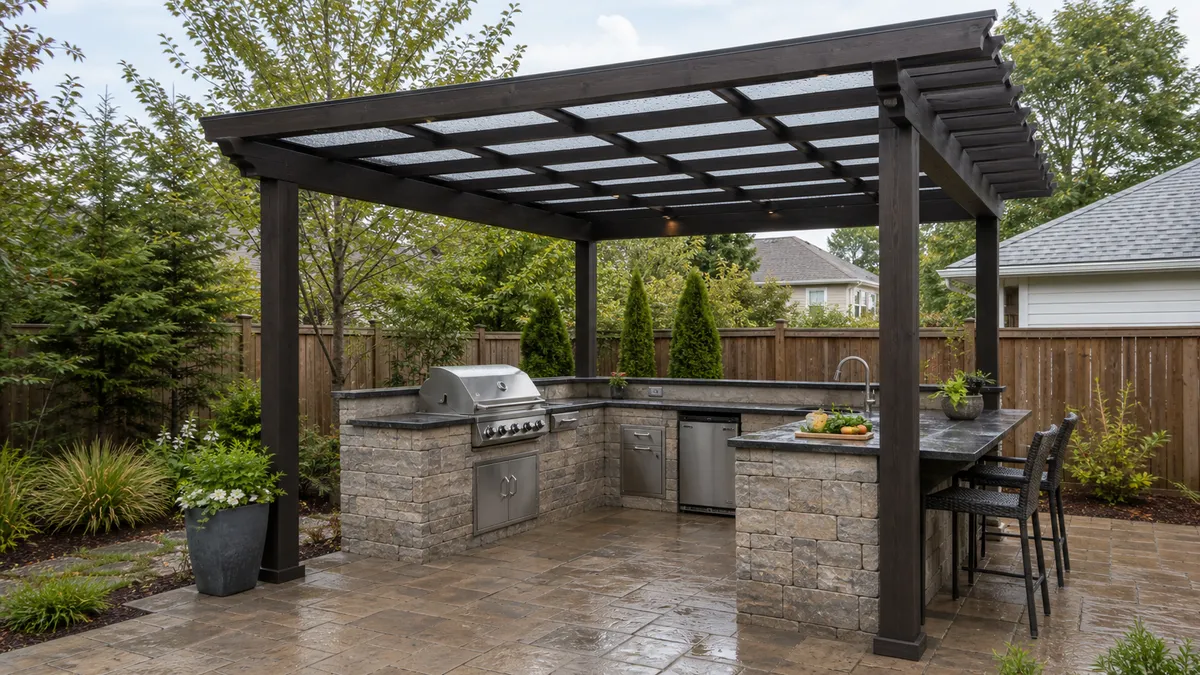
Pergola for Outdoor Kitchen
Use this when pergola for outdoor kitchen is closer to the real constraint than the current page.
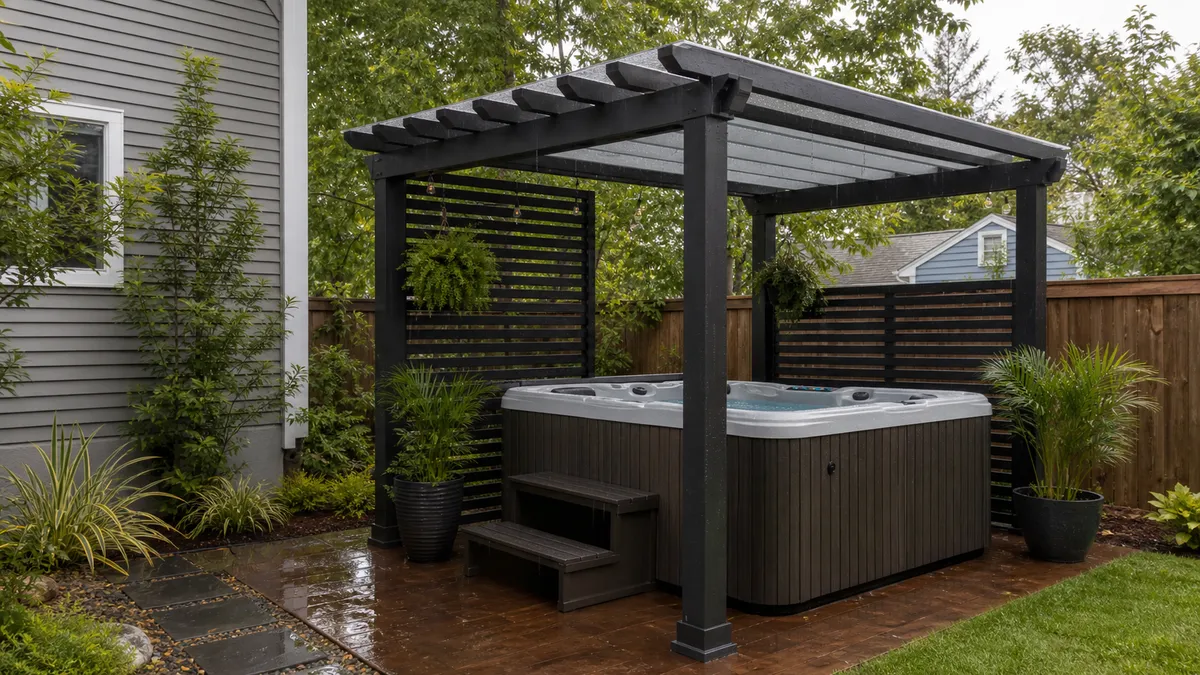
Pergola for Hot Tub
Use this when pergola for hot tub is closer to the real constraint than the current page.
Questions
FAQ
Will a pergola keep rain out?
Only if the roof material, slope, drainage and structure are designed for rain. Open rafters and decorative slats are shade structures. Fixed panels, solid roofs and some louvered roofs can manage rain, but edge drips, side wind, clogged drains and attachment details still matter.
Do louvered pergolas leak in heavy rain?
A closed louvered roof can manage ordinary rain when the louvers, troughs, gutters and downspouts are designed and clean. It is still an outdoor cover. Wind-driven rain, edge splash, clogged post drains, severe storms and snow can create leaks or spillover.
Can I put a roof on an existing pergola?
Maybe, but do not assume it. Panels, louvers, gutters, water and snow add load and wind surface. Check posts, beams, connectors, fasteners, footings, slab or deck support, purlins, flashing and local requirements before adding a roof.
How much slope does a pergola roof need?
It depends on the material. Palram's SUNTUF guide calls for at least 5 degrees, or 88 mm per meter. Polygal multiwall guidance calls for at least 10 degrees. Coolaroo recommends a 20-degree angle for its weather-resistant shade cloth.
Where should pergola rainwater drain?
Send water to a gutter, trough, downspout, post drain or clear edge discharge that moves it away from foundations, doors, steps, outlets, smooth walking surfaces and outdoor kitchen work zones. Cleaning access matters because blocked drains can turn a good roof into spillover.
Is shade cloth waterproof enough for a rainy patio?
Ordinary breathable shade cloth is usually not waterproof enough for dry dining. It can be weather-resistant and may shed some water when steep and tight, but water can mist through, pass through or pool. Use it for shade-first patios, not dry-room expectations.