
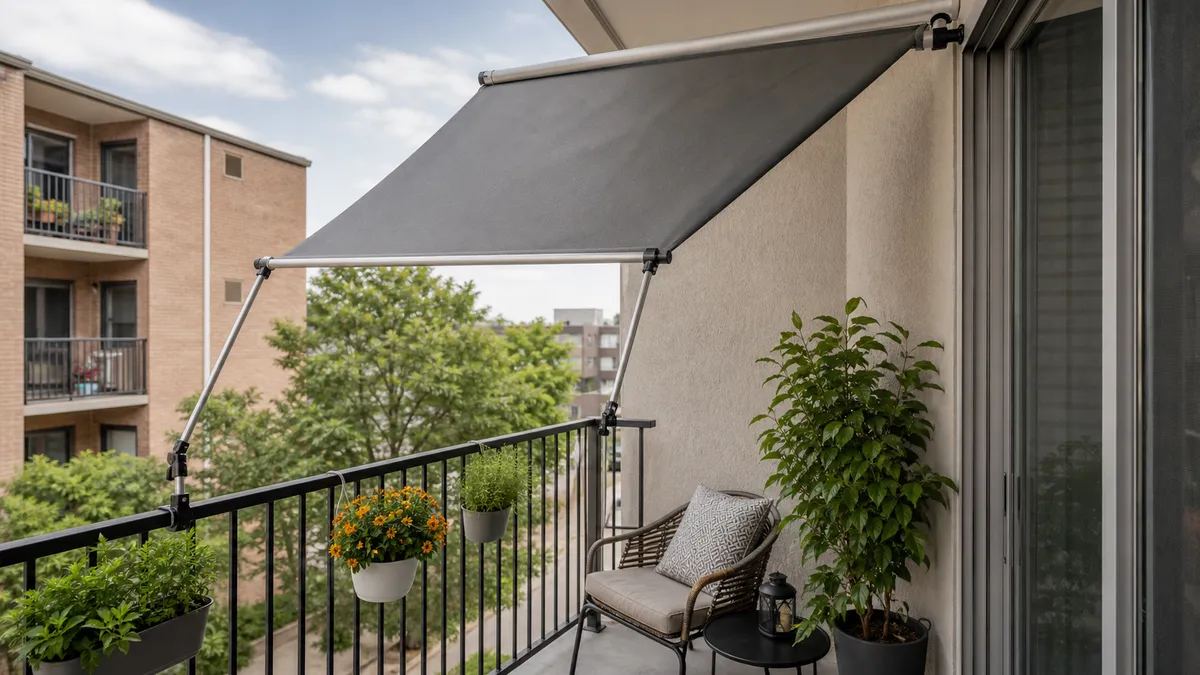
Quick Answer
Quick answer for an apartment balcony awning
A true apartment balcony awning is realistic only when written rules allow it, the building provides a verified attachment point, and the fabric can stay inside the balcony envelope. If drilling, rail loading, wind exposure or runoff fails the check, use smaller removable shade instead.
Choose a real balcony awning only with written approval and verified structure; use freestanding or removable shade when the wall, rail, projection or weather routine is uncertain.
Diagnosis
Most common problems
Check the symptom before buying another shade product.
Lease or building rules restrict exterior changes
A mounted awning changes more than furniture; it can involve facade appearance, holes, rail attachments or overhang.
Only glass rail, thin rail, trim or unknown cladding is available
A guardrail is a safety component, and unknown facade layers are not proof of a safe awning attachment.
High floor, corner balcony or frequent gusts
The National Weather Service warns that unsecured balcony and patio items can become wind hazards.
Door, light, sprinkler, rail or head clearance conflicts
Small balconies fail when the front bar, base or fabric blocks normal use before it creates useful shade.
Start with the apartment checks, not the awning
An awning for apartment balcony shade is not a normal patio purchase. The first question is not fabric color or crank style. It is whether the lease, building rules, balcony surfaces and weather exposure allow anything fixed, clamped, compressed or visible from outside.
Start with permission. Legal Aid Society guidance on tenant alterations points readers toward written landlord authorization before doing apartment work, and community rules can be stricter. The Axis HOA architectural guidelines are one concrete example: balcony and patio sunshades or awnings may need approval as exterior changes. Treat that as a rule pattern, not as universal law.
Then check the mounting surface. A glass rail, thin metal guardrail, stucco face, trim board, gutter, fascia or unknown cladding is not a proven awning mount. OSHA guardrail criteria are about fall protection forces; they do not make the rail an approved anchor for wind-loaded fabric. If the building cannot name an approved attachment point, move to a freestanding shade route.
- Permission issue: exterior changes, drilling, visible fabric or rail attachments need written approval first.
- Mounting issue: glass, thin rail, trim, stucco, cladding, fascia and unknown walls are stop signs.
- Wind issue: high floors and corner balconies need shade that can fold, retract or come inside quickly.
- Clearance issue: sliding doors, swing doors, lights, sprinklers, rail height and headroom must remain usable.
- Runoff issue: shade should not pool water, drip onto neighbors or project beyond the allowed balcony edge.
- No-drill issue: tension poles or screens still need rule approval, surface fit and a takedown plan.
Diagnosis
Apartment balcony checks before product shopping
Use this table before comparing awning sizes, fabric or controls.
| Balcony check | Reader signal | Realistic next move |
|---|---|---|
| Lease or building permission | Rules mention exterior changes, drilling, visible shades or rail attachments. | Ask for written approval, or keep shade freestanding and removable inside the balcony. |
| Mounting surface | Only glass rail, thin metal rail, stucco, trim, cladding, fascia or unknown wall is available. | Do not use it as an awning anchor; ask for approved points or choose portable shade. |
| Wind exposure | The balcony is high, exposed at a corner, or loose items move during gusts. | Use smaller fabric that folds, retracts or stores indoors before wind. |
| Projection and clearance | Door swing, sliding tracks, lights, sprinklers, rail height or headroom would be blocked. | Reduce projection, narrow the shade, or use side shade near the chair. |
| Runoff and neighbors | Rain would pool on fabric or drain to another balcony, walkway or property line. | Avoid rain-use claims and choose shade that closes or comes down before weather. |
| No-drill fit | A covered balcony has flat floor and ceiling surfaces, or there is room for a base. | Compare tension-pole shade, half umbrella, weighted umbrella, folding side screen or approved roller screen. |
When a real awning is realistic on an apartment balcony
The narrow yes case looks like this: written approval is in hand, the building confirms a structural mounting surface, the awning stays within the balcony envelope, and the fabric can retract before wind or rain exceeds the product instructions. A wall-mounted retractable awning should not be treated like a chair or planter.
Balconies also deserve more caution than a ground patio. California SB-721 treats exterior elevated elements such as multifamily balconies and associated waterproofing as inspection-worthy building safety items. That does not give advice for every state, but it supports the practical rule: do not drill through waterproofing, cladding, stucco or unknown balcony surfaces as casual DIY.
Clearance rules out many small balconies before structure does. Check sliding-door tracks, swing doors, window operation, sprinkler heads, lights, rail height, head clearance and the front bar's swing. If useful shade needs the awning to project beyond the balcony edge, ask the building before buying a larger size.
Awnings can still be valuable when the site passes those checks. The U.S. Department of Energy says awnings can shade outdoor living spaces and reduce solar heat gain at windows. Keep that claim in its lane: it explains shade value, not permission, anchor safety or rain performance.
- Use written approval before holes, brackets, visible exterior fabric or rail hardware.
- Mount only to a building-approved structural surface, not trim or unknown cladding.
- Keep projection, runoff and hardware inside the allowed balcony area.
When an apartment balcony awning is not realistic
Say no early when the building rules are unclear. No written approval, a glass rail, a thin guardrail, unknown wall layers, visible exterior restrictions or neighbor runoff are enough to stop a mounted awning purchase. The product listing may say balcony shade; the building still controls the exterior and attachment rules.
This is the section that prevents expensive wrong fixes. Bigger projection will not solve low side sun entering under the fabric line. Heavier fabric will not make a guardrail or stucco face safe for load. Adhesive hooks, suction cups, planter boxes and light-duty clamps are not awning anchors.
No-drill does not mean renter-approved. A tension product can leave compression marks, show above the rail, violate facade rules or become a wind problem. A waterproof fabric label also does not make the shade a rain roof. Rollac's retractable awning manual warns that rain can add water weight and that awnings should not be used in high wind, snow or unsafe weather.
If the sun enters from the side, choose a vertical answer. A removable side screen, curtain on an approved frame, roller shade on an allowed ceiling or half umbrella placed at the glare line often beats deeper overhead fabric. The broader small-space idea set belongs in the balcony shade ideas guide.
- Do not use rail clamps where the building has not approved accessory loads.
- Do not drill through facade, waterproofing, trim, fascia, gutters or unknown layers.
- Do not buy more projection when the real issue is side glare.
No-drill and portable shade routes that are more realistic
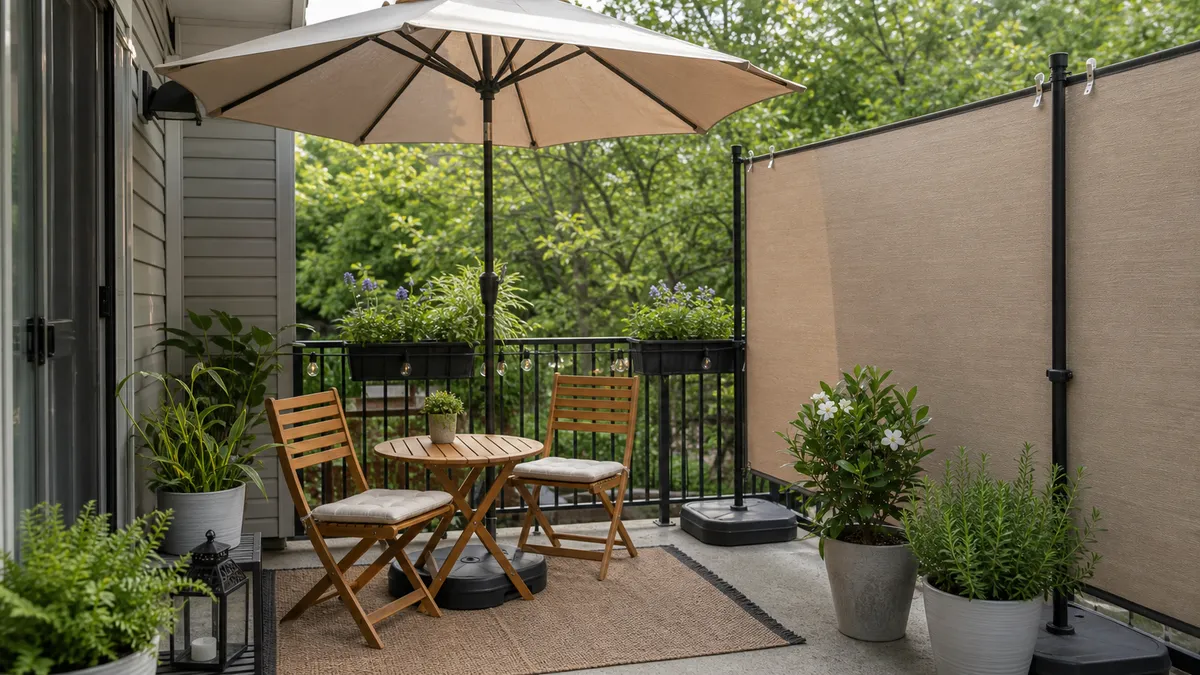
The lowest-risk route is usually furniture-like shade. A half umbrella or balcony umbrella with a weighted base can shade a chair or bistro table without wall holes. It still needs enough floor area, ballast, storage and a wind routine, especially above ground level.
Side shade often solves what an overhead awning misses. A folding side screen, removable privacy screen or outdoor curtain on an approved freestanding frame can block low sun without projecting beyond the balcony. Keep it lower and narrower when exterior appearance rules are strict.
Tension-pole shade is possible only on the right covered balcony. The B&Q / EVRE no-drill example shows why the details matter: the canopy is listed at 2 x 1.2 m, the pole range is 2-3 m floor to ceiling, and the product weighs about 15 kg. Those numbers are product-limit examples, not proof that your ceiling, floor or building allows compression shade.
An approved roller shade or screen can work when there is an existing frame, ceiling mount or building-approved location. It should be treated as a removable weather-sensitive shade, not a permanent exterior blind unless the rules and installation documents say so. For broader surface-by-surface choices, use the no-drill patio shade guide after this apartment check.
- Low effort: weighted umbrella, half umbrella, chair-level shade or folding side screen.
- Medium effort: approved tension-pole shade on a covered balcony with suitable surfaces.
- Higher effort: approved roller shade or retractable awning on verified structure.
Wind, rain, clearance and neighbor limits
Balcony wind is not the same as a sheltered backyard. A high floor, open corner or gap between buildings can turn fabric into a sail and loose poles into falling-object hazards. The National Weather Service advises removing or securing unsecured items from balconies and patios during high-wind conditions. Apply that mindset to every portable shade, not only fixed awnings.
Rain is another stop sign. A flat or under-pitched awning can pool water, drain onto neighbors or overload fabric. Rollac warns that water weight can damage an awning and gives weather limits in its manual. Follow the product manual rather than treating a water-resistant canopy as a storm cover.
Clearance should be checked with the balcony in normal use. Open the sliding door, swing any hinged door, move chairs, stand near the rail, and look for lights, sprinkler heads, window locks and trim. A front bar that passes over an empty floor may still hit a person, door or plant shelf during real use.
Shade value also depends on timing. EPA's UV Index guidance includes the shadow rule: a short shadow signals stronger UV exposure. Test the balcony at that time and again during late-day glare. If the problem is glare under the rail line, vertical shade is more useful than a deeper awning.
- Bring freestanding or clamped fabric inside before forecast wind if the manual or building rules require it.
- Keep runoff on your own balcony and away from lower units, walkways and shared areas.
- Leave doors, windows, sprinklers, lights, rail access and headroom usable.
Apartment balcony shade fixes ranked by effort and risk
Start with the smallest fix that solves the failed hour. Low-effort shade should be removable, stored dry and kept inside the balcony boundary. Medium-effort shade may use compression, a frame or an approved ceiling point. High-effort shade starts only after building approval and structural confirmation.
If you already know wall holes are not allowed, skip the retractable-awning shortlist. Compare movable shade first, then read the renter-friendly patio shade guide for broader lease-safe planning. The page you are on should decide whether an awning is realistic, not turn every apartment balcony into a shopping list.
Ranked fixes
Fix routes by effort, cost and risk
Use the lowest row that solves the actual balcony problem.
| Fix route | Effort / cost | Use when | Do not use if |
|---|---|---|---|
| Movable umbrella, half umbrella or folding side screen | Low effort / usually lower cost | You only need shade for one chair, a small table or low side glare. | The base cannot fit, store safely or stay inside the balcony boundary. |
| Approved tension-pole or clamp-free shade | Medium effort / listed limits matter | A covered balcony has suitable floor and ceiling surfaces and rules allow compression. | The pole would mark surfaces, load the rail or stay up during gusts. |
| Approved roller shade or removable screen on an existing frame | Medium effort / permission dependent | The building allows the frame, ceiling point or screen location. | It blocks egress, sprinklers, window operation or exterior appearance rules. |
| Professionally installed retractable awning | High effort / permission heavy | Written approval and verified structure are both confirmed before purchase. | The installer would drill unknown facade, waterproofing, trim, fascia or cladding. |
| Stop and ask management, landlord or HOA | Required before spending more | Approval, overhang, runoff, wind exposure or attachment loads are unclear. | Do not substitute a product listing for a building decision. |
Stop shopping and escalate when this appears
Escalate before purchase when the next step would alter the building. That includes drilling into facade, stucco, cladding, waterproofing, trim, fascia, gutters or any wall layer you cannot identify. It also includes brackets that change exterior appearance from the street or neighboring units.
Stop when the awning needs the guardrail. A rail can be strong enough for its guardrail job and still be wrong for accessory shade loads. Written building approval and product documentation should come before rail clamps, glass-panel contact or hardware that leans on thin metal parts.
Stop when the shade leaves your usable balcony area. Overhang, runoff below, conflict with sprinklers, blocked egress, neighbor complaints and no bad-weather storage routine are all signs that the awning idea is doing too much. In those cases, choose a freestanding shade, an approved screen or a smaller balcony-specific idea instead.
- Ask management before facade holes, rail hardware, exterior-visible fabric or overhang.
- Choose freestanding shade when approval, anchor strength or weather storage is unclear.
- Keep heat sources and grills away from shade fabric unless local rules and the product manual clearly allow the setup.
This won't fix it
Do not skip these checks
- No-drill hardware can still violate rules, leave compression marks or create falling-object risk.
- A guardrail is not automatically an approved awning anchor.
- Do not leave balcony fabric open when the manual, forecast or building rules say to close or remove it.
- Water-resistant shade fabric should not be treated as a balcony rain roof.
Read Next
Related fixes
Patio Awning Guide
Use this when patio awning is closer to the real constraint than the current page.
Balcony Shade Ideas for Apartments and Small Spaces
Use this when balcony shade ideas is closer to the real constraint than the current page.
Patio Shade Without Drilling
Use this when patio shade without drilling is closer to the real constraint than the current page.
Renter-Friendly Patio Shade
Use this when renter friendly patio shade is closer to the real constraint than the current page.
Questions
FAQ
Can I put an awning on an apartment balcony without drilling?
Sometimes, but only in a limited sense. A tension-pole shade, half umbrella, weighted umbrella or removable screen may avoid holes, but building rules can still restrict visible fabric, compression marks, rail contact, height and wind exposure. No-drill is not the same as automatically approved.
Do I need landlord or HOA approval for a balcony awning?
Get written approval before drilling, brackets, facade changes, rail clamps, visible exterior shades or anything projecting beyond the balcony. Rules vary by lease, condo board, HOA and building management, so the safe threshold is written permission before money is spent.
Can a balcony railing hold a clamp-on awning?
Do not assume it can. A balcony railing is a life-safety component, not a general awning anchor. Any clamp or fabric load needs building permission and product documentation that clearly allows that rail contact. If that proof is missing, use freestanding shade.
What is the best alternative if a real awning is not allowed?
Start with a weighted half umbrella, movable balcony umbrella, folding side screen or approved roller shade on an allowed frame. Use the smallest removable setup that blocks the failed sun hour, stays inside the balcony envelope and can be stored before wind.
Can I leave a balcony awning open in rain or wind?
Follow the product manual and building rules, and close or remove fabric before conditions exceed them. Rain can add water weight or drain onto neighbors, and wind can turn balcony objects into hazards. A shade awning is not a storm shelter.