
Quick Answer
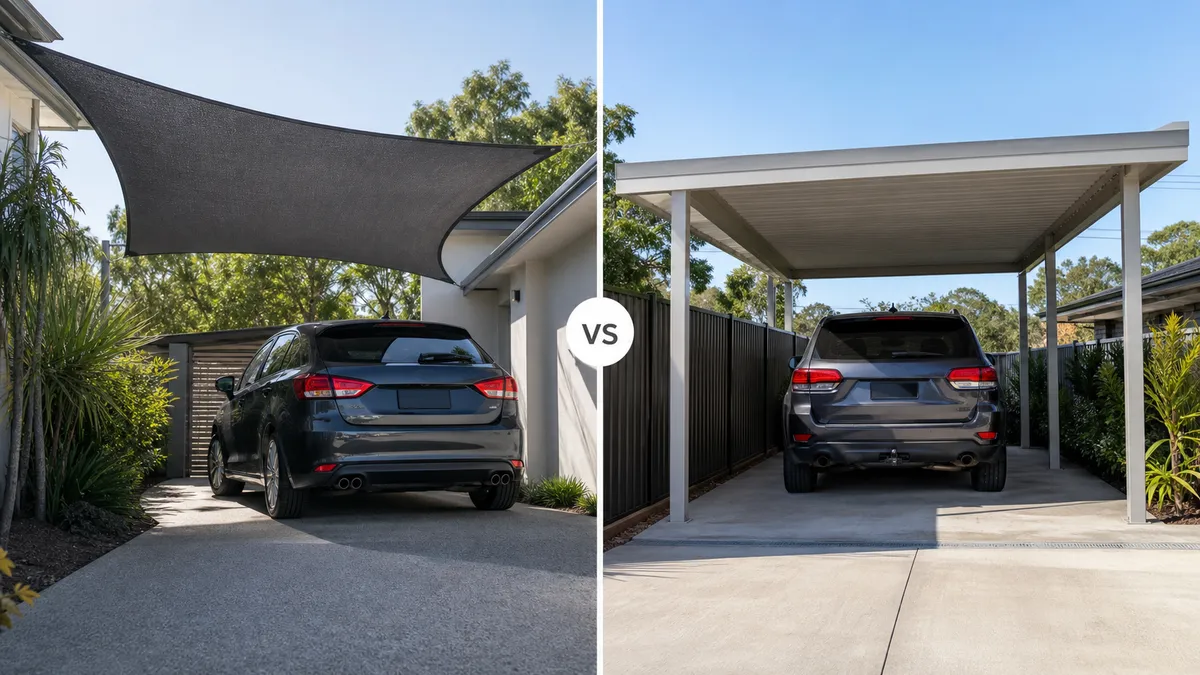
Short answer: shade sail or carport
Choose a shade sail for seasonal sun reduction only when verified anchors, posts or masonry can carry the fabric and removal before severe weather is realistic. Choose a carport for roof-like vehicle protection, year-round parking and unattended exposure. Hail, snow, weak anchors, narrow clearance or uncertain permits push the decision away from fabric-only shade.
Choose the shade sail when sun is the job and the anchors are proven; choose the carport when the car needs permanent roof-like cover.
Side by Side
Fast comparison snapshot
| When this matters | Choose | Why |
|---|---|---|
| Seasonal sun over one parked car with verified posts, masonry or engineered wall plates | Use a shade sail only for seasonal sun reduction. | The fabric can cut direct sun where the shadow lands, but the anchors and takedown routine carry the risk. |
| Hail, snow, falling branches, regular rain or long absences are the main concern | Move toward a carport, garage or engineered canopy. | NOAA and NWS guidance support treating hail and severe storm exposure as vehicle-damage risks, not shade problems. |
| Rental, HOA or front-driveway rules are unclear | Do not drill, set posts or order a permanent kit until approval is written. | Municipal examples show both carports and some shade sails can trigger permit, siting or engineering checks. |
| Narrow driveway where posts could block doors, liftgate travel, bins or turning radius | Choose the layout that keeps the vehicle path open, or choose neither. | A shaded bay fails if the doors, hatch, roof rack, trailer path or garage access no longer work. |
| Only gutters, decorative trim, weak fence posts, hollow masonry or unchecked fascia are available | Reject the shade sail until a real load path is confirmed. | Coolaroo instructions and Mississippi State Extension both put stable fixing points, anchors and wind-sturdy posts before fabric. |
Shade sail vs carport: the fast comparison
A shade sail is tensioned fabric held by anchors; a carport is a roofed parking structure with posts, connections and local-rule visibility. That is the clean carport vs shade sail split. Use the sail for direct sun over a parked car. Use the carport when the car needs roof-like vehicle protection while nobody is home.
Start with the job the shade must do. Cancer Council NSW and EPA guidance support shade for reducing UV exposure, but open-sided shade still depends on time of day, shadow position and indirect radiation. That matters over a driveway because a sail that shades the roof at noon may still miss the windshield, dashboard or side panels when the sun is low.
Weather changes the choice quickly. Mesh fabric drains through and does not keep a car dry. Waterproof fabric needs slope, tension and a runoff path, and Redland City Council's shade-sail guidance shows that waterproof sails can raise tie-down, footing, wind-loading and approval questions. A carport costs more, but its roof is built for the job fabric is often asked to imitate.
Comparison
Side-by-side fit check
Use this before comparing kit prices or fabric sizes.
| Decision point | Shade sail | Carport | What it means for the car |
|---|---|---|---|
| Sun, UV and heat | Reduces direct sun where the shadow lands; fabric rating and pitch matter. | Gives fixed roof shade, but open sides can still admit low sun. | Good for cabin heat directionally; do not promise full UV or heat control. |
| Rain | Mesh drains through; waterproof fabric needs slope, tension and runoff planning. | Roofed cover handles rain better when drainage is designed. | Choose by where water goes after it leaves the cover. |
| Hail, snow and falling debris | Not a hail, snow or branch roof unless a product is engineered and rated for that job. | Better direction only when designed for local wind, snow and impact exposure. | Hail-prone parking needs more than ordinary shade fabric. |
| Wind | Needs stable anchors, tension hardware, inspection and a removal routine. | Needs posts, connections and uplift resistance that are actually designed. | Both can fail when weak connections are treated as structure. |
| Installed cost | Often cheaper only when existing anchors work and posts are simple. | Higher upfront cost, with permits, site work and structure in the budget. | Compare fabric plus posts and footings against the finished carport. |
| Permits and rules | Large, permanent, waterproof or attached sails may trigger local checks. | Municipal examples often treat carports as permitted structures. | Check building, HOA and lease rules before drilling or setting posts. |
| Driveway clearance | Low corners, turnbuckles and posts can block doors or roof racks. | Posts and roof height must leave room for doors, liftgates and exit space. | The car must still work normally under the shade. |
| Maintenance | Inspect, clean, retension and remove fabric when the manual calls for it. | Inspect roof, fasteners, posts, drainage and connections. | Permanent cover reduces fabric takedown but does not remove maintenance. |
Cost: compare installed total, not the fabric price
The shade-sail budget includes fabric, posts and footings, wall plates, anchors, turnbuckles, labor, rule checks and replacement fabric. A low fabric price is useful only when the driveway already has strong fixing points in the right places. If every corner needs a post, concrete and structural advice, the sail stops being a small purchase.
Carport costs are easy to underestimate too. HomeGuide's 2026 carport guide gives broad installed-cost ranges by size and type, while Angi separates material, labor, permits, site leveling, concrete slabs, electrical work, access and stricter high-wind or code regions as cost drivers. Treat those sources as commercial estimates, not quotes for your driveway.
Compare the finished job line by line. For the sail, price the fabric, corner hardware, turnbuckles, post holes, concrete, wall plates, corrosion-resistant fittings, removal storage and likely fabric replacement. For the carport, price the roof kit or custom frame, posts, footings or slab work, gutters or drainage, permit path, structural drawings when required and future roof maintenance.
A shade sail can still cost less when the project is seasonal sun over one vehicle and the anchors are already proven. A carport becomes easier to justify when the same driveway would need multiple new sail posts, long spans, waterproof fabric, engineering, rule approval and a takedown routine nobody will follow.
Cost
Installed-cost items to price
Use this as a quote checklist before calling one side cheaper.
| Cost item | Shade sail cost driver | Carport cost driver | Decision effect |
|---|---|---|---|
| Cover material | Mesh or waterproof fabric, size, stitching and replacement cycle. | Metal, polycarbonate or framed roof panels and finish. | Fabric can start cheaper; roof material buys permanence. |
| Posts and footings | Every missing corner may need a post, concrete and utility checks. | Posts and footings are core parts of the structure. | New posts narrow the price gap. |
| Hardware | Turnbuckles, shackles, pad eyes, eye bolts and wall plates. | Brackets, post bases, fasteners, beams and roof connections. | Weak hardware turns either plan into a repair risk. |
| Permits and advice | More likely when attached, large, waterproof or permanent. | Commonly part of carport planning in municipal examples. | Approval friction can decide the project before price does. |
| Maintenance | Cleaning, retensioning, fabric inspection, takedown and storage. | Roof, post, gutter, fastener and connection checks. | Choose the routine someone will actually keep. |
Dollar figures need local quotes. Use published cost guides only as planning context, not as universal pricing.
Weather protection: sun shade is not roof protection
Sun shade and weather protection are different jobs. DOE hot-weather guidance supports parking in shade as a way to keep a cabin from getting as hot, but that does not make a shade sail a measured cooling guarantee. ARPANSA also warns that shade structures can perform differently from fabric ratings because scattered radiation can enter from the sides.
Rain is the common trap. A mesh shade sail helps with sun but lets water through. Waterproof fabric can shed water only when the manual's pitch, low corner and tension are realistic, and the runoff has somewhere safe to land. Over a driveway, bad runoff can send water toward the garage threshold, a walkway, the car door, a neighbor's boundary or a slippery path.
Hail and snow push the answer away from ordinary fabric. NOAA NSSL says hail can damage cars, and NWS severe-weather guidance treats large hail and strong gusts as serious storm hazards. A normal shade sail should not be sold as hail or snow protection unless the exact product and attachment design are rated for that exposure.
A carport handles weather better, but only when it is designed and anchored properly. City of Kirkland carport guidance names structural design issues such as lateral loads, gravity support, snow loads and structure weight. A carport is not automatically safe. Roof-like parking cover belongs in a designed structure, not in a casual fabric shortcut.
- Use shade-sail fabric for sun reduction, not hail protection.
- Use waterproof fabric only when slope, tension and runoff are solved.
- Use a carport, garage or engineered canopy when severe weather protection is the real job.
Wind, anchors and permits
A shade sail is not harmless because it is fabric. Mississippi State University Extension says each sail corner needs an anchor, posts should be secured in concrete, and posts must be sturdy enough for wind. Coolaroo installation guidance also requires structurally suitable fixing points, inspection and severe-weather removal.
Reject weak anchors before choosing sail size. Gutters, decorative trim, weak fence posts, rotten timber, thin fascia, unsupported rafter tails, hollow masonry and veneer are not safe assumptions. If a builder or engineer cannot confirm the load path, the shade sail should wait.
Carports have their own wind problem. IBHS shows that carports, porch covers and patio covers can detach during high-wind events, especially when connections are weak, attached to fascia instead of structural framing, or poorly tied to foundations. A permanent roof can be better for daily protection only when posts, bases, beams and fasteners are part of a real design.
Permit language varies by location, so do not treat either choice as automatically allowed. Kirkland's carport guidance is one municipal example where carports need permit review. Fort Collins flags engineered or stamped plans for several carport attachment and kit conditions. Redland's shade-sail guidance shows that some sails can also raise approval and engineering questions. Check the building department, HOA and lease before work begins.
- Do not attach a sail to gutters, trim, weak fence posts or unchecked fascia.
- Do not assume a carport kit is safe without the required footing, connection and permit path.
- Do not use waterproof sail fabric over a driveway until wind loading and runoff are part of the plan.
Best by property and driveway fit
An open single-car driveway is the easiest place for a shade sail only when four corners can be placed without blocking use. Test every door, the trunk or liftgate, the hood, the roof rack or cargo box, the antenna, the garage door, gate swing, bins, trailer path and turning radius. HomeGuide notes that carport sizing must leave room for opening doors and exiting vehicles, and the same driveway logic applies before adding sail posts.
A narrow driveway often makes both choices awkward. A shade sail may need posts exactly where the doors open. A carport may solve weather but still fail if posts pinch the walking path or roof height conflicts with a tall vehicle. In that case, use a smaller side shade, park somewhere else or skip a permanent structure.
A two-car driveway changes the wind and structure calculation. One large sail over both vehicles can add a lot of fabric area and corner tension. Two smaller sails may be easier to remove but add more anchors. A carport or engineered canopy may cost more upfront, yet it can organize posts and roof coverage more clearly for repeated daily parking.
Rental and HOA properties need written permission before hardware. A sail is not renter-friendly if it requires wall plates, concrete posts or visible front-driveway fittings. A carport is usually even more visible. Written approval matters more than whether the cover is fabric or metal.
On windy, coastal and open sites, keep the sail smaller and removable or use an engineered structure. A sail that looks fine on a sheltered patio can behave very differently over an exposed driveway. A carport can be the better year-round cover, but only when the footings, connections and uplift loads are handled.
Tie-breaker: what to choose when both could work
If both choices can be built safely, choose the shade sail for seasonal sun reduction and choose the carport for permanent roof-like vehicle protection. The sail makes sense when the car only needs summer shade, the anchors are already proven, low corners clear the vehicle, and someone can remove or loosen the fabric before severe weather.
Choose the carport when the car sits outside year-round, weather arrives while nobody is home, or the driver wants a roofed parking space rather than a fabric routine. The higher cost and permit path buy something useful only if the structure is designed for the local site.
Choose neither when the real problem is not overhead cover. Low side glare may need a side screen. Hail may need a garage, engineered canopy or different parking plan. Weak anchors need structural work before fabric. A rule-blocked driveway needs written approval first. Bad runoff needs drainage planning before any waterproof cover is placed above a vehicle.
The final check is simple: the car still has to function under the shade. If the cover blocks door swing, liftgate travel, roof-rack clearance, walking room, garage access, trailer movement or emergency access, the design is wrong even if the product fits on paper.
Category research
Categories to research after the comparison
Compare these only after the anchor, clearance, weather and rule checks above pass. These are research categories, not ranked picks.
Seasonal sun
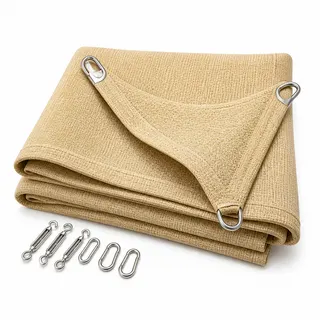
Four-corner mesh shade sail
Worth researching when four verified fixing points can shade one parked car.
- Best for direct sun
- Needs verified anchors
- Not hail protection
Check:Anchor strength, hardware gap, fabric pitch and removal routine.
Research category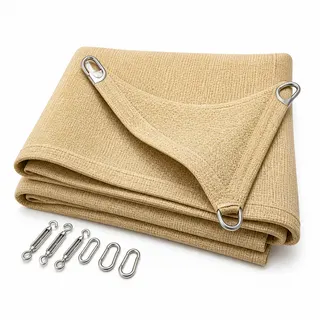
Rain caveat
Waterproof shade sail
Research only if slope, tension and runoff can work above the driveway.
- Needs a low corner
- Runoff must miss the car
- Can raise rule checks
Check:Manual slope, drainage destination, wind exposure and attachment strength.
Research category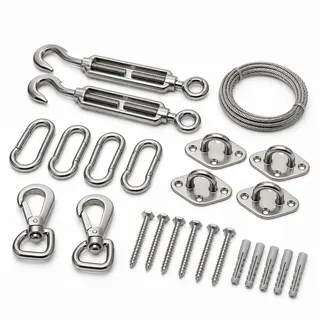
Connections
Shade sail hardware kit
Compare only after the wall plates, eye bolts and turnbuckles match the real structure.
- Turnbuckles set tension
- Fasteners need structure
- Hardware cannot fix weak posts
Check:Material grade, corrosion exposure, fastener compatibility and actual load path.
Research categoryWatch-outs
Before you buy or install
- Do not use a normal shade sail as hail, snow, branch or storm protection for a parked car.
- Do not attach fabric to gutters, trim, weak fence posts, hollow masonry or unchecked fascia.
- Do not call waterproof fabric a driveway roof unless slope, runoff, wind loading and approvals are solved.
- Do not assume a carport is storm-safe unless posts, foundations, connections and local loads are designed.
Read Next
Related guides
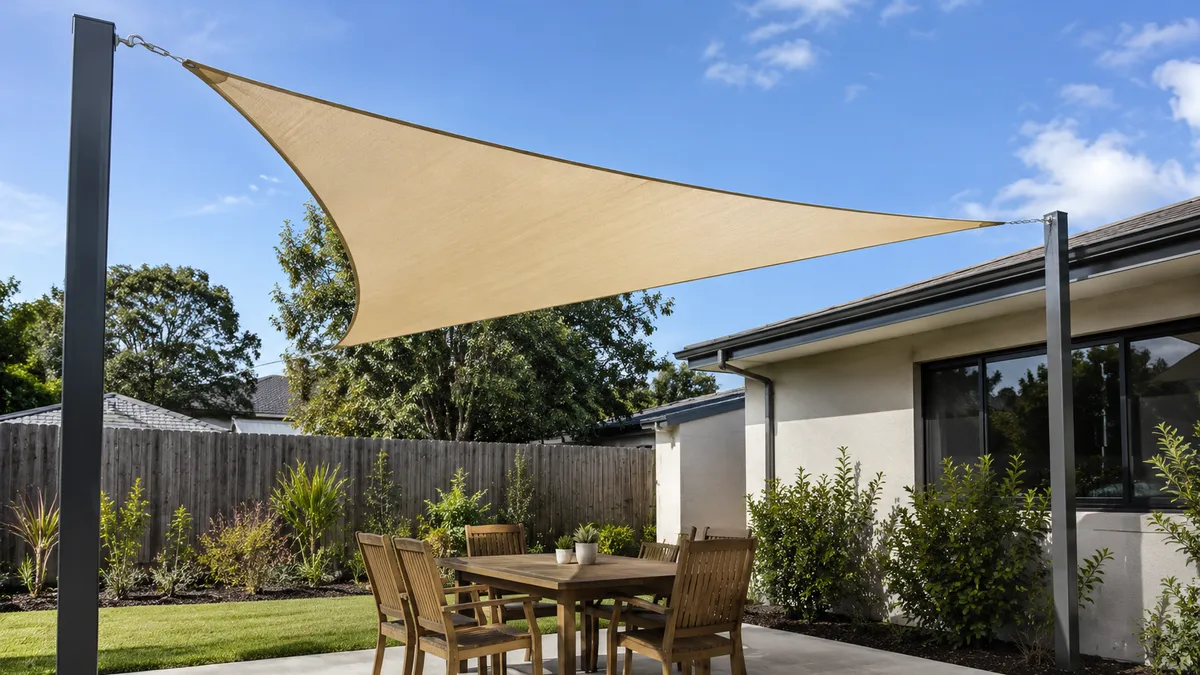
Shade Sail Guide
Use this when shade sail is closer to the real constraint than the current page.
Shade Sail for Carport
Use this when shade sail for carport is closer to the real constraint than the current page.
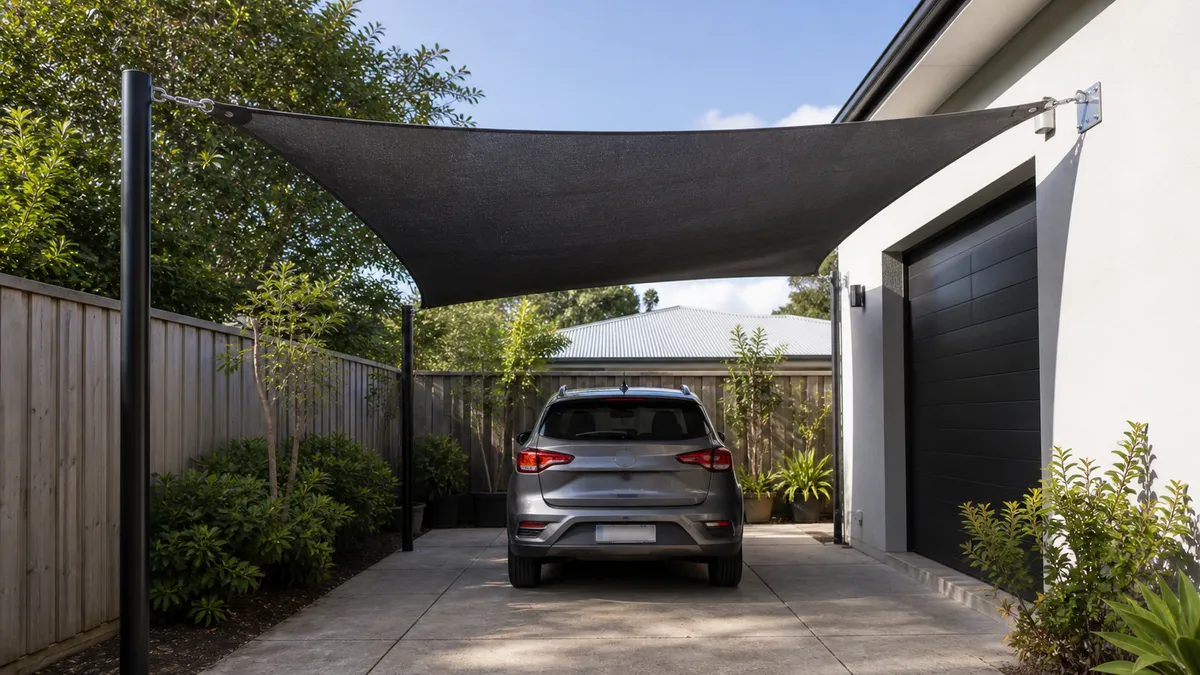
Shade Sail for Driveway
Use this when shade sail for driveway is closer to the real constraint than the current page.
Questions
FAQ
Is a shade sail a good substitute for a carport?
Only for sun reduction. A shade sail can protect the roof, windshield or dashboard from direct sun where the shadow lands, but it is not a roofed parking structure. Choose a carport, garage or engineered canopy when the job is rain, hail, snow, debris or unattended weather cover.
Which is cheaper installed, a shade sail or a carport?
A shade sail is often cheaper when strong anchors already exist and the project only needs fabric and hardware. The gap narrows when posts, footings, wall plates, turnbuckles, labor, engineering or permits are needed. Carports usually cost more upfront because the roof, posts and structure are the project.
Will a shade sail protect my car from hail or snow?
Do not count on it unless the exact product and attachment design are rated for that exposure. NOAA and NWS guidance support treating hail and severe storms as vehicle-damage risks. Ordinary shade fabric is for sun shade, not hail, snow load or falling-branch protection.
Do shade sails and carports need permits?
Rules vary by location, but neither choice is automatically exempt. Municipal examples show carports commonly need permit review, and some shade sails can raise approval or engineering questions when they are large, waterproof, attached, permanent or placed in a regulated area. Check local rules, HOA rules and lease terms first.
Is waterproof shade-sail fabric enough for driveway rain?
Only when the manual's slope, tension and runoff requirements work on the actual driveway. Mesh fabric drains through and the car gets wet. Coated fabric can pool when flat or loose, and runoff can create a garage, walkway or neighbor problem if the low corner is wrong.
Which works better for a narrow driveway?
Use whichever plan leaves the car usable. Open every door, hatch, hood and garage door, then check roof racks, antenna, bins, trailer paths and walking space. If sail posts or carport posts block normal movement, choose a smaller side shade, a different parking spot or no permanent cover.