
Quick Answer
Quick answer for a fire pit near a pergola
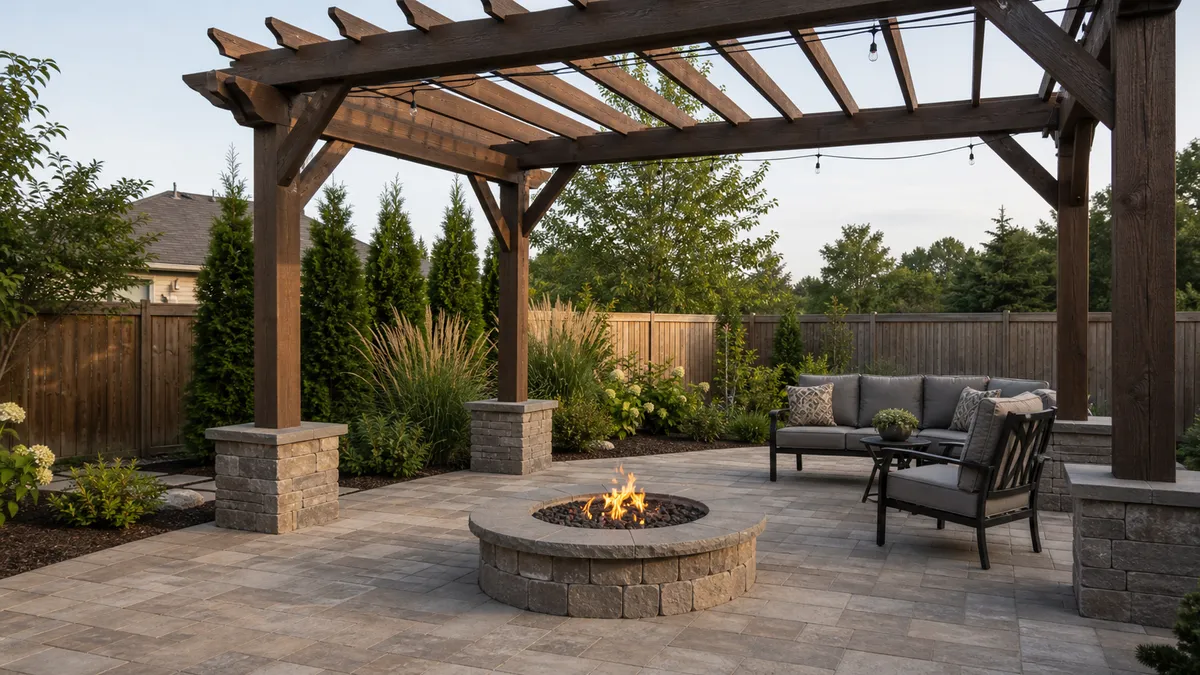
A fire pit under a pergola is not safe by default. Use it there only when the fire-pit manual, local fire rules, overhead clearance, side clearance, ventilation, noncombustible surface and emergency controls all line up. If any answer is uncertain, move the flame outside the pergola footprint and shade the seating instead.
Keep the fire pit outside the pergola footprint unless the manual, local rules, airflow, nearby combustibles and shutoff access clearly allow that exact location.
Diagnosis first
Check these fire-pit risks before you use the pergola
Treat the pergola as part of the fire area. Clear the safety questions before you choose seating, lights or accessories.
| Check | Only proceed when | No-go condition | What to do instead |
|---|---|---|---|
| Fuel type and manual | You know the exact wood, propane, natural-gas or tabletop appliance and have its manual. | Manufacturer instructions control clearances, fuel type, venting, shutoff and surface rules. | Stop if the appliance is unknown, converted between fuels, missing its manual or marked against overhead use. |
| Overhead cover | No combustible roof, canopy, shade cloth, curtain, vine, eave or low beam sits over the flame. | NFPA and USFA both point fire pits away from combustibles and overhead exposures. | Move the pit outside the covered footprint if fabric, wood, vinyl, panels or closed louvers are above it. |
| Side openness | Heat and smoke can escape on multiple sides, and any gas-manual ventilation rule is met. | Screens, curtains and walls can trap smoke, heat and carbon monoxide from combustion. | Remove side panels or relocate the pit when the area feels enclosed or the manual requires open walls. |
| Distance to combustibles | Posts, furniture, cushions, siding, branches, doors and openings meet the manual and local rule. | NFPA and USFA use 10 ft from combustibles as conservative outdoor fire-pit guidance. | Move seats, move the pit or abandon the pergola location when the 10 ft baseline or stricter local rule is not met. |
| Surface below the pit | The fire feature sits level on concrete, pavers, brick, stone or another approved noncombustible base. | NFPA guidance points portable fire pits to level noncombustible surfaces. | Do not rely on grass, artificial turf, wood decking, composite decking or a generic heat mat unless the manual and local rules approve it. |
| Local rules and smoke path | No burn ban, air-quality alert, HOA rule, rental rule, permit issue or smoke nuisance blocks the fire. | Local examples can require manufacturer instructions, attendance, extinguishing equipment and larger distances. | Verify before lighting if smoke reaches windows, doors, air intakes, neighbor spaces or a restricted area. |
| Emergency controls | An adult stays present, extinguishing equipment is reachable and gas or electrical shutoff is not hidden. | Code-style guidance requires attendance and immediate extinguishing equipment; gas manuals can require shutoff access. | Do not use the setup if a screen, cabinet, bench or panel blocks the shutoff, hose, extinguisher, sand or water. |
When the answer is no
Say no when the pergola adds a combustible cover over the fire. Wood rafters, fabric canopies, shade cloth, reed mats, dry vines, vinyl trim, low polycarbonate panels and side curtains should all be treated as fire exposure until the exact product documentation proves otherwise. A metal post does not make fabric above the flame acceptable.
Say no when the fire-pit manual is missing or the local rule is unclear. Fairfax County and Arvada Fire show how local rules can require manufacturer instructions, 15 ft or 25 ft example distances, constant attendance and extinguishing equipment. Those examples are not permission for every yard; they show why the local authority and the manual control the placement.
Say no when the surface is combustible or unstable. A portable bowl on grass, artificial turf, wood decking or composite decking under a pergola is not fixed by moving chairs farther away. Build a level noncombustible base or move the fire feature to open patio.
Say no when smoke, heat or wind moves toward people, openings or nearby property. EPA treats wood smoke as fine-particle exposure, especially for children, teenagers, older adults and people with heart or lung disease. If smoke enters doors, windows, outdoor air intakes or neighbor spaces, the pergola location is wrong.
- Move the fire pit outside the pergola footprint when any overhead combustible material remains above the flame.
- Do not light a fire during a burn ban, air-quality alert or uncertain local-rule condition.
- Route gas piping, fuel conversion, electronic ignition or built-in enclosure work to qualified help.
Wood-burning fire pit vs gas fire pit under a pergola
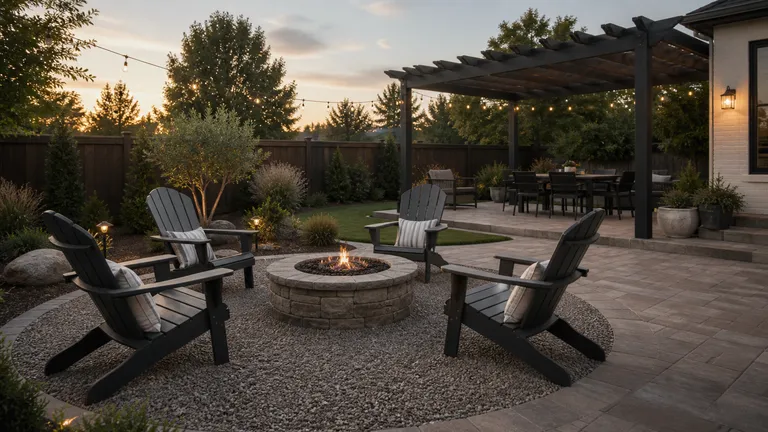
A wood-burning fire pit is the hardest match for a pergola. Sparks, embers and ash can move upward or sideways, and the fuel can keep smoking after the visible flame drops. USFA recommends metal screens for wood fires, and EPA recommends seasoned dry wood near 20% moisture while avoiding green wood, garbage, plastic, construction waste and yard waste.
A gas fire pit is cleaner for smoke, but it is not a shortcut under cover. Gas features bring fuel-type matching, leak testing, burner output, enclosure ventilation, drainage, service access and shutoff requirements. HPC warns not to use a natural-gas appliance with LP or an LP appliance with natural gas, and its manual puts leak testing and proper pressure on the installer.
Smokeless and tabletop fire features still burn fuel. Less visible smoke does not remove overhead clearance, side clearance, noncombustible surface or local-rule checks. A smaller flame under a fabric canopy is still a flame under fabric.
- Use wood only in open air with spark control, dry fuel, ash handling and local burn-rule clearance.
- Use gas only when the exact manual, fuel type, shutoff, venting and inspection requirements are met.
- Treat tabletop and smokeless units as fire features, not table decor.
Fuel type
Wood vs gas fire pits under or near a pergola
The fuel changes what can go wrong. Neither wood nor gas makes overhead cover automatically safe.
| Fire type | Main risk | What must pass | No-go trigger |
|---|---|---|---|
| Wood-burning fire pit | Sparks, embers, ash, smoke and burn restrictions. | Dry seasoned wood, spark control, outdoor clearance, noncombustible base and local burn rules. | Any fabric, low wood, vines, enclosed sides or smoke path under the pergola. |
| Propane or natural-gas fire pit | Gas pressure, fuel matching, BTU clearance, shutoff, venting and drainage. | Exact manual, correct fuel, leak test, open airflow, shutoff access and approved enclosure. | No shutoff, wrong fuel, unvented base, manual ban or uncertain overhead clearance. |
| Smokeless wood fire pit | Reduced visible smoke can hide the same clearance and combustion problems. | Same outdoor clearance, fuel, ventilation and surface rules as a wood fire. | Treating reduced smoke as permission to burn under a cover or enclosed corner. |
| Tabletop fire feature | Small flame near fabric, cushions, table finish and fuel canister. | Stable noncombustible support and manual-approved clearances. | Fabric, cushions, overhangs, unstable tables or crowded seating around the flame. |
| Built-in gas fire feature | Gas piping, electrical controls, enclosure heat, venting and service access. | Listed appliance, vented noncombustible enclosure, shutoffs, permits and inspection. | DIY gas conversion, hidden controls, sealed enclosure or no professional review. |
Clearance above, beside and around the fire pit
Separate overhead clearance from side clearance. A pergola can fail both: rafters or canopy above the flame, and posts, furniture, cushions, siding, branches or screens beside it. NFPA and USFA both use at least 10 ft from combustibles for fire pits, chimineas or outdoor fireplaces, with cautions around eaves, branches and overhead structures.
Gas clearances are manual-specific. HPC's published gas-fire guidance for standard burners up to 200,000 BTU gives one example: 36 in from the burner pan to combustibles, 84 in measured from the top of the fire pit enclosure to the ceiling or overhead structure and at least two open walls. For standard burners from 201,000 to 400,000 BTU, the same guidance calls for 48 in horizontal clearance and no overhead structures.
Those gas numbers are not a universal pergola rule. They show why the exact fire feature matters. A different burner, enclosure, ignition type, media depth, fuel, jurisdiction or roof condition can require more clearance. When the manual, local code and general fire-safety guidance disagree, follow the stricter requirement or move the fire pit.
- Check overhead material, side combustibles and local distance rules as separate items.
- Use NFPA and USFA 10 ft combustible-distance guidance as a conservative independent baseline.
- Use manufacturer gas numbers only for the appliance family they describe.
Pergola roofs, canopies and side screens
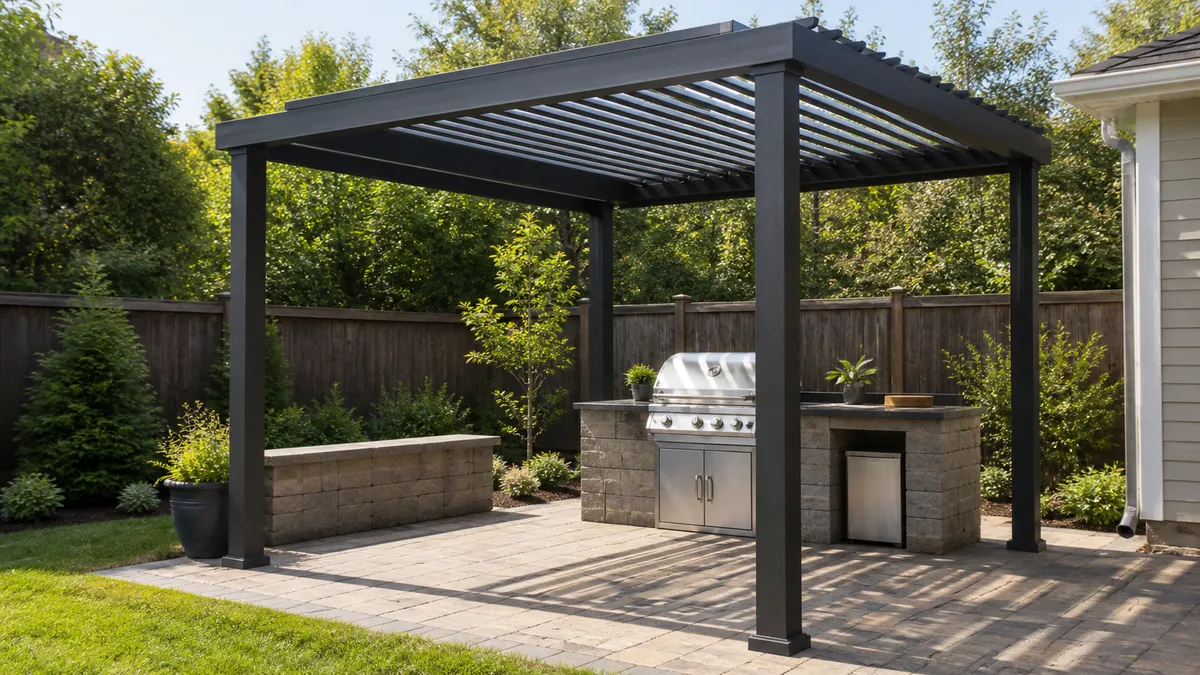
Open slats are easier to judge than a roofed pergola, but open slats are not automatic approval. A low wood beam is still combustible. A post beside the bowl still counts for side clearance. A decorative screen that blocks smoke can turn an open pergola into a poor fire location.
Fabric is the clearest stop sign. Fabric canopies, shade cloth, curtains, privacy panels and loose decor should stay away from flame, heat and sparks unless the exact product documentation approves that exposure. Do not buy a pergola canopy to make a fire pit feel covered.
Metal and louvered roofs need caution too. Aluminum does not solve trapped heat, smoke, nearby cushions or fabric side panels. Closed louvers can reduce ventilation exactly when the fire needs open air. Polycarbonate panels can be heat-vulnerable and can trap smoke over the flame.
Vines, reed mats and seasonal decor are often treated like shade, but near a fire pit they become fuel. Remove dry growth above or beside a flame before you plan the seating.
Cover checks
Pergola overhead and side material checks
Use this as a reject list before deciding where the chairs go.
| Pergola condition | Main concern | Safer treatment | Stop sign |
|---|---|---|---|
| Open slats with no cover | Posts and rafters may still be too close. | Use only if manual, local rules and combustible distance are met. | Low rafters or combustible posts near the flame. |
| Wood pergola | Combustible overhead and side material. | Keep the flame outside the footprint unless the exact setup is approved. | Any low wood member above or beside the fire. |
| Fabric canopy, shade cloth or curtains | Fabric exposure to heat, sparks and flame. | Remove fabric from the fire zone. | Any fabric above the flame or close to ember travel. |
| Louvered or metal roof | Trapped heat and smoke when closed or poorly vented. | Keep it open and away unless the fire-pit manual permits that roof condition. | Closed louvers, weak airflow or smoke collecting under the roof. |
| Polycarbonate or fixed roof panels | Heat damage and smoke trapping. | Use the roof away from the fire zone. | Any fixed panel directly over the flame. |
| Vines, reed mats or decor | Dry combustible material above or beside the fire. | Remove growth and decor from the fire zone. | Dry material close enough for sparks, flame or radiant heat. |
Surface, smoke and emergency controls
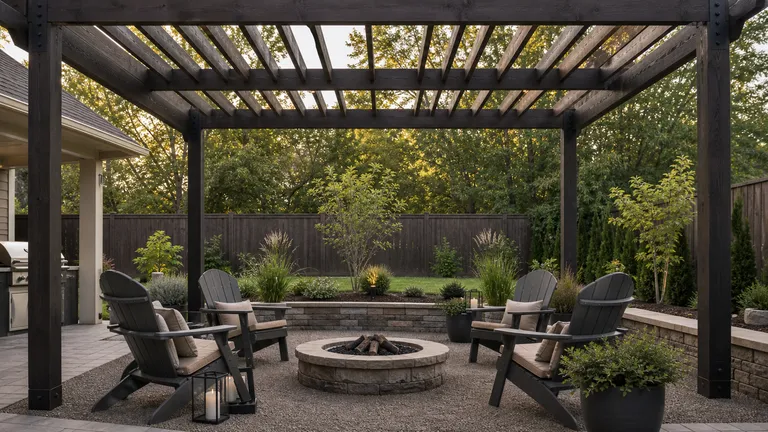
The surface below the fire pit is part of the safety decision. Use concrete, pavers, brick, stone or patio blocks unless the appliance manual and local fire rules approve a different listed arrangement. Do not present a generic mat under a hot bowl as enough for wood or composite decking.
Smoke is a location problem, not only a comfort problem. EPA says wood smoke contains fine-particle pollution and that sensitive groups can be affected more. Burn only allowed dry seasoned wood, avoid green wood and waste materials, and do not burn during air-quality alert days.
In an enclosed or mostly enclosed pergola, combustion can also create carbon monoxide risk when screens, curtains, walls or panels keep smoke and exhaust from dispersing.
Wind can turn a passing check into a stop sign. If wind pushes flame, sparks or smoke toward posts, curtains, cushions, doors, windows, intakes or neighboring patios, relocate the fire feature. Do not close side screens around an active fire to make the seating feel calmer.
Emergency access has to stay reachable after furniture and screens are placed. Fairfax County's portable-fireplace guidance requires constant attendance and immediate extinguishing equipment such as a rated extinguisher, hose, water, sand or dirt. HPC's gas manual requires an outside gas shutoff and, for electronic ignition models, an electrical shutoff such as a wall switch or breaker.
- Keep a rated extinguisher, hose, sand or dirt reachable during use.
- Keep gas shutoff and electrical shutoff visible and reachable for gas or electronic ignition.
- Make sure wood fires are fully out before leaving and handle cooled ash in a metal lidded container.
Safer layouts
Safer layouts for a fire pit near a pergola
The safer fix usually separates shaded seating from the flame instead of forcing the fire under the cover.
Fire pit outside the pergola footprint
Place the bowl or gas feature in open air and let the pergola shade the seating edge. This keeps cover, fabric and rafters away from flame, smoke and sparks.
Open pergola nearby
Use an open frame only when the manual, local clearance, noncombustible surface and side ventilation all permit it. Remove curtains, panels and vines from the fire area.
Listed built-in gas feature
Use qualified gas and electrical work, a vented noncombustible enclosure, accessible shutoffs, drainage, service access and inspection before lighting.
Open patio with portable shade away from heat
Use umbrellas or shade at the chairs, not over the flame. Keep fabric and bases out of ember paths and away from hot surfaces.
Covered or screened pergola with a pit centered below
Do not build this when a low roof, fabric, curtains, vines, poor ventilation or uncertain manual clearance remains in the fire zone.
Stop before lighting
Do not use the fire pit here
If one of these conditions is present, do not look for a better accessory. Move the fire pit, remove the combustible exposure or verify the placement with the manual, local authority and qualified installer.
- The manual prohibits overhead cover, enclosed use or the planned fuel arrangement.
- A local burn ban, air-quality alert, HOA rule, rental rule or fire-marshal restriction applies.
- Fabric, shade cloth, curtains, vines, panels, eaves or low beams sit above the flame.
- The gas shutoff or electrical shutoff cannot be reached quickly.
- Smoke enters doors, windows, outdoor air intakes or neighbor spaces.
- The fire sits on grass, artificial turf, wood decking, composite decking or an unapproved heat mat.
What will not make the setup safe
A spark screen does not make fabric, vines or a low roof safe. It can reduce flying embers from a wood fire, but it does not remove radiant heat, smoke, ash, local restrictions or the need for clearance to overhead material.
A smaller flame under a low roof is still a flame under a low roof. Do not turn the gas knob down or burn a smaller wood load as a substitute for manual-approved overhead clearance and open ventilation.
Switching from wood to gas does not make the pergola location safe by itself. Gas can reduce smoke and embers, but it adds fuel-type matching, leak testing, BTU-specific clearance, enclosure ventilation, drainage, gas shutoff, electrical shutoff and permit questions.
A fire-pit pergola kit is not a safety approval. Read the fire-pit manual, the pergola material instructions and the local fire rules. If those documents do not clearly allow the exact placement, keep the fire in open air and shade the seats.
- Do not use aluminum or louvers as a blanket fireproof claim.
- Do not use smokeless branding to ignore ventilation or smoke exposure.
- Do not use a generic heat mat to approve combustible decking.
- Do not add curtains, privacy screens or canopy panels to make a fire area feel finished.
This won't fix it
Do not skip these checks
- Do not put a wood-burning fire pit below a fabric, vine-covered, screened or low-roof pergola.
- Do not call a gas fire pit safe under cover until the exact manual, BTU clearance, venting and shutoff requirements pass.
- Do not rely on a spark screen, smaller flame or smokeless label to solve overhead clearance.
- Do not hide gas or electrical shutoffs behind benches, screens, cabinets or fixed panels.
- Do not burn when smoke enters doors, windows, air intakes or neighbor spaces.
Read Next
Related fixes
Questions
FAQ
Can you put a fire pit under a pergola?
Only when the exact manual, local fire rules, overhead clearance, side clearance, ventilation, noncombustible surface and emergency controls all line up. If fabric, low beams, enclosed sides, smoke problems or uncertain rules remain, the safer answer is no.
Is a gas fire pit safer than a wood fire pit under a pergola?
Gas can reduce smoke, ash and flying embers, but it adds fuel matching, leak testing, BTU clearance, shutoff, enclosure venting and permit concerns. It is not automatic permission to use a fire feature under a pergola roof.
How much clearance do I need above a fire pit?
There is no universal safe height for every fire pit. Use the appliance manual and local authority first. NFPA and USFA give 10 ft combustible-distance guidance, while gas manufacturers may publish different overhead and side-clearance rules for specific burners.
Can a fire pit sit on a deck under a pergola?
Treat wood and composite decking as a stop sign unless the appliance manual and local fire rules approve a listed protective setup. A generic heat mat should not be presented as enough under a fire pit, especially below a pergola cover.
What is the safest pergola layout for a fire pit area?
Usually the fire pit sits outside the pergola footprint while the pergola shades the seating edge. Keep cover, fabric, curtains and vines away from flame, heat, sparks and smoke, then verify the manual, surface and local rules.